Lobed Comb Jelly
A lobed comb jelly is any of several gelatinous, transparent marine invertebrates belonging to the order Lobata within the phylum Ctenophora. These animals…
What is lobed comb jelly?
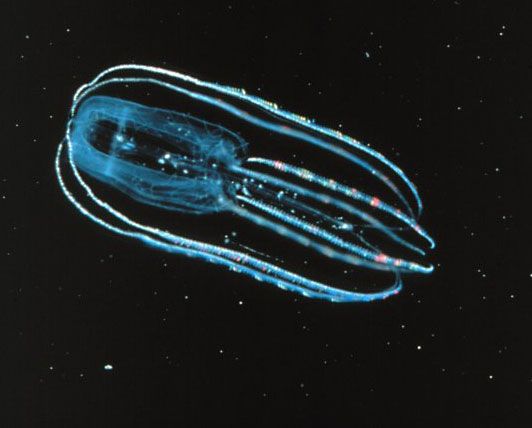
A lobed comb jelly is any of several gelatinous, transparent marine invertebrates belonging to the order Lobata within the phylum Ctenophora. These animals are found in most oceans, typically inhabiting surface waters near the shore.1
Key characteristics of lobed comb jellies include:
- Locomotion: They propel themselves weakly through the water by coordinating the beating of many rows of fused cilia.1
- Physical Structure: Unlike other ctenophores, they possess two greatly enlarged oral lobes that surround the mouth. Their feeding tentacles are relatively smaller than those found in other members of the phylum.1
- Diet: They are carnivorous, preying on tiny aquatic animals.1
Like other ctenophores, these jellies are part of a group known for their iridescent comb plates and, in many species, the ability to produce bioluminescent displays. While they share a body form similar to cnidarian medusae, they are distinct due to their lack of stinging cells and the presence of a true mesoderm.2
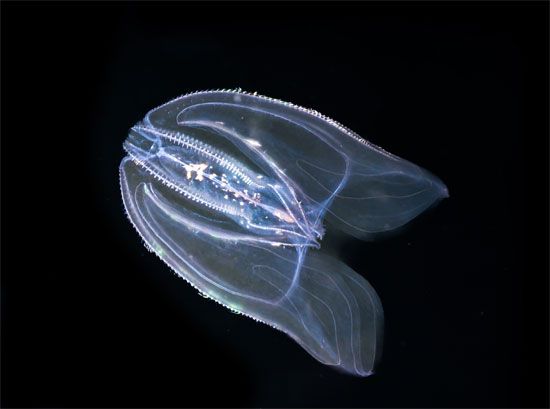
How do comb jellies use bioluminescence in the ocean?
Comb jellies, or ctenophores, are renowned for their ability to produce some of the most brilliant and beautiful bioluminescent displays in the animal kingdom. This light is generated through a highly efficient, heatless chemical reaction that occurs when a light-emitting molecule, luciferin, is oxidized in the presence of an enzyme called luciferase.com/science/enzyme) called luciferase.34
The light produced by these organisms is typically blue or green, a wavelength that transmits exceptionally well through seawater and is highly visible to many marine species. In comb jellies, this luminescence appears to be under nervous control, allowing them to exhibit nocturnal displays. While the specific evolutionary purpose of this light in ctenophores is not always fully understood, bioluminescence in the broader marine environment often serves critical survival functions, such as defense against predators, communication, or attracting prey.3425
What are colloblasts and how do they help comb jellies catch prey?
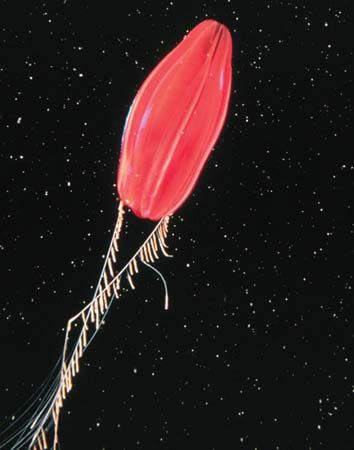
Colloblasts are specialized adhesive cells found exclusively in ctenophores (comb jellies). These unique cells are located on the animal’s long, retractable tentacles, which are particularly prominent in the order Cydippida.2
These cells function as a highly effective capture mechanism for the comb jelly’s diet of small planktonic animals. When a prey organism comes into contact with a tentacle, the colloblasts release a sticky secretion. This adhesive substance ensures that the prey adheres firmly to the tentacle upon contact, preventing escape and allowing the comb jelly to draw its food toward its mouth.2
Unlike cnidarians, which typically use stinging cells (nematocysts) to immobilize their prey, comb jellies rely on this adhesive strategy to secure their food.2
How do ctenophores differ from cnidarians like jellyfish?
Although ctenophores (comb jellies) and cnidarians (such as jellyfish) share a superficial resemblance and were once grouped together, they are distinct phyla with fundamental biological differences.27
Key differences include:
- Stinging Cells: The most defining feature of cnidarians is the presence of nematocysts—specialized stinging capsules used for defense and prey capture. Ctenophores lack these cells; instead, they use adhesive cells called colloblasts to capture prey.872
- Body Structure and Symmetry: Ctenophores exhibit biradial symmetry, whereas cnidarians typically display radial symmetry. Furthermore, ctenophores possess a true mesoderm, a middle tissue layer containing specialized muscle cells, making them more highly evolved in this regard than cnidarians.27
- Locomotion: Ctenophores move using eight rows of fused cilia known as comb plates. Cnidarians generally lack these structures and move through different mechanisms, such as rhythmic pulsations of the bell.29
- Development: There are fundamental differences in the embryological development between the two groups.2
While some ctenophores may appear to have stinging cells, research has shown they obtain them by preying on cnidarians, rather than producing them themselves.9
Sources
- lobed comb jelly — Encyclopædia Britannica
- ctenophore — Encyclopædia Britannica
- Bioluminescence: Top Questions — Encyclopædia Britannica
- Bioluminescence - The range and variety of bioluminescent organisms — Encyclopædia Britannica
- Marine bioluminescence — Encyclopædia Britannica
- Did you know? — Merriam-Webster
- cnidarian - Critical appraisal — Encyclopædia Britannica
- nematocyst — Encyclopædia Britannica
- cnidarian — Encyclopædia Britannica
Published on · 3 min read