Cucumber Beetle
A cucumber beetle is any of several species of leaf beetles belonging to the subfamily Galerucinae that are recognized as significant agricultural pests.…
What is cucumber beetle?
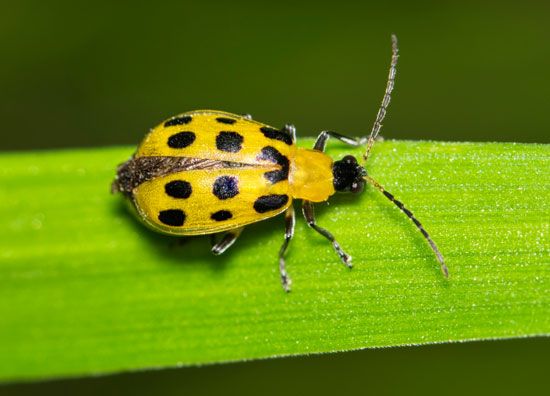
A cucumber beetle is any of several species of leaf beetles belonging to the subfamily Galerucinae that are recognized as significant agricultural pests. These insects are typically greenish-yellow, measure between 2.5 and 11 mm in length, and are characterized by distinct black spots or stripes on their wing covers.12
Common varieties include:
- Striped cucumber beetle (Acalymma vittatum): Features two black stripes on each wing cover.1
- Spotted cucumber beetle (D. undecimpunctata): Marked with black spots on each wing cover.1
These beetles are particularly injurious to garden plants such as cucumbers and squashes. While the adults feed on the leaves, their larvae typically attack the roots and stems. Some related species, such as D. longicornis, feed on corn pollen and silk, with larvae known as corn rootworms. Like all members of the order Coleoptera, they undergo complete metamorphosis, progressing through egg, larval, pupal, and adult stages.213
What is the difference between the striped and spotted cucumber beetle?
The primary difference between the striped and spotted cucumber beetle lies in their physical markings and scientific classification. Both are members of the leaf beetle family and are considered significant agricultural pests, but they are distinguished by their wing cover patterns:1
- Striped cucumber beetle (Acalymma vittatum): This species is identified by the presence of two black stripes on each wing cover (elytron).1
- Spotted cucumber beetle (D. undecimpunctata): This species is characterized by black spots on each wing cover.1
Despite these visual differences, both beetles share similar life cycles and feeding habits. As adults, they feed on the leaves of garden plants like cucumbers and squashes, while their larvae typically target the roots and stems of the plants.12
How do cucumber beetles damage vegetable crops?
Cucumber beetles damage vegetable crops through both direct feeding and the transmission of plant diseases. As leaf beetles, they cause harm at different stages of their life cycle:
- Direct Feeding: Adult beetles consume the foliage and flowers of various crops, particularly cucurbits like cucumbers and squashes. Meanwhile, the larvae live underground, where they feed on the roots and stems of the plants, which can severely weaken or kill them.216
- Disease Transmission: These beetles serve as critical vectors for serious plant pathogens. They are known to spread bacterial wilt and cucumber mosaic, which can devastate harvests of melons and cucumbers.67
By acting as both direct herbivores and carriers of infectious diseases, these insects represent a significant challenge to agricultural health.18
What are some natural ways to protect gardens from pests?
Protecting gardens from pests using natural methods relies on a combination of cultural practices, physical barriers, and biological strategies to maintain a healthy environment without relying solely on chemical interventions.910
Cultural and Physical Practices
Prevention is the most effective approach to pest management. Key practices include:910
- Sanitation: Regularly remove and destroy dead or diseased plant material to eliminate habitats where pests may harbor.910
- Crop Rotation: Alternating crops helps disrupt the life cycles of pests that target specific plants.910
- Pruning: Thinning plants ensures proper air circulation, which can reduce the prevalence of certain diseases.9
- Physical Barriers: Using fences or protective bags for individual fruits can prevent intrusion by larger pests and insects.10
- Soil Management: Techniques such as adjusting soil acidity or using heat treatments in greenhouses can create unfavorable conditions for soil-borne pests.10
Biological Control
This method involves using living organisms to manage pest populations.41
Sources
- cucumber beetle — Encyclopædia Britannica
- cucumber beetle — Merriam-Webster
- Agricultural technology - Mechanical and cultural controls — Encyclopædia Britannica
- Agricultural technology - Biological controls — Encyclopædia Britannica
- Coleoptera - General features — Encyclopædia Britannica
- striped cucumber beetle — Merriam-Webster
- spotted cucumber beetle — Merriam-Webster
- Plant disease - Transmission — Encyclopædia Britannica
- gardening - Control of pests and diseases — Encyclopædia Britannica
- Biological control — Encyclopædia Britannica
- horticulture - Pest control — Encyclopædia Britannica
Published on · 3 min read