Meadow Katydid
A meadow katydid is any of approximately 20 species of small to medium-sized, slender insects belonging to the genus Orchelimum within the family…
What is meadow katydid?
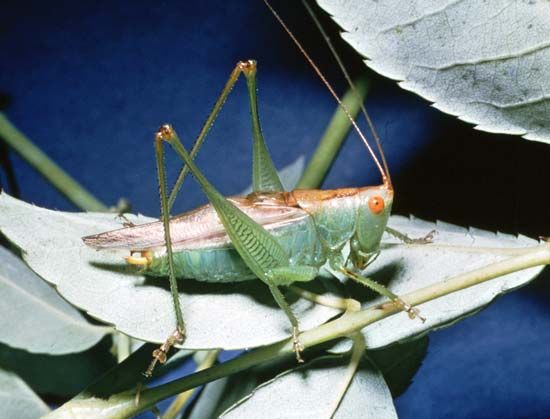
A meadow katydid is any of approximately 20 species of small to medium-sized, slender insects belonging to the genus Orchelimum within the family Tettigoniidae. These insects are commonly found in grassy meadows near bodies of water such as lakes and ponds.1
Physically, they are characterized by large orange eyes and a body that is brown on the top and green on the bottom. A notable behavior of the meadow katydid is its ability to seek refuge in water when disturbed; they can cling to underwater plants and remain submerged for several minutes. Like other members of the order Orthoptera, they produce songs consisting of buzzes and clicks during both the day and night. They are closely related to the smaller “lesser meadow katydids” of the genus Conocephalus.1
How do katydids produce sound using their wings?
Katydids produce sound through a process known as stridulation, which involves rubbing their forewings together in a specific manner.32
The mechanism relies on specialized structures located on the wings:
- The File: One forewing features a serrated surface, or “file,” which runs along an enlarged vein.2
- The Scraper: The opposite forewing possesses a sharp edge that acts as a scraper.2
As the insect rubs these wings together, the file is scraped against the sharp edge, causing the wing surfaces to vibrate. The specific nature of the resulting song—including its rhythm, repetition rate, and pitch—is determined by the natural resonance of these vibrations and the movement patterns of the wings.2
While these songs are often used for mating, they can also serve territorial, aggressive, or defensive purposes. Because each species has its own unique rasping song, these calls are species-specific, allowing individuals to recognize their own kind.3
What is the difference between a katydid and a grasshopper?
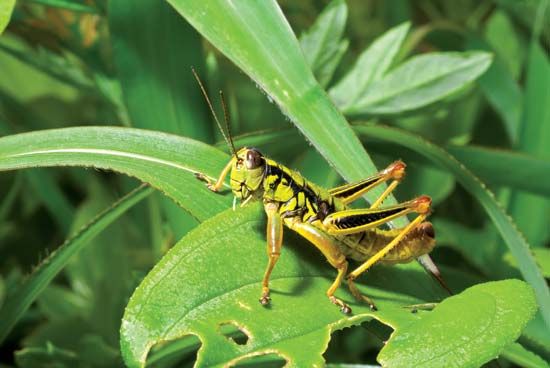
While katydids and grasshoppers are both members of the order Orthoptera, they belong to different suborders and possess distinct physical and behavioral characteristics.
Key Differences
Feature
Katydids (Suborder Ensifera)
Grasshoppers (Suborder Caelifera)
Antennae
Long, threadlike; often as long as or longer than the body.
Short; typically less than 30 segments.
Hearing Organs
Located on the front tibiae (legs).
Located on the sides of the first abdominal segment.
Sound Production
Rubbing forewings together (stridulation).
Rubbing hindlegs against the forewings.
Activity
Primarily nocturnal.
Primarily diurnal (active by day).
Ovipositor
Sword-shaped or bladelike.
Paired valvular appendages for digging.
Taxonomic Classification
It is a common point of confusion that some katydids, such as “cone-headed grasshoppers,” have “grasshopper” in their common name despite being true members of the family Tettigoniidae (katydids). True grasshoppers belong to the family Acrididae, which is part of the suborder Caelifera, whereas katydids are part of the suborder Ensifera, making them more closely related to crickets than to true grasshoppers.976
How do insects like the meadow katydid use camouflage to hide from predators?
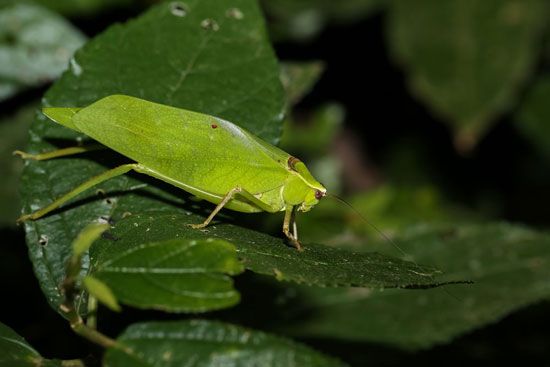
Katydids, including the meadow katydid, rely on crypsis—the ability to conceal themselves by blending into their surroundings—as a primary defense against predators. Because many katydids are poor flyers, they depend heavily on this camouflage to remain undetected.211
These insects often match the appearance of the trees, bushes, or grasses they inhabit. For example, the meadow katydid (Orchelimum) features a body that is brown on top and green on the bottom, helping it blend into its grassy meadow habitat. Other species take this further through the mimicry of vegetation; the peacock katydid, for instance, precisely mimics the discoloration of a dead leaf.21
Beyond visual camouflage, some katydids use behavioral strategies to avoid detection. When threatened, meadow katydids may enter the water and cling to underwater plants to hide. Additionally, some species mask their mating signals from predators like bats by using substrate-borne vibrations, known as tremulations, instead of relying solely on audible songs.12
Sources
- meadow katydid — Encyclopædia Britannica
- katydid — Encyclopædia Britannica
- stridulation — Merriam-Webster
- sound reception - Behavioral observations — Encyclopædia Britannica
- long-horned grasshopper — Encyclopædia Britannica
- Orthoptera - Annotated classification — Encyclopædia Britannica
- Orthoptera - Habitat — Encyclopædia Britannica
- Orthoptera - Sound production and hearing — Encyclopædia Britannica
- Orthoptera - Food — Encyclopædia Britannica
- cone-headed grasshopper — Encyclopædia Britannica
- crypsis — Merriam-Webster
Published on · 3 min read