Leaf Beetle
A leaf beetle is any member of the family Chrysomelidae, a diverse group comprising approximately 35,000 species of beetles found worldwide, with the highest…
What is leaf beetle?
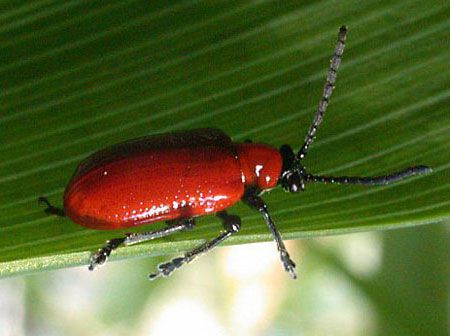
A leaf beetle is any member of the family Chrysomelidae, a diverse group comprising approximately 35,000 species of beetles found worldwide, with the highest concentration in the tropics.1
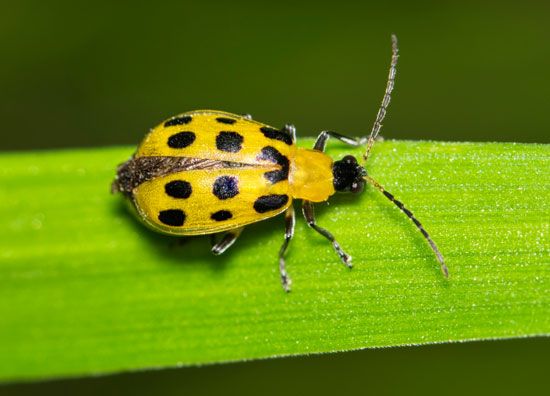
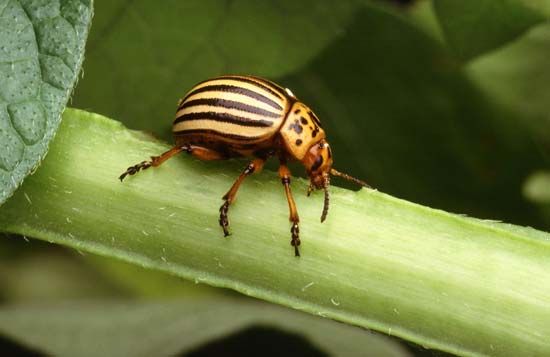
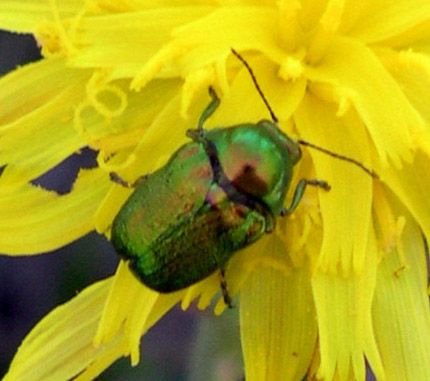
These insects are typically small—often less than 12 mm (0.5 inch) long—and are characterized by an oval or rounded shape, short legs, and short antennae. They frequently exhibit bright colors and a smooth, shining appearance. As their name suggests, both the larvae and adults of these beetles are phytophagous, meaning they feed on the leaves, stems, or roots of plants.123
Because of their feeding habits, many leaf beetles are considered significant agricultural and ornamental pests. Well-known examples include the asparagus beetle, cucumber beetle, tortoise beetle, and the Colorado potato beetle. Unlike some solitary beetle families, leaf beetles are often found in aggregations.14
How do leaf beetles protect themselves from predators?
Leaf beetles (Chrysomelidae) employ a variety of strategies to defend themselves against predators, relying on chemical defenses, coloration, and specialized behaviors.
Chemical Defenses and Coloration
Many leaf beetles are inedible to predators, a trait often signaled by prominent, conspicuous colors and contrasting spots. This aposematic coloration serves as a warning to predators, such as birds, which learn to associate these patterns with distasteful or dangerous prey. Additionally, some species produce foul-smelling or distasteful secretions from special glands to repel attackers.6789
Behavioral Adaptations
- Camouflage: Some leaf beetles rely on camouflage to blend into their surroundings, making them difficult for predators to detect.710
- Case-bearing: Larvae of the subfamilies Cryptocephalinae and Lamprosomatinae, known as casebearing leaf beetles, construct protective cases using their own excrement. When disturbed, these larvae retract their legs, causing them to resemble droppings and effectively avoid predation.3
- Agility: Certain groups within the family, such as flea beetles, possess remarkable leaping abilities that allow them to escape threats quickly.8
What is the difference between the life cycles of leaf beetles and other insects?
Leaf beetles, like all members of the order Coleoptera, undergo holometabolous development, also known as complete metamorphosis. This life cycle consists of four distinct stages: egg, larva, pupa, and adult.413
Comparison of Metamorphic Patterns
The primary difference between leaf beetles and other insects lies in their specific pattern of development:
- Holometabolous (Beetles, Butterflies, Flies, Wasps): These insects undergo a dramatic transformation. The larva is wingless and morphologically distinct from the adult, serving primarily as a growth stage. The pupal stage acts as a nonfeeding period where the insect undergoes a total reorganization of tissues to develop adult structures like wings and reproductive organs.414
- Hemimetabolous (Grasshoppers, Termites, True Bugs): These insects undergo gradual or incomplete metamorphosis. Their life cycle consists of egg, nymph, and adult. The nymph resembles a miniature, wingless version of the adult and shares similar eating habits, gradually developing adult features through successive molts.414
- Ametabolous (Silverfish, Springtails): These primitive insects exhibit almost no change in form throughout their growth, simply increasing in size until they reach adulthood.414
While leaf beetles follow the standard beetle life cycle, some species exhibit unique adaptations, such as using their own excrement and molted skins to camouflage themselves during the larval and pupal stages. Additionally, while most beetles follow the four-stage cycle, some insects—including certain beetles—undergo hypermetamorphosis, a specialized form of complete metamorphosis involving multiple distinct larval types.15164
How do scientists control leaf beetle populations in gardens?
Scientists and gardeners employ several strategies to manage leaf beetle populations, often utilizing integrated pest management to minimize environmental impact17.
Biological and Cultural Controls
- Biological Agents: Introducing natural enemies, such as parasitic wasps and flies, can help regulate beetle populations. Microbial agents are also effective; for example, the bacterium Bacillus popilliae is used to induce “milky disease” in certain beetle larvae, while Bacillus thuringiensis is commonly used to target various larvae in home gardens.17118
- Physical Removal: For pests like leaf miners, which are protected within plant tissue, a practical garden method is to manually remove and burn infested leaves.19
- Resistant Varieties: Planting crop varieties that are naturally resistant to beetle attack is considered an ideal, though long-term, solution.17
Chemical and Advanced Techniques
While insecticides are frequently used, they are often combined with other methods to improve efficacy and reduce chemical reliance. Advanced techniques include the use of chemical attractants to lure beetles into traps and the sterile-insect technique, which involves releasing sterilized males to disrupt reproduction.17
It is important to note that biological control methods must be carefully evaluated, as the introduction of non-native species can lead to unintended ecological consequences, such as the invasive spread of the cane toad.18
Sources
- leaf beetle — Encyclopædia Britannica
- Chrysomelidae — Merriam-Webster
- Coleoptera - As plant feeders — Encyclopædia Britannica
- Coleoptera - Larvae — Encyclopædia Britannica
- Coleoptera - Distribution and abundance — Encyclopædia Britannica
- insect - Protection from enemies — Encyclopædia Britannica
- Coleoptera - Beetles as prey — Encyclopædia Britannica
- mimicry - Batesian mimicry — Encyclopædia Britannica
- Coleoptera - Protection — Encyclopædia Britannica
- mimicry — Encyclopædia Britannica
- Chemoreception - Defensive odors — Encyclopædia Britannica
- casebearing leaf beetle — Encyclopædia Britannica
- Metamorphosis — Encyclopædia Britannica
- Coleoptera - Typical life cycle — Encyclopædia Britannica
- insect - Types of metamorphosis — Encyclopædia Britannica
- Coleoptera - General features — Encyclopædia Britannica
- Agricultural technology - Biological controls — Encyclopædia Britannica
- Japanese beetle — Encyclopædia Britannica
- leaf miner — Encyclopædia Britannica
- Biological control — Encyclopædia Britannica
Published on · 3 min read