Luna Moth
The luna moth (Actias luna) is a large, showy saturniid moth native to eastern North America. These nocturnal insects are recognized by their pale green…
What is luna moth?
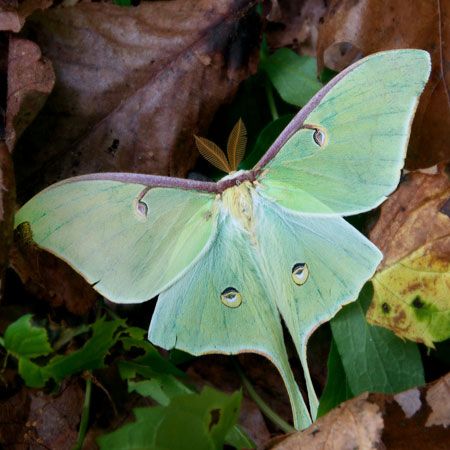
The luna moth (Actias luna) is a large, showy saturniid moth native to eastern North America. These nocturnal insects are recognized by their pale green wings, which feature a thin brown border, an eyespot on each hind wing, and long, tail-like projections.12
The life cycle begins as a green caterpillar that feeds on the leaves of various trees and shrubs. As adults, they lack mouthparts and survive for only a few days, focusing entirely on reproduction.1
Unfortunately, luna moth populations are in decline. They face significant threats from habitat loss, pesticides, and light pollution, which disrupts their ability to navigate. They are also vulnerable to a non-native tachinid fly introduced in the early 20th century. Protecting these unique creatures is essential for maintaining the biodiversity of their native ecosystems.1
What is the purpose of the eyespots on a luna moth’s wings?
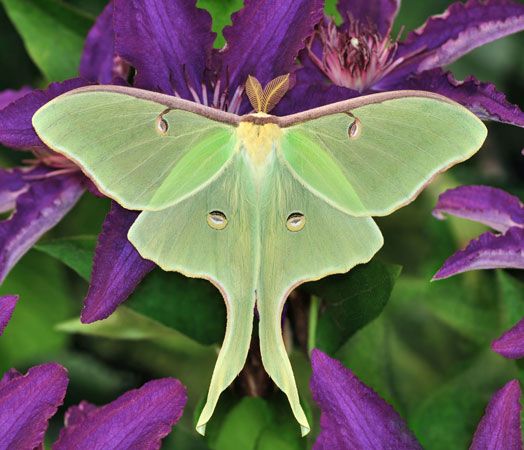
The eyespots found on the wings of a luna moth and other saturniid moths serve a vital protective function. These prominent, eye-like markings are designed to attract the attention of predators and focus their attacks on less vulnerable parts of the moth’s body, such as the outer edges of the wings.3
By drawing a predator’s strike toward these non-vital areas, the eyespots increase the likelihood that the moth can escape without suffering a life-threatening injury, even if a portion of the wing is torn off in the process. This defensive strategy is a form of concealing coloration and distraction, helping the insect survive encounters with visually hunting predators.3
How do pheromones help moths find each other in the dark?
Moths rely on a sophisticated chemical communication system to locate mates in the dark. When a female moth is ready to mate, she releases specific sex-attractant pheromones from glands in her abdomen. These chemical signals can travel significant distances, allowing males to detect them using specialized scent sensilla located on their large, feathery antennae.
Rather than simply following a continuous scent trail, moths utilize a strategy called odor-modulated anemotaxis to navigate toward the source. Because wind turbulence disperses pheromones into intermittent “wisps” or bursts, moths use the odor as a trigger to switch on a behavioral program that relies on wind direction.9
Upon detecting a pheromone puff, the male typically takes flight and moves upwind. Many species perform a zigzagging flight pattern—similar to a sailboat tacking into the wind—to maintain their orientation toward the source. By combining their sense of smell with mechanosensory feedback from their antennae to track wind direction, they can successfully pinpoint a female even in total darkness.910
What are the main differences between moths and butterflies?
While both moths and butterflies belong to the order Lepidoptera, they exhibit several distinct physical and behavioral differences:
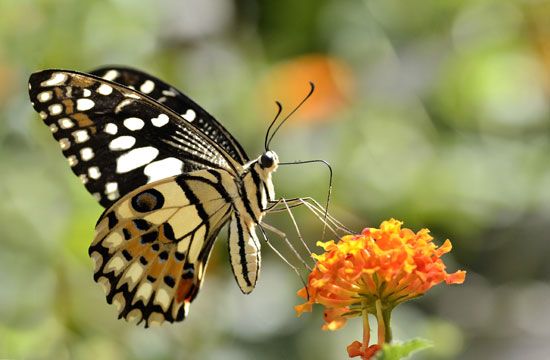
- Antennae: Most moths have thick or feathery antennae, whereas butterflies typically possess simple, club-tipped antennae.13
- Body Shape: Butterflies generally have slim, dainty bodies, while moths are typically stout and often fuzzy.13
- Resting Position: When at rest, butterflies usually hold their wings vertically over their backs. Moths tend to fold their wings tentlike over their bodies, wrap them around their bodies, or hold them extended at their sides.13
- Activity Patterns: Moths are primarily nocturnal, while butterflies are typically diurnal.13
- Pupation: During metamorphosis, most moths build fibrous cocoons for protection. In contrast, most butterflies form a naked chrysalis using their own body tissues.1314
- Coloration: Butterflies are often colorful with dramatic wing patterns, while moths are frequently more drab, though notable exceptions exist in both groups.13
Sources
- luna moth — Encyclopædia Britannica
- luna moth — Merriam-Webster
- Lepidoptera - Protection against danger — Encyclopædia Britannica
- Eyespot — Encyclopædia Britannica
- Lepidoptera - Thorax — Encyclopædia Britannica
- saturniid moth — Encyclopædia Britannica
- Photoreception - Differences in resolution — Encyclopædia Britannica
- eyespot — Merriam-Webster
- Chemoreception - Sex-attractant pheromones — Encyclopædia Britannica
- Lepidoptera - Courtship and mating — Encyclopædia Britannica
- Chemoreception - Aphrodisiac pheromones — Encyclopædia Britannica
- Chemoreception - Movement toward an odor source — Encyclopædia Britannica
- What’s the difference between moths and butterflies? — Encyclopædia Britannica
- Lepidoptera - Pupa , or chrysalis — Encyclopædia Britannica
Published on · 3 min read