Cephalopod
Cephalopods, including octopuses, squids, and cuttlefishes, are widely considered the most intelligent of all invertebrate animals. Their cognitive abilities…
How intelligent are cephalopods compared to other marine animals?
Cephalopods, including octopuses, squids, and cuttlefishes, are widely considered the most intelligent of all invertebrate animals. Their cognitive abilities are supported by a highly developed central nervous system where major ganglionic centers are concentrated into a complex brain.123
Compared to other marine animals, cephalopods exhibit remarkable behavioral flexibility and cognitive sophistication:
- Learning and Memory: They demonstrate a clear capacity for learning, including the ability to discriminate between objects and remember experiences to inform future actions.14
- Tool Use: The veined octopus is the first documented invertebrate to use tools, specifically by carrying coconut shells to serve as portable shelters.12
- Complex Sensory Processing: Their eyes are highly developed, resembling those of vertebrates in efficiency, and they use tactile and chemical stimuli from their arms to navigate their environment.43
- Adaptive Behavior: They exhibit cunning hunting strategies and can rapidly change skin color and texture for camouflage or communication, a process controlled by the brain.142
What defense mechanisms do cephalopods use to protect themselves from predators?
Cephalopods utilize a sophisticated array of defense mechanisms to evade or deter predators, relying on both physical adaptations and complex behaviors.
Camouflage and Visual Deception
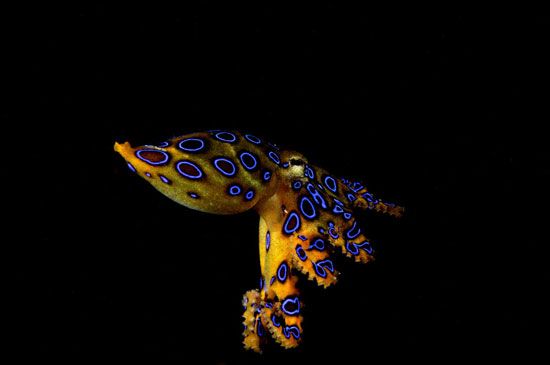
Cephalopods are masters of disguise, using specialized skin cells called chromatophores and reflecting iridocytes to alter their color and pattern. By controlling these cells through their brain, they can blend into their surroundings—imitating sand, coral, or seaweed—or display vivid “alarm patterns” to startle potential threats. They can also change their skin texture by erecting papillae or curling their arms to further enhance their camouflage.1
Chemical and Visual Distraction
- Ink Ejection: Most cephalopods possess an ink sac that releases a dark, melanin-rich fluid. This ink creates a visual screen to conceal the animal’s escape. In some species, the ink can temporarily paralyze a predator’s senses of sight and smell.561
- Decoys: Squids may eject a spindle-shaped mass of ink that mimics their own size, acting as a “dummy” to distract predators while the squid turns transparent and jets away.1
- Bioluminescence: Many species use photophores to emit light, which can be used for defense or to create a luminous cloud that confuses attackers.16
Physical Maneuvers
Cephalopods are highly agile, using jet propulsion to make rapid escapes. Their flexible bodies allow them to squeeze into tiny crevices to hide from predators, and some squids can even “fly” above the water surface to evade pursuit by predatory fish.7
How do cephalopods differ from other classes of mollusks?
Cephalopods are distinct from other classes of mollusks due to their highly specialized adaptations for an active, predatory lifestyle. While most mollusks possess an open circulatory system, cephalopods (excluding the Nautilus) have a closed circulatory system with distinct arteries, veins, and capillaries, supported by three hearts that facilitate higher metabolic rates.210
Key differences include:
- Nervous System and Intelligence: Cephalopods possess an extremely concentrated nervous system with major ganglia fused into a complex brain that encircles the esophagus. This supports advanced behaviors such as learning, memory, and object discrimination, which are far more sophisticated than those of other molluscan classes.410
- Locomotion: Unlike the ciliary or muscular foot-based movement seen in many mollusks, cephalopods use a modified foot—the funnel—to achieve rapid jet propulsion by expelling water from the mantle cavity.210
- Sensory Organs: Their eyes are highly developed, bearing a striking resemblance to vertebrate eyes in their ability to focus and regulate light, whereas other mollusks typically have simpler sensory structures.410
- Physical Features: Cephalopods are characterized by a head-foot region surrounded by tentacles or arms and, in most modern species, an ink sac used for defense, a feature not found in other molluscan classes.1011
What are some examples of well-known cephalopod species?
Cephalopods are a diverse class of marine animals that include several well-known species. Here are some notable examples:
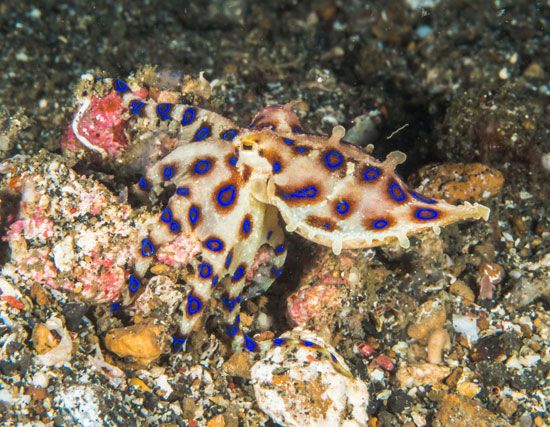
- Octopus: These eight-armed mollusks are renowned for their intelligence and ability to change skin color rapidly. The common octopus (O. vulgaris) is widely distributed in tropical and temperate seas, while the giant Pacific octopus (Enteroctopus dofleini) is the largest known octopus species. Another notable member is the veined octopus, famous for its documented use of tools, such as carrying coconut shells for shelter.133
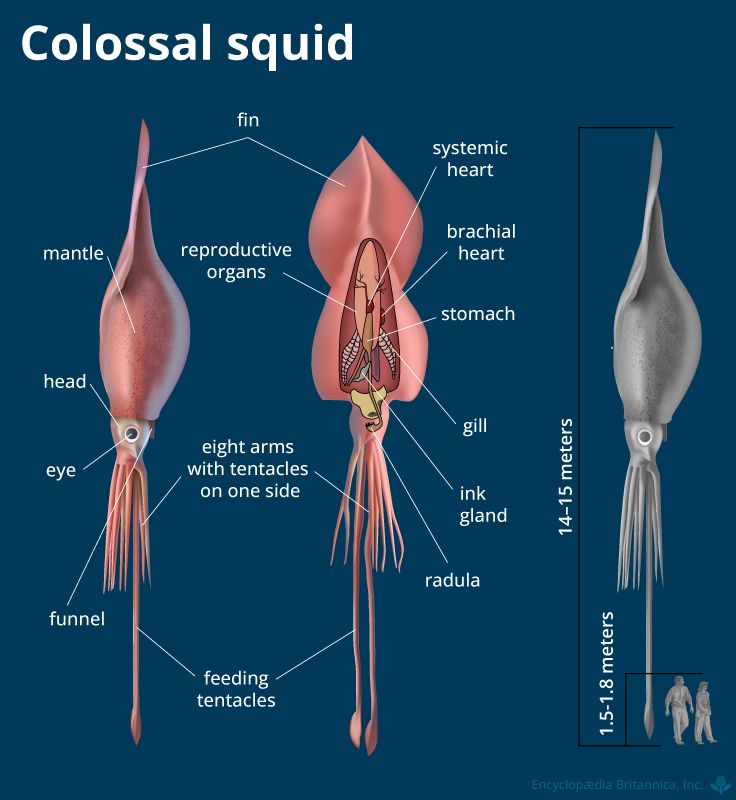
- Squid: These 10-armed cephalopods include the giant squid (Architeuthis) and the colossal squid (Mesonychoteuthis hamiltoni), both of which are among the largest living invertebrates. The Southern pygmy squid (Idiosepius notoides) represents the other end of the spectrum, being one of the smallest species.141516
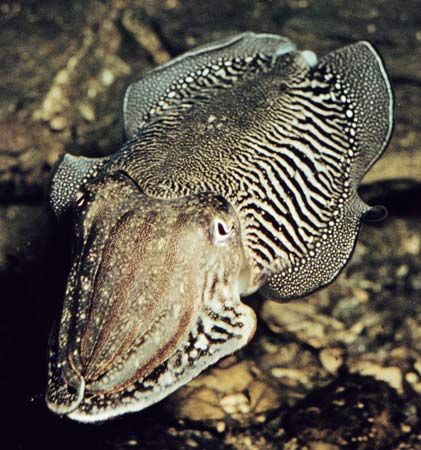
- Cuttlefish: Characterized by a thick internal shell called a cuttlebone, these animals are known for their complex behaviors and ability to delay gratification, a trait often associated with intelligent vertebrates.17
- Nautilus: The chambered nautilus is a unique cephalopod that possesses a coiled external shell. It is the last surviving genus of the ancient order Nautiloidea. In contrast, the paper nautilus (Argonauta) is more closely related to the octopus and is known for the thin, fragile shell secreted by the female.1318
Sources
- cephalopod - Behaviour — Encyclopædia Britannica
- nervous system - Complex mollusks — Encyclopædia Britannica
- octopus — Encyclopædia Britannica
- cephalopod - Form and function — Encyclopædia Britannica
- Do octopuses have ink? — Encyclopædia Britannica
- cephalopod - Locomotion — Encyclopædia Britannica
- mollusk - Features of defense — Encyclopædia Britannica
- mimicry - Aggressive mimicry — Encyclopædia Britannica
- aggressive mimicry — Encyclopædia Britannica
- Circulatory system - Mollusca — Encyclopædia Britannica
- bivalve - External features — Encyclopædia Britannica
- mollusk - Annotated classification — Encyclopædia Britannica
- cephalopod — Encyclopædia Britannica
- cuttlefish — Encyclopædia Britannica
- How Big Is the Giant Squid? — Encyclopædia Britannica
- squid — Encyclopædia Britannica
- chambered nautilus — Merriam-Webster
- nautilus — Encyclopædia Britannica
- giant squid — Encyclopædia Britannica
Published on · 4 min read