Cuyuni River
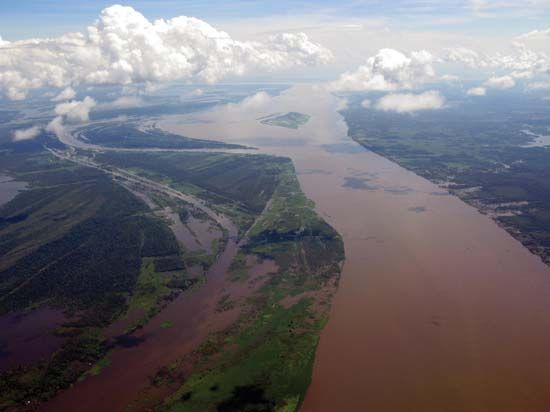
The Cuyuni River is a 350-mile (560 km) river located in northern South America, rising in the Guiana Highlands of eastern Venezuela.
What is Cuyuni River?
The Cuyuni River is a 350-mile (560 km) river located in northern South America, rising in the Guiana Highlands of eastern Venezuela.12
The river flows northward before turning eastward to meander through the tropical rain forests of Guyana, where it serves as an international boundary for approximately 60 miles (100 km). It eventually flows southeastward to join the Mazaruni River near Bartica, ultimately contributing to the Essequibo River system.123
Due to numerous rapids, the river is not suitable for large-scale navigation. Instead, its primary economic importance lies in its role as a source of alluvial gold and diamonds. Together with the Mazaruni and Potaro rivers, the Cuyuni is a key tributary that drains the northwestern region of Guyana.14
What are the Guiana Highlands?
The Guiana Highlands are a vast, heavily forested plateau and low-mountain region in South America, situated south of the Orinoco River and north of the Amazon River. This expansive area covers the southern half of Venezuela, the northern part of Brazil, a portion of southeastern Colombia, and the majority of the Guianas.5
The terrain is characterized by three primary elements:
- Rolling hilly upland: A basement layer generally below 1,000 feet (300 meters).5
- Low mountains: Found near stream divides, ranging from 2,000 to 3,000 feet (600 to 900 meters).5
- Tabular plateaus: Known as tepuis, these are capped with erosion-resistant sandstone and form the highest elevations, such as Mount Roraima.56
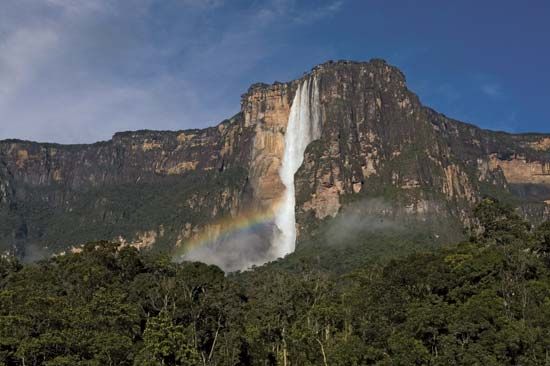
The region is rich in natural resources, including gold, diamonds, iron ore, and valuable hardwoods. It is also home to Angel Falls, the world’s highest waterfall.56
How is gold and diamond mining impacting the environment in Guyana?
In Guyana, gold and diamond mining are significant economic activities, with gold found in both alluvial and subsurface deposits and diamonds extracted from rivers in the interior. While these activities contribute to the economy, they pose notable environmental challenges.8
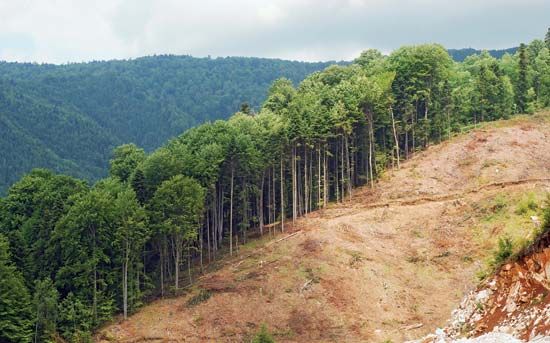
Mining operations, particularly those involving the clearing of tropical forests to access mineral deposits, contribute to deforestation. Furthermore, the use of mercury in the amalgamation process—a common method for recovering fine particulate gold—presents serious environmental and health risks. When mercury is released into waterways, it can contaminate aquatic ecosystems, potentially rendering fish, a vital food source, unsafe for human consumption. Although the use of mercury is a long-standing practice in gold recovery, the hazards of mercury poisoning have led to increased calls for the use of carefully designed equipment to prevent environmental contamination.91011
What are the main tributaries of the Essequibo River?
The Essequibo River is the largest river in Guyana, flowing approximately 630 miles (1,010 km) from the Acarai Mountains to the Atlantic Ocean.313
The river system, which drains more than half of the country, is fed by several major tributaries, including:
- Rupununi River: A significant tributary that flows through the savannas and forests of the interior.3
- Mazaruni River: A major waterway that contributes to the extensive drainage basin of the Essequibo.3
- Cuyuni River: Another primary tributary that joins the system, helping to define the river’s vast reach across the Guyanese landscape.3
Together, these rivers form a vital network that supports the region’s diverse freshwater habitat and rich biodiversity.313
Sources
- Cuyuni River — Encyclopædia Britannica
- Cuyuni — Merriam-Webster
- Essequibo River — Encyclopædia Britannica
- Guyana - Drainage — Encyclopædia Britannica
- Guiana Highlands — Encyclopædia Britannica
- Venezuela - Relief — Encyclopædia Britannica
- French Guiana - Land — Encyclopædia Britannica
- Guyana - Resources and power — Encyclopædia Britannica
- Guyana - Economy of Guyana — Encyclopædia Britannica
- mercury processing - History — Encyclopædia Britannica
- Status of the world’s tropical forests - Ranching and mining — Encyclopædia Britannica
- gold processing - Amalgamation — Encyclopædia Britannica
- Essequibo - Geography — Encyclopædia Britannica
Published on · 2 min read