Cyclanthaceae
Plants in the family Cyclanthaceae play several vital roles within their native Neotropical ecosystems, primarily through their interactions with local fauna…
What role do Cyclanthaceae plants play in their native ecosystems?
Plants in the family Cyclanthaceae play several vital roles within their native Neotropical ecosystems, primarily through their interactions with local fauna and their adaptation to specific habitats.
- Pollination: These plants produce strong scents and heat from their inflorescences to attract weevils, which serve as their primary pollinators. The colorful spathes surrounding the spadix further assist in attracting these insects.1
- Seed Dispersal: The dispersal of seeds is largely facilitated by ants, which are attracted to the fruiting inflorescences. Additionally, species that grow along riverbanks likely rely on water for seed dispersal, though birds and mammals may also contribute to the process.1
- Habitat Specialization: Many species are adapted to specific environments, including riverbanks and coastal mangrove communities, where they contribute to the local vegetation structure.1
While these plants are ecologically significant, they are also culturally and economically important to humans, who utilize their fibers for items such as Panama hats, mats, baskets, and thatching.21
What are the main characteristics of plants in the Cyclanthaceae family?
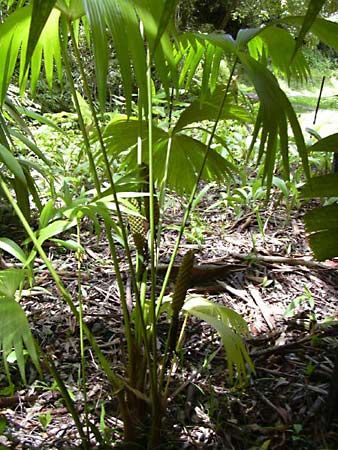
The Cyclanthaceae family, often referred to as the Panama hat palm family, consists of approximately 12 genera and 225 species of monocotyledonous plants native to the New World tropics. While they are often mistaken for palms due to their appearance, this similarity is the result of parallel evolution rather than a close biological relationship.12
Physical Characteristics
- Growth Habit: These plants are typically stemless, perennial, palmlike herbs, though the family also includes woody herbaceous shrubs and a few lianas.12
- Leaves: The leaves are characteristically plicate (fanlike), parallel-veined, and often deeply forked or lobed. They are arranged in a spiral or, rarely, a distichous pattern, and are supported by petioles of varying lengths.12
- Inflorescence: The plants are monoecious, meaning they bear both male and female flowers on the same individual. These flowers are densely crowded onto a rodlike structure called a spadix, which is surrounded by conspicuous, sheathing spathes that may be red, white, yellow, or green.241
In most genera, the flowers are arranged in groups consisting of one female flower surrounded by four males. The genus Cyclanthus is a notable exception, featuring a unique, screwlike spadix with alternating cycles of male and female flowers.12
Are there any endangered or threatened species within the Cyclanthaceae family?
Sorry, the Britannica knowledge base does not contain information regarding the conservation status of specific species within the Cyclanthaceae family.
While the provided search results discuss the ecology and characteristics of Cyclanthaceae, they do not list any members of this family as endangered or threatened. Please note that the search results mention endangered species in the context of cycads, which are a distinct group of plants and should not be confused with the Cyclanthaceae family.
What types of habitats do Cyclanthaceae plants typically prefer?
Plants in the Cyclanthaceae family are restricted to the New World tropics (Neotropics), with a distribution ranging from southern Mexico through Central America, the West Indies, and into South America as far as central Bolivia and southeastern Brazil.6
Regarding their specific habitat preferences, many species of Cyclanthaceae are found growing along riverbanks. Additionally, some species are adapted to thrive in mangrove communities along coastal areas.6
Sources
- Cyclanthaceae — Encyclopædia Britannica
- Pandanales - Cyclanthaceae — Encyclopædia Britannica
- pollination - Wind — Encyclopædia Britannica
- cycadophyte - Sporophylls and strobili — Encyclopædia Britannica
- Cyclanthaceae — Merriam-Webster
- cycadophyte - Ecology and habitats — Encyclopædia Britannica
- Cyclanthales — Merriam-Webster
Published on · 2 min read