Cynognathus
Cynognathus was an advanced cynodont that exhibited several unique, mammal-like physical characteristics that distinguished it from its reptilian…
What are the key physical characteristics of Cynognathus that make it unique?
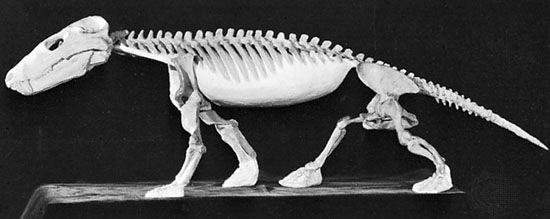
Cynognathus was an advanced cynodont that exhibited several unique, mammal-like physical characteristics that distinguished it from its reptilian contemporaries.1
Key features include:
- Locomotion: Unlike many other cynodonts that maintained a sprawling gait, Cynognathus had limbs tucked well under its body, allowing for more efficient and rapid movement.12
- Dentition: Its teeth were highly specialized, featuring incisors for nipping, prominent canines for predation, and cheek teeth separated by a diastema for slicing food.1
- Skull and Jaw: The skull featured large openings for powerful jaw muscles. Its lower jaw was dominated by the dentary bone, a significant departure from the reptilian condition and a precursor to mammalian anatomy.1
- Respiration: A well-developed secondary palate separated its food and breathing passages, enabling the animal to chew and breathe simultaneously—a trait associated with higher metabolic rates.12
These adaptations made Cynognathus a highly effective predator, roughly the size of a modern wolf.1
What can Cynognathus tell us about the development of endothermy (warm-bloodedness) in the mammal lineage?
Cynognathus provides significant evidence regarding the evolution of endothermy in the lineage leading to mammals. While it retained some reptilian skeletal traits, its anatomy suggests a transition toward the higher metabolic rate characteristic of warm-blooded animals.12
A key indicator is the presence of a well-developed secondary palate. This structure separated the animal’s food and breathing passages, which allowed Cynognathus to chew its food while simultaneously breathing. This capability facilitated more efficient processing and digestion of food, a requirement for sustaining the higher energy demands associated with endothermy.12
Furthermore, the specialization of its teeth—including incisors for nipping, canines for predation, and cheek teeth for slicing—indicates an active, predatory lifestyle similar to that of a modern wolf. The placement of its limbs tucked well under the body also supported more rapid and efficient locomotion than the sprawling gait of typical reptiles, further pointing toward a more active, high-energy physiology.1
How did Cynognathus’ jaw structure differ from earlier therapsids and modern mammals?
The jaw structure of Cynognathus represents a critical transitional stage in the evolution of the mammalian jaw.
Compared to earlier therapsids, the lower jaw of Cynognathus was increasingly dominated by the dentary bone, while the other jaw elements—which were prominent in ancestral reptiles—became relatively reduced. This shift anticipated the condition seen in modern mammals, where the dentary bone serves as the sole component of the lower jaw.13
In contrast to modern mammals, Cynognathus had not yet completed the evolutionary transition to the mammalian jaw joint. In modern mammals, the jaw joint is formed exclusively by the dentary and squamosal bones, as the posterior jaw bones of their ancestors migrated to become part of the middle ear (the quadrate, articular, and angular bones). While Cynognathus displayed a more advanced, mammal-like jaw than its predecessors, it still retained the ancestral reptilian jaw elements that would eventually be repurposed for hearing in later mammalian descendants.31
How does Cynognathus fit into the evolutionary history of mammals?
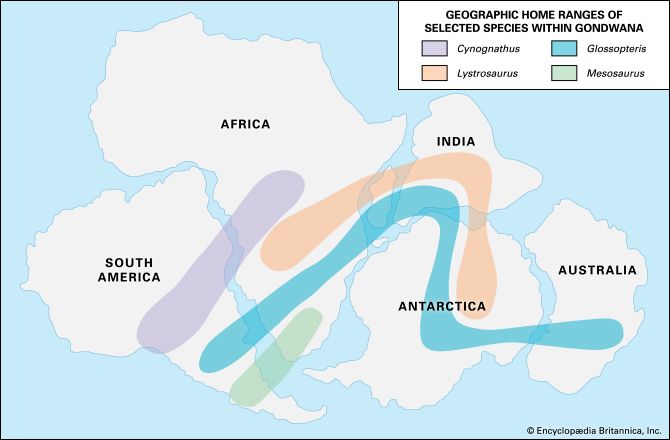
Cynognathus is a pivotal genus of advanced therapsids that serves as a key representative of the cynodont lineage, the group from which the earliest mammals evolved during the Jurassic Period.12
Living during the Lower Triassic, Cynognathus exhibited several anatomical features that bridged the gap between ancestral reptiles and mammals:
- Skeletal Structure: Unlike the sprawling gait of many reptiles, its limbs were tucked beneath its body, facilitating efficient locomotion.1
- Feeding Adaptations: It possessed a well-developed secondary palate, allowing it to chew and breathe simultaneously, and its teeth were regionally specialized into incisors, canines, and cheek teeth.12
- Jaw Morphology: Its lower jaw was dominated by the dentary bone, with other ancestral reptilian jaw elements significantly reduced, mirroring the trend toward the modern mammalian jaw.1
These traits suggest Cynognathus was an active, high-metabolism predator, providing essential evidence for the evolutionary trajectory toward mammalian physiology.12
Sources
- Cynognathus — Encyclopædia Britannica
- cynodont — Encyclopædia Britannica
- Morganucodon — Encyclopædia Britannica
Published on · 3 min read