Morganucodon
Morganucodon lived during the Triassic-Jurassic boundary, a time when terrestrial ecosystems were dominated by archosaurs, including dinosaurs, crocodilians…
What other animals lived alongside Morganucodon during its time?
Morganucodon lived during the Triassic-Jurassic boundary, a time when terrestrial ecosystems were dominated by archosaurs, including dinosaurs, crocodilians, and pterosaurs.1
While Morganucodon and other early mammals were small, insectivorous or omnivorous creatures, they shared their environment with a diverse array of other animals:
- Dinosaurs: By the Jurassic, dinosaurs had become the dominant terrestrial vertebrates. This included saurischians like the long-necked sauropods and carnivorous theropods (such as Allosaurus), as well as ornithischians like Stegosaurus.1
- Other Reptiles: Turtles were present throughout the period, and modern forms of lizards appeared by the Late Jurassic. Tritylodonts, which were closely related to early mammals but not part of the same family, also emerged near the Triassic-Jurassic boundary.12
- Amphibians: While their diversity declined significantly by the Jurassic, more modern forms, including the first frogs, began to develop.1
What is Morganucodon and when did it live?
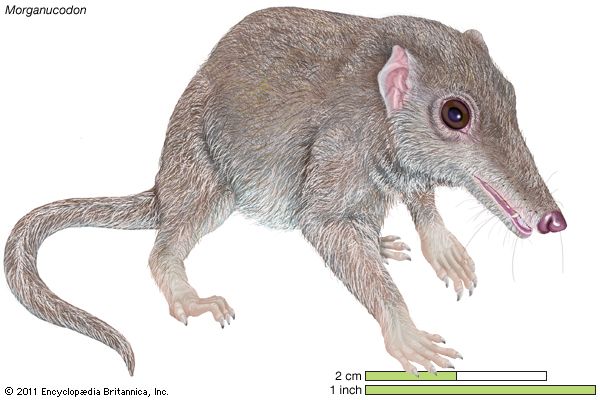
Morganucodon is an extinct genus of tiny mammals that lived during the Triassic–Jurassic boundary, approximately 200 million years ago.1
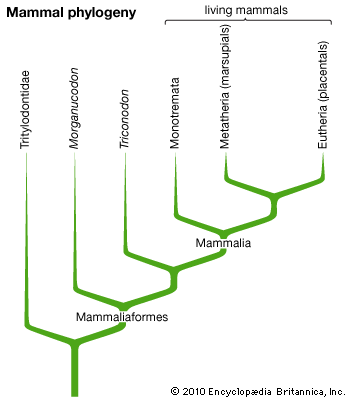
Resembling a modern shrew, rat, or gerbil, this small creature weighed between 27 and 89 grams and likely fed on insects and other invertebrates. Morganucodon is scientifically significant for possessing a jaw joint formed by the dentary and squamosal bones, a defining skeletal characteristic of mammals. While it is often considered one of the earliest mammals, some researchers classify it within the Mammaliaformes, a clade that includes both mammals and their closest extinct relatives.1
Its biology featured hair and a hearing system capable of detecting higher frequencies than those of contemporary reptiles or birds.1
What are the key physical characteristics of Morganucodon?
Morganucodon possessed several distinct physical characteristics that mark its significance in the evolution of mammals:
- Body Size and Form: It was a tiny creature, weighing between 27 and 89 grams. Its body structure resembled that of a modern gerbil or rat, featuring a long face similar to a shrew or civet.1
- Integument: Like living mammals, Morganucodon had skin covered with hair.1
- Jaw Structure: A defining feature is its jaw joint, which is formed by the dentary and squamosal bones. This represents a critical evolutionary transition where posterior jaw bones were reduced and incorporated into the middle ear.1
- Sensory Capabilities: While its brain was smaller than that of any living mammal, its hearing was highly developed, capable of detecting frequencies up to 10 kilohertz—significantly higher than the range of contemporary reptiles and birds.1
How does Morganucodon compare to other early mammal-like creatures?
Morganucodon serves as a pivotal example in the study of mammalian evolution, representing a “mosaic” of traits that bridge the gap between ancestral therapsids and modern mammals.15
Compared to other early mammal-like creatures, Morganucodon is distinguished by its jaw structure. While most vertebrates possess a lower jaw composed of several bones, Morganucodon features the mammalian condition where the dentary bone is isolated, and the posterior bones have migrated to become middle ear ossicles. This transition is a key diagnostic feature used to classify it as one of the earliest mammals.15
However, its classification remains debated:
- Broad Definition: Under the jaw-joint criterion, Morganucodon is considered one of the oldest mammals.1
- Strict Definition: In a more restrictive sense, it is classified within the Mammaliaformes, a clade of close relatives that sits outside the common ancestry of living monotremes, marsupials, and placentals.1
Unlike tritylodonts, which emerged around the same time but are not part of the family Morganucodontidae, Morganucodon represents a specific evolutionary lineage that parallels the developmental processes seen in modern mammals.1
Sources
- Morganucodon — Encyclopædia Britannica
- Jurassic Period - Vertebrates — Encyclopædia Britannica
- Jurassic Period - Paleogeography — Encyclopædia Britannica
- Triassic Period - Terrestrial reptiles and the first mammals — Encyclopædia Britannica
- mammal - The evolution of the mammalian condition — Encyclopædia Britannica
Published on · 3 min read