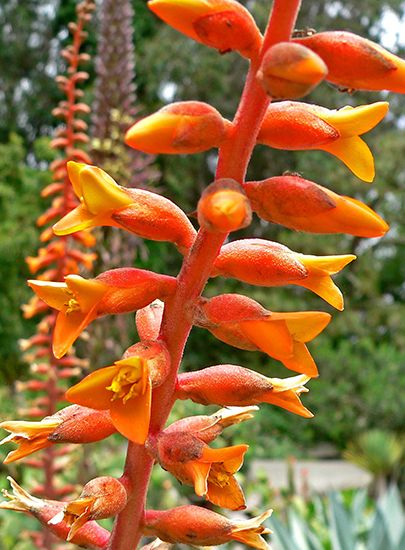
Cyperaceae
The Cyperaceae family includes several species with significant economic value, though they are rarely used as primary food crops. Notable examples include:
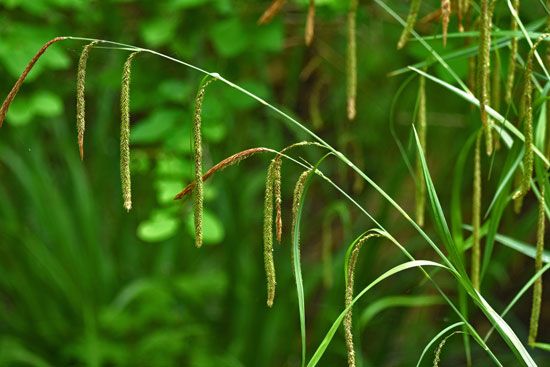
Are there any economically important species within the Cyperaceae family?
The Cyperaceae family includes several species with significant economic value, though they are rarely used as primary food crops. Notable examples include:
- Food Crops: The Chinese water chestnut (Eleocharis dulcis) and chufas or tiger nuts (Cyperus esculentus) are cultivated for their edible underground tubers.1
- Materials and Utility: Many species are used regionally for weaving mats, baskets, and screens due to their strong, fibrous stems. Papyrus (Cyperus papyrus) was historically vital in ancient Egypt for creating paper, boats, and other goods.12
- Ornamentals: Various Carex and Cyperus species are widely cultivated as ornamental plants in gardens, ponds, and greenhouses.1
- Environmental Management: Certain fast-growing sedges are utilized in wastewater treatment to absorb excess nutrients like nitrogen and phosphorus.1
Conversely, some species are economically detrimental as weeds, such as the purple nut sedge (Cyperus rotundus), which is considered one of the world’s most problematic agricultural pests.1
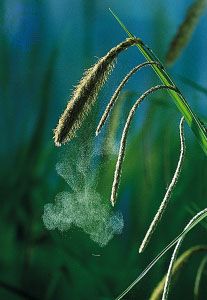
What are some common names for plants in the Cyperaceae family, and where are they typically found?
The Cyperaceae family, commonly known as the sedge family, consists of grasslike, herbaceous monocotyledonous plants. These plants are found on every continent except Antarctica, thriving in a wide variety of habitats, though they are most prevalent in sunny, moist to wet environments such as marshes, bogs, fens, and lakeshores.31
Common Names and Genera
While the family is collectively referred to as sedges, it includes several distinct groups often identified by their common names:
- Sedges: Members of the largest genus, Carex, are the most widely recognized.1
- Bulrushes and Club Rushes: These include species within the genera Scirpus, Schoenoplectus, and Trichophorum.1
- Beak Rushes: Belonging to the genus Rhynchospora.1
- Nut Rushes: Species within the genus Scleria.1
- Cotton Grasses: Members of the genus Eriophorum, often found in peatlands.14
- Papyrus: The well-known Cyperus papyrus.4
Typical Habitats
Sedges are ecologically versatile and occur in almost all environments except for extreme deserts and deep-water or marine ecosystems. While they are most abundant in wetlands, they are also significant components of:1
- Forests: Many species grow in the understory of both temperate and tropical forests.1
- Grasslands and Savannas: Particularly in moist sites or sandy, thin soils.1
- Alpine Regions: Including the paramo grasslands of Central and South America.1
- Man-made Habitats: Such as ditches and canal banks.1
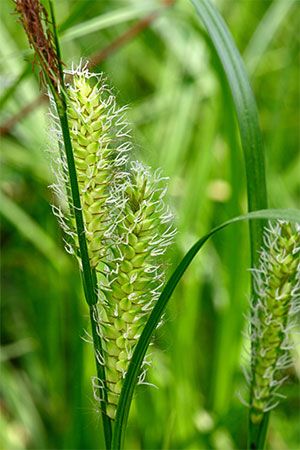
How do Cyperaceae plants differ from grasses (Poaceae family)?
While the Cyperaceae (sedge family) and Poaceae (grass family) are both grasslike, herbaceous plants, they differ in several key morphological and anatomical features:6
- Stem Structure: Sedges often have triangular, solid stems, whereas grass stems are never triangular and are typically hollow except at the nodes.6
- Leaf Arrangement: Sedges exhibit tristichous phyllotaxy, meaning their leaves are arranged in three vertical rows (at 120-degree angles). Grasses have distichous leaves, arranged in two vertical rows on opposite sides of the stem.6
- Leaf Sheaths: In grasses, leaf margins overlap but remain separate. In sedges, the leaf margins fuse together as they encircle the stem.6
- Floral Morphology: In sedge spikelets, each individual flower is subtended by a single scale. In contrast, grass flowers are usually subtended by two scales.6
- Pollination and Genetics: Grasses have localized centromeres and single-celled pollen grains. Sedges possess diffuse centromeres and disperse pollen as tetrads (where three nuclei degenerate, leaving one functional nucleus).6
Are there any endangered or threatened species within the Cyperaceae family?
Sources
- Cyperaceae - Economic and ecological importance — Encyclopædia Britannica
- papyrus — Encyclopædia Britannica
- Cyperaceae - Distribution and abundance — Encyclopædia Britannica
- Cyperaceae — Merriam-Webster
- Cyperaceae — Encyclopædia Britannica
- Cyperaceae - Characteristic morphological features — Encyclopædia Britannica
Published on · 3 min read