Daddy Longlegs
Daddy longlegs (order Opiliones) are unique among arachnids because they utilize direct sperm transfer for reproduction. Unlike many other arachnids that…
How do daddy longlegs reproduce and what is their life cycle like?
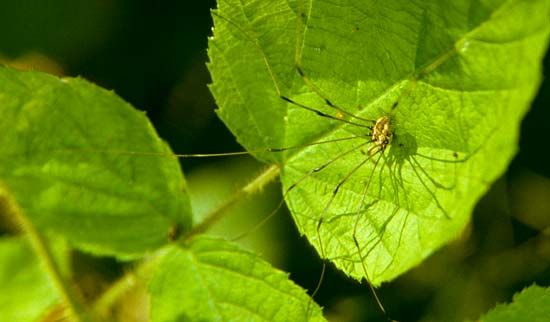
Daddy longlegs (order Opiliones) are unique among arachnids because they utilize direct sperm transfer for reproduction. Unlike many other arachnids that rely on indirect methods or complex courtship rituals, daddy longlegs engage in little to no courtship; mating occurs whenever a male and female encounter one another. During this process, the male uses a chitinized penis to insert sperm directly into the female’s genital opening while the partners face each other.1
Following mating in the autumn, the female uses a long ovipositor to deposit her eggs into a cleft in the soil. These eggs remain in the ground throughout the winter and hatch with the arrival of spring warmth. Most species of daddy longlegs have a life span of less than one year, though some may survive for several years.2
How many species of daddy longlegs have been identified so far?
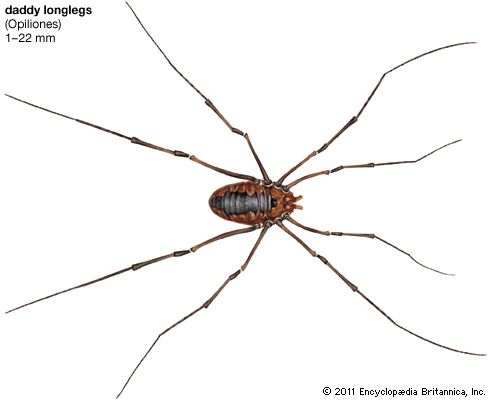
There are more than 6,650 identified species of daddy longlegs (order Opiliones). Other scientific sources, such as annotated classifications of arachnids, estimate the number of described species at approximately 7,000.25
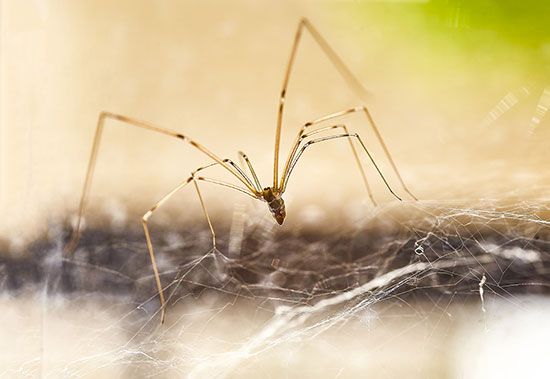
It is important to note that these organisms are frequently confused with the daddy longlegs spider (family Pholcidae), which is a separate group containing about 960 species.6
What is the typical habitat and distribution of daddy longlegs around the world?
Daddy longlegs (order Opiliones) are remarkably widespread, with a global distribution that spans both temperate and tropical climates across both hemispheres.2
Regarding their habitat preferences, these arachnids typically favor environments that are wet or otherwise moist. While the majority of species thrive in these damp conditions, some have successfully adapted to comparatively dry environments. They are most frequently observed during late summer and are commonly sighted in fields at the time of crop harvest, which has contributed to their alternative name, “harvestman.”2
What are the feeding habits and diet of daddy longlegs?
Many species of daddy longlegs (order Opiliones) are omnivorous, maintaining a diet that includes small insects, mites, spiders, snails, and various types of vegetable matter. They obtain their food through either predation or scavenging7.72
Unlike many other arachnids that rely solely on external digestion—where digestive fluids are injected into prey to liquefy their contents—daddy longlegs are unique among the group for their ability to ingest small solid particles. When they do consume prey, they may also tear it into smaller pieces or inject digestive fluids to consume the liquefied remains. While some arachnids lie in wait for their meals, daddy longlegs are known to actively wander over vegetation, such as herbs and bushes, in pursuit of prey. Notably, they do not produce silk or webs to capture food.972
Sources
- arachnid - Reproduction and life cycle — Encyclopædia Britannica
- daddy longlegs — Encyclopædia Britannica
- malacostracan - Reproduction and life cycles — Encyclopædia Britannica
- Reproductive behaviour - Segmented worms — Encyclopædia Britannica
- arachnid - Annotated classification — Encyclopædia Britannica
- spider - Annotated classification — Encyclopædia Britannica
- daddy longlegs: Top Questions — Encyclopædia Britannica
- list of arachnids — Encyclopædia Britannica
- arachnid - Food and feeding — Encyclopædia Britannica
Published on · 2 min read