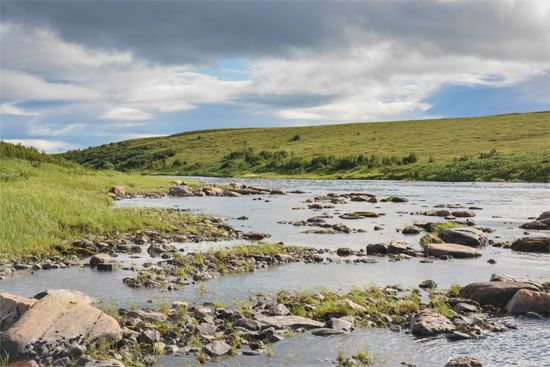
Dan River
The Dan River is a 180-mile-long (290-kilometer) river located in the United States, flowing eastward through southern Virginia and northern North Carolina.…
What is Dan River?
The Dan River is a 180-mile-long (290-kilometer) river located in the United States, flowing eastward through southern Virginia and northern North Carolina. It serves as the principal tributary of the Roanoke River, joining it just north of the Virginia–North Carolina border.12
The river has played a significant role in the development of the region, particularly in Danville, Virginia, which was established along its banks. Historically, the river supported the city’s growth as a major tobacco market and textile center, with the falls of the Dan River being harnessed to provide hydroelectric power for the area.3
How does the Roanoke River connect to the Dan River?
The Roanoke River and the Dan River connect just north of the Virginia–North Carolina boundary. At this confluence, the Dan River serves as the Roanoke’s principal tributary. Before reaching this junction, the section of the Roanoke River upstream is historically referred to as the Staunton River.1
What role did the Dan River play in the textile industry?
The Dan River played a pivotal role in the development of the textile industry in Danville, Virginia, primarily by providing a reliable source of energy. By harnessing the river’s falls, known as the pinnacles, the city was able to generate cheap hydroelectric power to support large-scale manufacturing operations.electric power](https://www.britannica.com/science/hydroelectric-power) to support large-scale manufacturing operations.3
This energy source was instrumental in the establishment and growth of the Dan River Cotton Mills (later Dan River, Inc.) in the 1880s. This facility eventually grew to become the largest single-unit textile factory in the world, cementing Danville’s status as a leading textile center for many decades until the mill complex ceased operations in 2006.3
How is hydroelectric power generated from rivers?
Hydroelectric power is generated by converting the potential energy of water into mechanical energy and, ultimately, into electricity.6
The process typically involves the following steps:
- Collection: Water is stored at a higher elevation, often by using a dam to impound a river, which creates a reservoir.76
- Flow: The water is directed downward through large pipes or tunnels known as penstocks. The vertical distance between the reservoir and the turbine is called the head.6
- Conversion: As the water reaches the bottom, its pressure and flow cause turbines to rotate. These turbines convert the energy of the moving water into mechanical energy.86
- Generation: The rotating turbines drive generators, which produce electricity.6
- Transmission: Transformers increase the voltage of the generated electricity to make it suitable for long-distance transmission.6
While this process provides a renewable energy source, it is important to acknowledge that the construction of dams can significantly disrupt natural ecosystems, such as by blocking fish migration or displacing communities.76
Sources
- Roanoke River — Encyclopædia Britannica
- Dan — Merriam-Webster
- Danville — Encyclopædia Britannica
- Danube River - Physiography — Encyclopædia Britannica
- Roanoke — Encyclopædia Britannica
- Did you know? — Merriam-Webster
- turbine — Encyclopædia Britannica
- hydroelectric power — Encyclopædia Britannica
Published on · 2 min read