Darkling Beetle
While there are few broad cultural references to darkling beetles, they have a notable historical presence in human records. The name itself is derived from…
Are there any cultural or historical references to darkling beetles?
While there are few broad cultural references to darkling beetles, they have a notable historical presence in human records. The name itself is derived from the Latin tenebrio, meaning “one who shuns light” or “someone who does things in the dark,” which reflects their nocturnal habits.12
Historically, these insects have interacted with human civilization as pests in stored goods. For example, remains of the flour beetle (Tribolium), a member of the family Tenebrionidae, were discovered in a grain jar within an Egyptian tomb dating back to approximately 2500 BCE.3
In modern contexts, these beetles are significant in scientific and practical applications:
- Scientific Research: The flour beetle is frequently used in laboratory studies concerning population ecology, heredity, and behavior due to the ease of raising them in large numbers.3
- Practical Use: The larvae of the mealworm (Tenebrio) are widely utilized as a food source for pets, such as birds and fish.3
What role do darkling beetles play in their ecosystem?
Darkling beetles (family Tenebrionidae) serve diverse and essential roles within their ecosystems, primarily functioning as scavengers and predators.25
Ecological Roles
- Scavengers: Many darkling beetles play a critical role in nutrient cycling by breaking down organic matter. They consume dry, decomposing vegetation, dead animal tissue, rodent excrement, and other waste products. By processing these materials, they help clean the environment and return nutrients to the soil.125
- Predators: Some species, particularly those residing in rotten wood or under bark, act as predators by feeding on the larvae of other insects.2
- Habitat Specialists: Their versatility allows them to occupy various niches. While many are found in soil or rotting logs, others live in damp areas, inhabit ant nests as commensals, or bore into wood.12
- Food Source: As part of the food web, darkling beetles and their larvae serve as a food source for various other animals.1
While some species are considered pests when they infest stored grains and dried food products, their broader ecological contribution as decomposers is vital for maintaining healthy habitats.125
Where are darkling beetles commonly found in nature?
Darkling beetles (family Tenebrionidae) are found on every continent, though they are most common in warm, dry climates. Because they are a diverse family of approximately 20,000 species, they occupy a wide variety of natural habitats.25
Common locations where they are found include:
- Soil and Ground: Many species live on or beneath the ground, where they scavenge for organic matter.25
- Wood and Bark: Several species inhabit rotting logs, stumps, or live under the bark of trees, where they may feed on fungi or act as predators of other insect larvae.25
- Damp Environments: Some darkling beetles prefer damp places, where they may feed on rodent excrement, fungi, or other waste products.5
- Nests: Certain species live as commensals within the nests of social insects, such as ants.25
- Stored Products: Some species, such as the flour beetle, are frequently found in dried food products, including grain and meal.25
What are the distinguishing physical characteristics of darkling beetles?
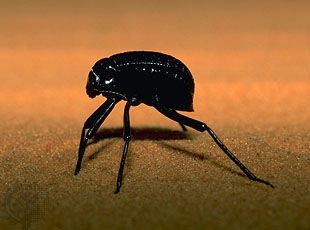
Darkling beetles (family Tenebrionidae) exhibit significant physical diversity, making them difficult to identify as a single family at a glance. While many ground-dwelling species are robust and dark-colored, others vary greatly in size, shape, and appearance.12
Physical Characteristics
- Size and Shape: Adult darkling beetles range from 2 to 35 mm in length. Their body shapes vary from flat to cylindrical.1
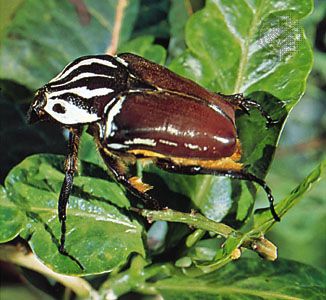
- Coloration: While most are dark or black, some species feature bright markings or a metallic sheen.12
- Structural Adaptations:
- Wings: Many species have vestigial, functionless wings. In some dry-climate species, the wing covers (elytra) are fused together to prevent water loss.71
- Specialized Features: Some species, such as the forked fungus beetle, possess blunt, hornlike projections on the head.1
- Texture: Depending on the species, the body may be smooth or roughened.12
- Larvae: The larvae are typically hard, cylindrical, and wormlike, reaching about 25 mm in length.71
Sources
- darkling beetle — Merriam-Webster
- darkling beetle — Encyclopædia Britannica
- Tenebrionidae — Merriam-Webster
- tenebrionid — Merriam-Webster
- Coleoptera - Feeding habits and habitats — Encyclopædia Britannica
- Coleoptera - As scavengers — Encyclopædia Britannica
- Coleoptera - Size range and diversity of structure — Encyclopædia Britannica
Published on · 3 min read