Fungus Weevil
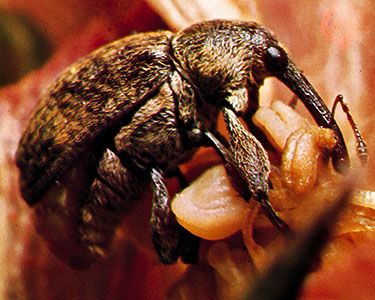
A fungus weevil is any of approximately 3,000 species of insects belonging to the family Anthribidae within the order Coleoptera.
What is fungus weevil?
A fungus weevil is any of approximately 3,000 species of insects belonging to the family Anthribidae within the order Coleoptera.1
While they are often confused with “true weevils” (family Curculionidae), fungus weevils are distinguished by their antennae, which are not elbowed. These insects typically range from 0.5 to 50 mm in length and possess a head prolonged into a short snout.12
Adults are commonly found on dead twigs or fungi, while their larvae feed on fungi, seeds, or deadwood. Primarily found in tropical regions, the family includes the coffee bean weevil, which is recognized as a significant agricultural pest. In contrast, true weevils are known for their elbowed antennae and include destructive species such as the grain weevil and the boll weevil.12
How do fungus weevils differ from true weevils?
Fungus weevils (family Anthribidae) and true weevils (family Curculionidae) are distinct groups within the order Coleoptera. While both possess a snout, they differ significantly in their physical characteristics and habits:
- Antennae Structure: The most reliable way to distinguish them is by their antennae. True weevils have distinctly elbowed antennae that often fold into special grooves on their snout. In contrast, fungus weevils have non-elbowed antennae, which can sometimes be quite long—occasionally exceeding the length of their entire body.231
- Feeding Habits: True weevils are primarily plant feeders, with larvae that typically consume specific parts of a plant, such as seeds, roots, stems, or fruits. Fungus weevils, as their name suggests, are generally associated with fungi and deadwood; their larvae typically feed on fungi, seeds, or decaying wood.23
- Classification: True weevils belong to the family Curculionidae, which is one of the largest families of beetles, containing approximately 40,000 species. Fungus weevils belong to the family Anthribidae, which comprises about 3,000 species.23
What role do fungus weevils play in forest ecosystems?
Fungus weevils (family Anthribidae) play a functional role in forest ecosystems primarily through their association with decaying organic matter. Because their larvae feed on fungi, seeds, or deadwood, these insects contribute to the natural process of decomposition within forest environments.1
By inhabiting dead twigs and consuming fungal growth, they participate in the breakdown of woody debris, which is essential for nutrient cycling in forest habitats. While they are often found on dead wood, their presence is closely tied to the availability of fungi, which serves as a primary food source for their developing larvae.1
It is important to note that while some related beetle groups, such as the primitive weevil (family Brentidae), may bore into living trees and cause significant damage, the primary ecological contribution of fungus weevils is centered on their interaction with fungi and dead plant material.16
Why is the coffee bean weevil considered a significant pest?
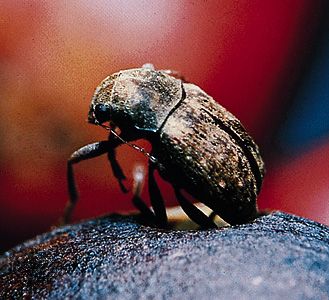
The coffee-bean weevil (Araecerus fasciculatus) is considered a significant pest primarily due to its status as a nearly cosmopolitan species in warm regions, where it demonstrates a broad ability to feed and breed on a wide variety of stored products.7
Unlike some pests that are limited to a single host, the coffee-bean weevil is highly adaptable, infesting diverse items including:
Because it can thrive in such a wide range of stored goods, it poses a persistent threat to agricultural storage and food security in tropical and subtropical climates. It is important to distinguish this species from the common bean weevil (Acanthoscelides obtectus), which specifically targets the pods and seeds of beans and peas.78
Sources
- fungus weevil — Encyclopædia Britannica
- weevil — Encyclopædia Britannica
- List of insects - beetles and weevils (order Coleoptera) — Encyclopædia Britannica
- Coleoptera - Feeding habits and habitats — Encyclopædia Britannica
- Coleoptera - Size range and diversity of structure — Encyclopædia Britannica
- primitive weevil — Encyclopædia Britannica
- coffee-bean weevil — Merriam-Webster
- bean weevil — Merriam-Webster
Published on · 3 min read