Darter
Darters are a group of approximately 100 species of small, slender freshwater fish belonging to the subfamily Etheostominae. They are distinguished from many…
How do darter fish differ from other types of freshwater fish?
Darters are a group of approximately 100 species of small, slender freshwater fish belonging to the subfamily Etheostominae. They are distinguished from many other freshwater fish by several specific characteristics:1
- Behavior and Habitat: Unlike fish that may swim in open water, darters are bottom-dwellers native to clear streams in North America. They are named for their characteristic habit of darting quickly about when feeding or disturbed.12
- Size: They are notably small, typically ranging from 2.5 to 23 cm (1 to 9 inches), with the majority measuring only 5–7 cm.1
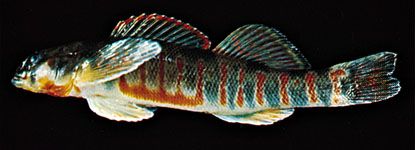
- Appearance: Many species are among the most brightly colored fish in North America, particularly the males during the spring breeding season. For example, the Christmas darter displays vibrant red and green transverse bars.12
- Anatomy: Like other members of the family Percidae, they possess two dorsal fins.1
Their presence in an aquatic ecosystem is often considered an indicator of good environmental health.2
How do darter fish reproduce, and what are their mating behaviors?
Darter fish exhibit diverse reproductive strategies, with spawning habits that vary significantly across species. While some darters simply scatter or bury their eggs and abandon them, others engage in more complex parental care. In species that provide care, males typically establish and defend nests against intruders.13
To create these nests, darters use their fins or bodies to dig circular depressions in the substrate. During the spring breeding season, males often undergo dramatic changes in appearance, developing vibrant colors that serve as reproductive signals to attract mates and intimidate rivals. This sexual dimorphism is common, with males generally being more brightly colored than females.314
When defending their spawning sites, male darters may also aerate the eggs by using their fins to direct a flow of water into the nest. Unlike many other perciform fishes that produce pelagic eggs, darters produce demersal eggs, which sink to the bottom and often possess adhesive qualities that help them remain in place.3
Where are darter fish typically found, and what types of habitats do they prefer?
Darter fish are native exclusively to eastern North America. They are specialized inhabitants of clear, freshwater environments, typically found living near the bottom of streams and creeks.1
These fish show a strong preference for specific aquatic conditions:
- Flow and Substrate: Many species, such as the Christmas darter, thrive in fast-flowing, rocky streams.2
- Environmental Quality: Because they require clear, high-quality water to survive and hunt, their presence is often used as an indicator of a healthy aquatic ecosystem.12
- Habitat Sensitivity: Their reliance on specific, often restricted, environments makes them highly vulnerable to habitat loss. For example, the snail darter became the center of a significant legal controversy in the 1970s when dam construction threatened its limited habitat in the Little Tennessee River.1
What are the key physical characteristics of darter fish?
Darter fish are small, slender freshwater fishes belonging to the subfamily Etheostominae within the family Percidae. Their key physical characteristics include:1
- Size: They are generally small, typically ranging from 2.5 to 23 cm (1 to 9 inches) in length, with the majority of species measuring between 5 and 7 cm.1
- Body Shape: They possess elongated, slender bodies and are equipped with two distinct dorsal fins, a common trait among members of the order Perciformes.14
- Scales: Like other percoids, they typically have ctenoid scales, which are rough-edged and feature small teeth along their posterior margins.4
- Coloration: Many darters are among the most brightly colored fishes in North America. They often exhibit sexual dimorphism, with males developing vibrant, brilliant colors—such as red, green, and blue—particularly during the spring breeding season to attract mates and signal reproductive readiness.162
- Adaptations: Their name is derived from their characteristic quick, darting movements, which they use when feeding on small aquatic animals like insects and worms or when disturbed.16
Sources
- darter — Encyclopædia Britannica
- Christmas plants and animals: 12 festive species - Christmas darter ( Etheostoma hopkinsi ) — Encyclopædia Britannica
- perciform - Life history — Encyclopædia Britannica
- coloration - Reproductive signals — Encyclopædia Britannica
- coloration - Territorial advertising — Encyclopædia Britannica
- perciform - Annotated classification — Encyclopædia Britannica
- ostariophysan - Secondary sexual characteristics — Encyclopædia Britannica
Published on · 3 min read