Pinecone Fish
The pinecone fish refers to any member of the family Monocentridae, specifically within the genera Cleidopodus and Monocentris. These fish are named for…
What is pinecone fish?
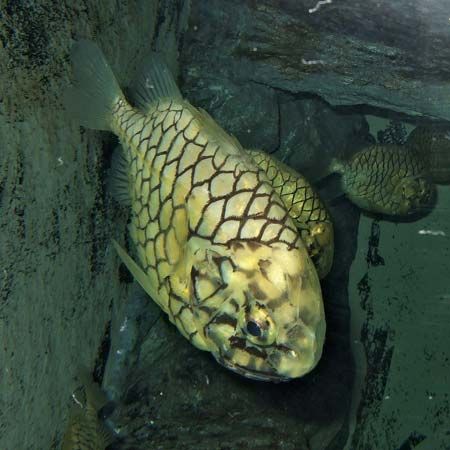
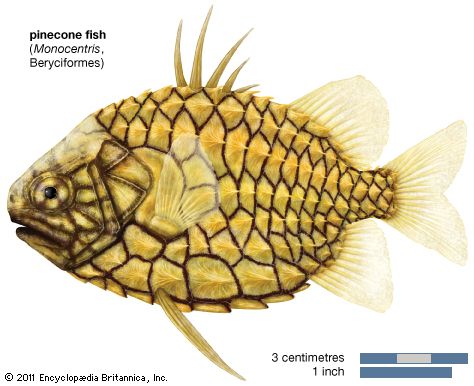
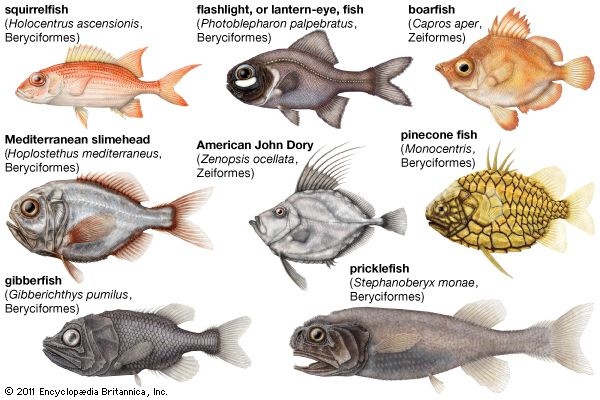
The pinecone fish refers to any member of the family Monocentridae, specifically within the genera Cleidopodus and Monocentris. These fish are named for their oval bodies, which are covered in enlarged, spiny, platelike scales that resemble a pinecone.1
Key characteristics include:
- Habitat: They are typically found in deepwater marine environments across the Indo-Pacific region.1
- Physical Features: They possess luminescent organs located on the lower jaw and are encased in a boxlike structure formed by fused, bony scales.12
- Species: The Japanese pinecone fish (M. japonicus) is a well-known species that reaches about 13 cm in length and is often kept in saltwater aquariums or used as a food fish. Other species, such as M. reedi and M. neozelanicus, inhabit different areas of the Pacific Ocean.1
How do the luminescent organs help the fish survive?
Luminescent organs, or photophores, provide several critical survival advantages for deep-sea fish, including the pinecone fish:
- Camouflage: Many deep-sea fish possess photophores on their ventral (bottom) surfaces that emit light downward. This allows them to match the intensity of sunlight filtering down from the surface, effectively concealing their silhouette from predators lurking below.34
- Predation: Some species use glowing structures as lures to attract unsuspecting prey toward their mouths.354
- Communication and Recognition: Distinctive patterns of light organs help individuals identify members of their own species and may assist in maintaining schools.35
- Defense: Bioluminescence can be used to startle or frighten potential predators, or to confuse them, allowing the fish to escape.34
In some fish, these organs house symbiotic luminous bacteria, which the host fish nourishes and controls to produce light as needed.6
What other deep-sea fish have bioluminescent features?
Many deep-sea fish utilize bioluminescence to survive in the extreme darkness of the ocean depths. Beyond the pinecone fish, several other groups are well-known for their light-producing capabilities:
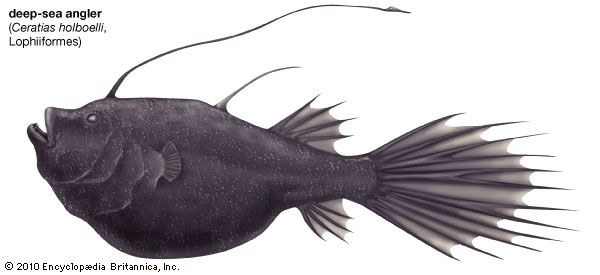
- Anglerfishes: These predators are famous for a modified dorsal spine that acts as an elongated rod. At the tip of this rod dangles a luminous organ used to lure unsuspecting prey directly toward the fish’s large jaws.34
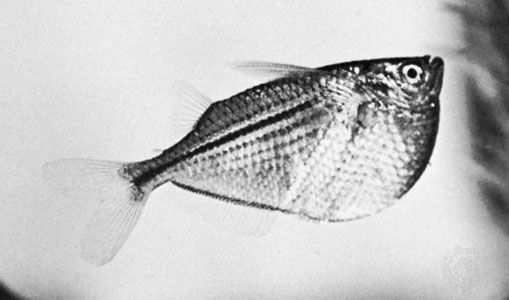
- Lantern fishes and hatchetfishes: These fish possess complex arrangements of photophores along their bodies. These organs are often used for species and sex recognition, as well as for counter-illumination—a form of camouflage where the fish matches the intensity of sunlight filtering from above to hide its silhouette from predators below.3
- Flashlight fishes: Found in regions like Indonesia, these fish have large light organs beneath their eyes that house symbiotic luminous bacteria. They can control the light by drawing a fold of black skin over the organ.5
- Deep-sea sharks: Certain species, such as the kitefin shark (Dalatias licha) and various lanternsharks (Etmopterus species), produce light through internal chemical reactions rather than through bacterial partnerships.5
Why do some fish evolve armor-like scales?
Fish evolved armor-like scales primarily as a defense mechanism against environmental hazards and predators. In early jawless fishes, such as the ancient ostracoderms, heavy dermal armor likely developed through natural selection to protect against aggressive, clawed invertebrate predators like eurypterids.891011
This protective adaptation, known as dermal bone, arose early in fish evolution. While primitive fishes often possessed thick, multi-layered bony plates or scales, many modern teleost fishes have evolved thinner, overlapping scales that provide protection while allowing for greater freedom of movement.9
However, armor has evolved repeatedly in species that lack the ability to rely on fast locomotion for survival. For instance, trunkfish (boxfish) are encased in rigid bony plates, and some modern teleosts, such as certain catfishes and sticklebacks, have secondarily acquired bony plates in their skin to serve as a defensive barrier. Over time, many vertebrate lines have shown a progressive reduction in heavy body armor as they developed more complex sense organs and behaviors to evade predators.119
Sources
- pinecone fish — Encyclopædia Britannica
- pinecone fish — Merriam-Webster
- Bioluminescence - The role of bioluminescence in behavior — Encyclopædia Britannica
- Bioluminescence - The range and variety of bioluminescent organisms — Encyclopædia Britannica
- Marine bioluminescence — Encyclopædia Britannica
- Bioluminescence: Top Questions — Encyclopædia Britannica
- Bioluminescence - The role of bioluminescence in metabolism — Encyclopædia Britannica
- scale — Encyclopædia Britannica
- Integument - Fishes — Encyclopædia Britannica
- fish - Agnatha: early jawless fishes — Encyclopædia Britannica
- fish - Placodermi: plate-skin fishes — Encyclopædia Britannica
- fish - The skin — Encyclopædia Britannica
- Avoidance behaviour - Protection reflexes, armour, and spines — Encyclopædia Britannica
Published on · 3 min read