Deinonychus
Deinonychus belongs to the family Dromaeosauridae, a group of agile, carnivorous theropod dinosaurs commonly known as dromaeosaurs. Because they share the…
What other dinosaurs were closely related to Deinonychus?
Deinonychus belongs to the family Dromaeosauridae, a group of agile, carnivorous theropod dinosaurs commonly known as dromaeosaurs. Because they share the same family classification, several other dinosaurs are considered close relatives of Deinonychus:12
- Velociraptor: Perhaps the most well-known relative, this genus from central and eastern Asia shares the characteristic sickle-shaped claw on the second toe and ossified tail tendons used for balance.32
- Dromaeosaurus: This genus shares the family traits of dromaeosaurs, including the specialized foot talons and grasping hands.2
- Utahraptor: A significantly larger member of the dromaeosaur group, though it is less completely known than Deinonychus.2
- Microraptor: A small, feathered dinosaur that is often debated as being either a dromaeosaur or a troodontid; it is noted for being one of the most birdlike dinosaurs discovered.2
These dinosaurs, along with troodontids, are recognized as the closest known relatives of birds, sharing unique skeletal features like a flexible wrist joint.124
What are the key physical characteristics of Deinonychus?
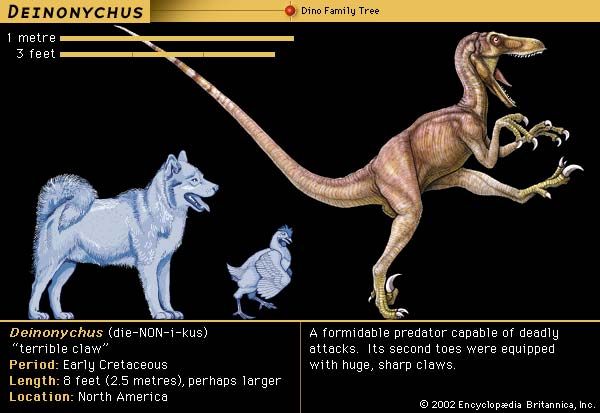
Deinonychus was a bipedal, carnivorous theropod that lived during the Early Cretaceous Period. As a member of the dromaeosaur family, it possessed several distinct physical characteristics that facilitated its role as an agile predator:16
- Killing Talons: Its most notable feature was a large, sickle-shaped claw on the second toe of each foot, measuring up to 13 cm (5 inches) in length. This talon was held off the ground while walking and served as its primary weapon.16
- Tail Structure: It featured a long, slender tail stiffened by bundles of bony rods. This structure acted as a counterbalance, allowing the dinosaur to maintain stability during high-speed movement or while attacking prey.16
- Wrist and Hands: Like other dromaeosaurs, Deinonychus had a unique wrist joint that allowed its hands to flex sideways. This adaptation, combined with long arms and three-clawed hands, enabled it to grasp prey effectively.136
- Size and Intelligence: It measured approximately 2.5 to 3 meters (8 to 10 feet) in length and weighed between 45 and 70 kg (100 to 155 pounds). Its relatively large brain supported the complex coordination required for its predatory behavior.16
How is Deinonychus related to modern birds?
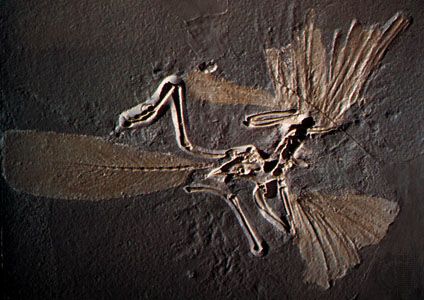
Deinonychus is considered one of the closest known relatives of modern birds, as it belongs to the group of theropod dinosaurs from which birds evolved. This evolutionary link was famously championed by paleontologist John Ostrom, who identified structural parallels between Deinonychus and the early bird-like fossil Archaeopteryx.167
Key shared characteristics that demonstrate this relationship include:
- Wrist Anatomy: Both Deinonychus and birds possess a unique wrist joint that allows the hand to flex sideways. In dromaeosaurs, this adaptation likely aided in grasping prey, whereas in birds, the same motion is essential for the flight stroke.681
- Skeletal Features: They share anatomical traits such as long arms and hands, a similar pelvis, and hollow, thin-walled bones.63
- Complex Coordination: The relatively large brain of Deinonychus supported the complex, coordinated movements required for its predatory lifestyle, a trait that aligns with the advanced neurological capabilities seen in birds.18
How has Deinonychus been portrayed in popular culture, such as movies or books?
Deinonychus is most famously recognized as the biological model for the “raptor” dinosaurs featured in the 1993 motion picture Jurassic Park.1
While the film popularized the term “raptor” for these creatures, the name is a contraction of Velociraptor, a different genus of dromaeosaur that was significantly smaller than Deinonychus. In reality, Deinonychus was a larger, agile predator measuring approximately 2.5 meters (8 feet) in length, which better matched the size of the dinosaurs depicted on screen. It is also important to note that the term “raptor”—derived from the Greek word for “seize” or “grab”—is more accurately applied to birds such as hawks and eagles, which utilize their talons to capture prey.1
Sources
- Deinonychus — Encyclopædia Britannica
- Velociraptor — Encyclopædia Britannica
- dromaeosaur — Encyclopædia Britannica
- deinonychus — Merriam-Webster
- dinosaur - Tetanurae — Encyclopædia Britannica
- dinosaur - Dinosaur descendants — Encyclopædia Britannica
- John Ostrom — Encyclopædia Britannica
- Velociraptor: Top Questions — Encyclopædia Britannica
- Archaeopteryx — Encyclopædia Britannica
Published on · 3 min read