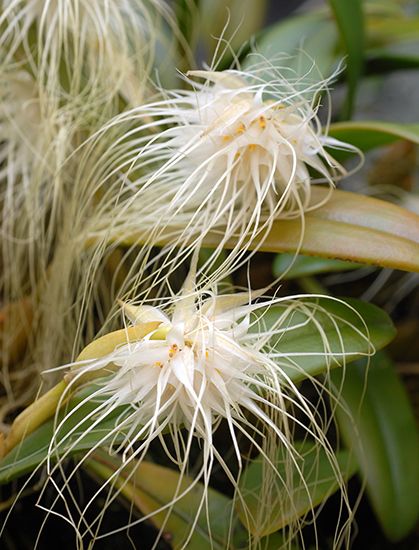
Dendrobium
Dendrobium is a large genus comprising up to 1,500 species of epiphytic orchids within the family Orchidaceae. These plants are native to tropical and…
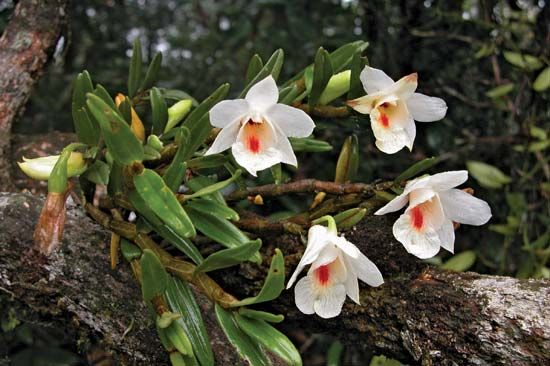
What is Dendrobium?
Dendrobium is a large genus comprising up to 1,500 species of epiphytic orchids within the family Orchidaceae. These plants are native to tropical and subtropical regions of Asia, Australia, and various Pacific islands.1
Many species are highly valued in the floral industry and as ornamental plants. They exhibit significant diversity in appearance, ranging from small, pale blooms to large, showy flowers that may grow singly or on arching spikes. A defining structural characteristic is the base of the lateral sepals, which are joined to form a small sac. Additionally, these orchids possess pseudobulbs—swollen stems that can be reedlike or bulblike—which vary in height from 5 cm to 4.5 metres. Notable examples include the pigeon orchid, the bull orchid, and the cucumber orchid.1
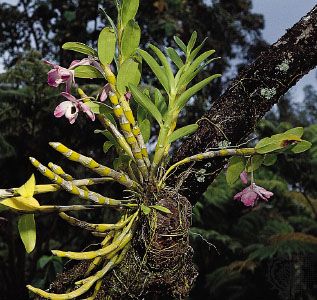
What is an epiphyte and how does it survive?
An epiphyte is any plant that grows upon another plant or object solely for physical support. It is important to clarify that epiphytes are not parasitic; they do not derive water or nutrients from their host, but rather use the host as a structure to reach better environmental conditions.23
How Epiphytes Survive
Most epiphytes thrive in moist tropical regions, where their elevated position in the tree canopy allows them to access sunlight that would otherwise be blocked by dense forest cover. Their survival strategies include:
- Water Acquisition: Epiphytes obtain moisture from rain and water vapor in the air. While many absorb water through their roots, numerous species possess specialized leaves capable of taking in moisture directly.2
- Nutrient Absorption: Lacking a connection to the ground, these plants typically absorb minerals and nutrients from organic debris—such as decaying leaves—that collects on the supporting plant.2
- Dispersal: Because their habitat requirements are narrow, many epiphytes rely on the wind to spread their dustlike or feathery seeds. Others produce edible fruits that are dispersed by birds and tree-dwelling animals.2
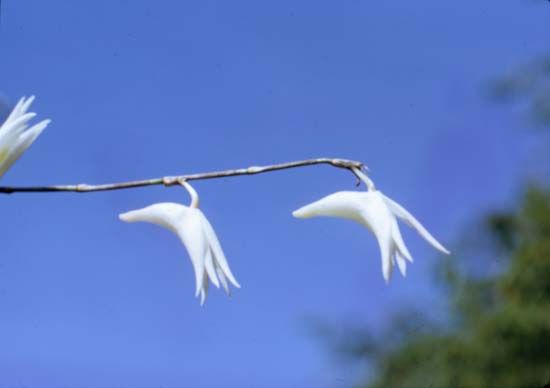
How do pseudobulbs help orchids store water?
Pseudobulbs are specialized, thickened stem structures found in many epiphytic orchids, such as those in the genus Bulbophyllum.456
While the provided search results identify pseudobulbs as solid, bulbous enlargements of the stem that serve as storage organs, they do not explicitly detail the physiological mechanism of how these structures store water. However, it is understood that these thickened stems function as reservoirs, allowing epiphytic orchids to survive in environments where water availability is intermittent or inconsistent by storing moisture and nutrients to sustain the plant during dry periods. These structures vary significantly in form, ranging from single-internode types to those consisting of multiple internodes, and are a key adaptation for plants that do not have direct access to ground-level water sources.45
What are the main differences between orchids and other flowers?
Orchids are distinguished from other flowering plants primarily by a unique combination of structural characteristics within their flowers and reproductive systems. While individual traits—such as specialized pollen masses or specific seed structures—can be found in other plant groups, the Orchidaceae family is defined by the specific way these features are organized.7
Key Morphological Differences
- The Column: In most flowers, the male and female reproductive parts are separate. In orchids, the filaments, anthers, style, and stigma are fused into a single, central structure called the column.8
- Floral Symmetry: Orchid flowers are typically bilaterally symmetrical. This is largely due to the development of one petal into a specialized landing platform for pollinators, known as the lip or labellum, which sits opposite the fertile stamen.8
- Pollen Organization: Rather than loose pollen grains, orchids produce masses of pollen called pollinia. These are often bound by a sticky substance and may be attached to a specialized structure called a viscidium, which facilitates transfer by pollinators.8
- Seed Development: Unlike most angiosperms, which undergo double fertilization to produce an endosperm to nourish the developing embryo, orchid seeds lack endosperm entirely. Consequently, they are extremely small and dustlike, requiring a symbiotic relationship with mycorrhizal fungi to germinate and obtain nutrients in nature.910
Sources
- Dendrobium — Encyclopædia Britannica
- epiphyte — Encyclopædia Britannica
- parasitic plant — Encyclopædia Britannica
- pseudobulb — Merriam-Webster
- orchid - Growth forms — Encyclopædia Britannica
- Bulbophyllum — Encyclopædia Britannica
- orchid - Structural diversity — Encyclopædia Britannica
- orchid - Floral structure — Encyclopædia Britannica
- orchid - Seeds — Encyclopædia Britannica
- orchid - Natural history — Encyclopædia Britannica
Published on · 3 min read