Dendrocolaptidae
Dendrocolaptidae is a family of songbirds within the order Passeriformes, native to regions ranging from Mexico through South America. While some authorities…
What is Dendrocolaptidae?
Dendrocolaptidae is a family of songbirds within the order Passeriformes, native to regions ranging from Mexico through South America. While some authorities classify these birds as the subfamily Dendrocolaptinae within the family Furnariidae, others recognize them as a distinct family.12
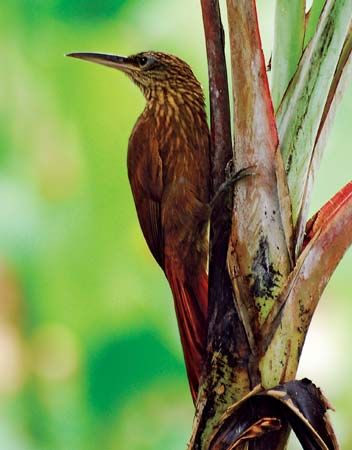
Commonly known as woodcreepers, these birds are typically brownish in color and are adapted for a climbing lifestyle in forests and brushlands. They possess stiff, broad tail feathers that act as a prop, allowing them to navigate tree trunks while probing bark and leaves for insects. Their physical characteristics often include stout, compressed bills—though some species feature downcurved or wedge-shaped bills—and plumage marked with pale streaks or bars.213
Representative members of this group include the scythebill and various woodcreeper species, such as the barred woodcreeper and the ivory-billed woodcreeper. These birds are generally solitary and are often identified by their distinct vocalizations.21
How do woodcreepers use their tails to climb trees?
Woodcreepers are specialized for an arboreal lifestyle, utilizing their physical anatomy to navigate vertical surfaces efficiently. Their tail feathers are broad and stiff, which allows the birds to use them as a prop against tree trunks. By bracing these rigid feathers against the bark, woodcreepers create a stable base of support that helps them maintain their position while they probe bark and leaves in search of insects. This structural adaptation is a common feature among various climbing birds, providing the necessary leverage to move upward in short, vertical hops.14
What are ovenbirds and how are they related to woodcreepers?
The term “ovenbird” is used in two distinct ways, which can lead to confusion. In North America, the ovenbird (Seiurus aurocapillus) is a species of wood warbler (family Parulidae) known for its ground-dwelling habits and domed, oven-shaped nest.67
However, the name is also applied broadly to the tropical American family Furnariidae, particularly the genus Furnarius (or horneros), which builds mud-and-grass nests resembling ovens.167
The relationship between these groups is taxonomic: woodcreepers are members of the family Furnariidae. While some authorities classify woodcreepers as a separate family, Dendrocolaptidae, they are widely recognized as the subfamily Dendrocolaptinae within the Furnariidae. Consequently, woodcreepers and the ovenbirds of the genus Furnarius are closely related members of the same diverse avian family, sharing common skeletal and muscular features despite their different nesting and foraging behaviors.81
Why do some woodcreepers follow marching ant columns?
Some woodcreepers follow marching columns of army ants to take advantage of the disturbance the ants create in the forest. As these nomadic ants swarm across the forest floor, they flush out a variety of small animals, including insects, spiders, millipedes, isopods, frogs, and lizards.
Woodcreepers, such as the plain-brown woodcreeper, join other birds in these “ant-following” groups to seize these fleeing creatures. While the birds do not typically eat the ants themselves, they rely on the ants’ foraging activity to expose prey that would otherwise be hidden or difficult to catch. This behavior is a opportunistic feeding strategy, allowing the birds to efficiently gather food that has been routed out by the ants’ passage.91
Sources
- woodcreeper — Encyclopædia Britannica
- Dendrocolaptidae — Encyclopædia Britannica
- Dendrocolaptidae — Merriam-Webster
- piciform - Form and function — Encyclopædia Britannica
- Locomotion - Climbing birds and mammals — Encyclopædia Britannica
- Furnariidae — Encyclopædia Britannica
- Ovenbird — Encyclopædia Britannica
- Passeriform - Nesting — Encyclopædia Britannica
- Passeriform - Ant-following — Encyclopædia Britannica
Published on · 2 min read