Diadectes
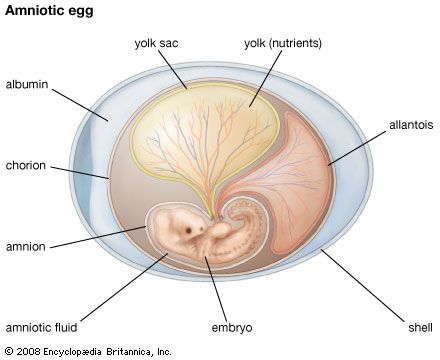
Diadectes was a tetrapod that shared features with both primitive tetrapods and amniotes, though it lacked the defining amniotic membrane of reptiles.…
How did the skeletal structure of Diadectes differ from its reptile-like ancestors?
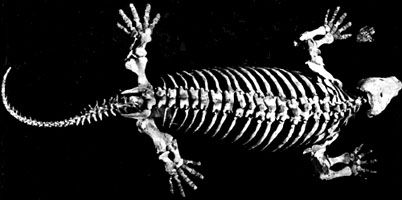
Diadectes was a tetrapod that shared features with both primitive tetrapods and amniotes, though it lacked the defining amniotic membrane of reptiles. Compared to more generalized, reptile-like ancestors, the skeletal structure of Diadectes was characterized by its heavy construction.1
Key skeletal differences included:
- Robust Build: The skeleton was heavily reinforced, featuring massive limbs, limb girdles, a thick backbone, and heavy ribs.1
- Skull Morphology: The skull was relatively high and short, broad at the back, and featured a constricted snout.1
- Dentition: Unlike the sharp, prey-holding teeth found in many primitive tetrapods, Diadectes possessed blunt, peglike teeth. Its front teeth were elongated for nipping plant material, while its cheek teeth were adapted for grinding, marking it as one of the earliest terrestrial herbivores.12
What is the taxonomic classification of Diadectes and when did it live?
Diadectes is an extinct genus of tetrapods that lived during the Carboniferous and Lower Permian periods, approximately 360 million to 270 million years ago.1
Regarding its taxonomic classification, Diadectes is closely related to the first amniotes, though it is not classified as an amniote itself because it lacked the protective amniotic membrane characteristic of that group. Its precise placement within the evolutionary tree has been a subject of long-standing controversy among paleontologists, as it exhibits a mixture of features found in both primitive tetrapods and amniotes.1
Where were the first Diadectes fossils discovered, and by whom?
The first Diadectes fossils were discovered in North America within Carboniferous and Lower Permian rock formations. These specimens were described by the American paleontologist Edward Drinker Cope, who was renowned for his extensive work identifying thousands of extinct vertebrate species across the western United States.15
Are there any modern animals that share similar features or ecological roles with Diadectes?
Diadectes was one of the earliest terrestrial herbivores, utilizing its blunt, peglike teeth to grind plant material and its longer front teeth to nip vegetation. While no modern animal is a direct descendant or a perfect ecological equivalent, its role as a specialized herbivore in a terrestrial environment is broadly comparable to that of modern artiodactyls, such as deer or cattle, which have also evolved to process fibrous plant matter through specialized dentition and digestive strategies.16
However, it is important to note that Diadectes was a primitive tetrapod that lacked the complex digestive systems, such as rumination, found in many modern mammalian herbivores. Furthermore, because Diadectes lived over 270 million years ago, its physiological and reproductive biology—specifically its lack of an amniotic membrane—differed fundamentally from all modern terrestrial vertebrates. The provided search results do not identify any specific modern species that shares a direct evolutionary or functional niche with Diadectes.16
Sources
- Diadectes — Encyclopædia Britannica
- Caudata - Bones and cartilage — Encyclopædia Britannica
- dinosaur - Ornithopoda — Encyclopædia Britannica
- Amniota — Encyclopædia Britannica
- Edward Drinker Cope — Encyclopædia Britannica
- Diarthrognathus — Encyclopædia Britannica
- artiodactyl - Food habits — Encyclopædia Britannica
Published on · 2 min read