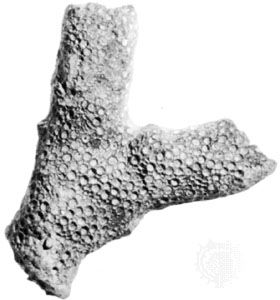
Hesperorthis
Hesperorthis is an extinct genus of brachiopods, commonly referred to as lamp shells. These organisms are particularly significant as fossils found in…
What is Hesperorthis?
Hesperorthis is an extinct genus of brachiopods, commonly referred to as lamp shells. These organisms are particularly significant as fossils found in Ordovician marine rocks, which date back approximately 438 to 505 million years.1
The shell of Hesperorthis is characterized by its plano-convex structure, meaning it is composed of two valves: a flat brachial valve and a convex pedicle valve. Additionally, the shell features a distinct radiating pattern of ribs and a broad, triangular area located at the dorsal shell margin.1
It is important to distinguish this genus from Hesperornis, which refers to a genus of extinct, toothed, swimming birds from the Cretaceous period, rather than a marine invertebrate.2
What are brachiopods and how do they differ from clams?
Brachiopods, commonly known as lamp shells, are a phylum of bottom-dwelling marine invertebrates that have existed since the Cambrian Period. While they superficially resemble mollusks like clams, they are not related to them.45
The primary differences between brachiopods and clams include:
- Symmetry: Brachiopods are bilaterally symmetrical across their valves, meaning the left and right sides of an individual valve are mirror images. In contrast, clams are typically symmetrical between their two valves (the left and right shells are mirror images of each other).46
- Valve Structure: Brachiopod shells are unequal in size, with one valve covering the dorsal (top) side and the other covering the ventral (bottom) side. Clam shells are typically equal in size and cover the left and right sides of the animal.46
- Anatomy: Brachiopods possess a unique feeding organ called a lophophore, which is housed within the mantle cavity. They are often attached to the seafloor by a fleshy stalk called a pedicle.678
- Biological Classification: Brachiopods are a distinct phylum (Brachiopoda), whereas clams belong to the phylum Mollusca.
What characterizes the Ordovician period in Earth’s history?
The Ordovician Period (485.4 to 443.8 million years ago) was the second period of the Paleozoic Era, characterized by profound changes in Earth’s geology, climate, and life.11
Geological and Climatic Conditions
Rapid seafloor spreading at oceanic ridges led to some of the highest global sea levels in the Phanerozoic Eon, flooding continents to unprecedented levels. Atmospheric carbon dioxide levels were significantly higher than today, fostering warm climates globally. However, the period ended with a brief, intense interval of glaciation over the Southern Hemisphere, likely triggered by the movement of Gondwana over the South Pole and a drawdown of atmospheric carbon dioxide.121113
Biological Evolution and Extinction
The period is famous for the “Ordovician radiation,” an intense diversification of marine life that saw the evolution of almost every modern phylum of marine invertebrate. Seas were dominated by:1211
- Brachiopods and bryozoans
- Trilobites and mollusks
- Echinoderms and graptolites
The period concluded with the second-largest mass extinction in Earth’s history, claiming roughly 85 percent of species, largely driven by rapid cooling and falling sea levels.121411
How do paleontologists use fossils to date rock layers?
Paleontologists and geologists use fossils to date rock layers primarily through the law of faunal succession, which observes that groups of fossilized plants and animals appear in the rock record in a predictable, orderly sequence over time.1718
Key Methods for Fossil Dating
- Index Fossils: These are the most effective tools for dating. To be useful, an index fossil must be easily recognizable, abundant, geographically widespread, and have existed for only a short span of geologic time. Their presence in a rock layer allows geologists to correlate that layer with others of the same age across different regions.1918
- Correlation: By identifying similar fossil assemblages in separated rock outcrops, scientists can establish that the layers were formed contemporaneously. This process is fundamental to stratigraphy and helps build the geologic time scale.2018
- Calibration with Absolute Dating: While fossils provide relative ages, they are often calibrated using radiometric dating. By measuring the decay of radioactive isotopes in associated volcanic materials, scientists can assign precise numerical ages to the fossil-bearing strata.2021
Sources
- Hesperorthis — Encyclopædia Britannica
- Hesperornis — Merriam-Webster
- homopteran - Critical appraisal — Encyclopædia Britannica
- lamp shells — Encyclopædia Britannica
- Brachiopoda — Merriam-Webster
- branchiopod - Evolution and paleontology — Encyclopædia Britannica
- Silurian Period - Brachiopods — Encyclopædia Britannica
- lamp shells - Form and function — Encyclopædia Britannica
- Circulatory system - Brachiopoda — Encyclopædia Britannica
- clam shrimp — Encyclopædia Britannica
- A Journey Through Time Since the Precambrian - Ordovician Period: 485.4 million to 443.4 million years ago — Encyclopædia Britannica
- Ordovician Period - Invertebrates — Encyclopædia Britannica
- Ordovician Period - Causes — Encyclopædia Britannica
- Ordovician Period - Mass extinction at the end of the Ordovician — Encyclopædia Britannica
- Ordovician Period — Encyclopædia Britannica
- Ordovician Period - Paleoclimate — Encyclopædia Britannica
- index fossil — Encyclopædia Britannica
- law of faunal succession — Encyclopædia Britannica
- geologic time — Encyclopædia Britannica
- dating - Principles and techniques — Encyclopædia Britannica
- dating - Distinctions between relative-age and absolute-age measurements — Encyclopædia Britannica
Published on · 3 min read