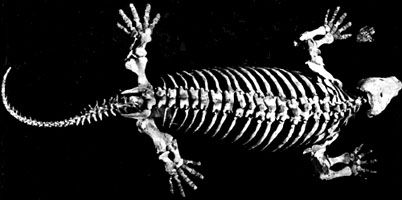
Seymouria
Seymouria was an extinct genus of terrestrial tetrapod that possessed a unique blend of characteristics, making it a significant subject in the study of…
What are some of the unique skull features of Seymouria, and how do they compare to modern amphibians and reptiles?
Seymouria was an extinct genus of terrestrial tetrapod that possessed a unique blend of characteristics, making it a significant subject in the study of vertebrate evolution. Its skull was notably deep, resembling those found in both early amphibians and early amniotes (the group containing reptiles, mammals, and their relatives).1
Key features of the Seymouria skull include:
- Pineal Eye: The roof of the skull featured an opening for a pineal eye, a light-receptive organ common in many primitive vertebrates.1
- Labyrinthodont Teeth: The teeth, located along the jaw margins and on the palate, exhibited a complex, folded internal structure known as a labyrinthodont configuration. This trait is characteristic of early tetrapods.1
- Reptilian-like Stance: While the skull shared features with amphibians, the overall skeletal structure—including the vertebrae and limb girdles—allowed for a terrestrial stance that was more reptilian than amphibian, enabling the animal to raise its body well off the ground.1
Although Seymouria is often associated with the ancestral line of true reptiles, it is classified as a member of the order Seymouriamorpha, which represents a transitional mix of traits rather than a member of the amniote group itself.12
What type of environment did Seymouria likely inhabit, and how was it adapted to this environment?
Seymouria was a terrestrial tetrapod that lived during the Permian Period, approximately 251 million to 299 million years ago. Fossil evidence indicates that it inhabited environments in what is now North America, specifically near present-day Seymour, Texas.1
Its physical structure reveals a strong adaptation to life on land:
- Terrestrial Stance: Unlike many of its amphibian contemporaries, Seymouria possessed a skeletal structure—specifically in its vertebrae and limb girdles—that allowed it to raise its body well off the ground. This stance was more reptilian than amphibian, facilitating efficient movement in a terrestrial environment.1
- Skull and Sensory Adaptations: The animal featured a deep skull equipped with a pineal eye, a light-receptive organ that likely assisted in environmental awareness. Its teeth, which featured a complex labyrinthodont configuration, were well-suited for its role as a predator or generalist in its ecosystem.1
While some of its relatives, the seymouriamorphs, remained primarily aquatic, Seymouria was clearly specialized for a life spent out of the water.1
How does Seymouria contribute to our understanding of vertebrate evolution?
Seymouria serves as a critical link in our understanding of vertebrate evolution because it exhibits a mosaic of characteristics that bridge the gap between early amphibians and amniotes—the group that includes reptiles, mammals, and their relatives.1
Its significance lies in the following areas:
- Transitional Morphology: As a member of the order Seymouriamorpha, Seymouria displays a mixture of amphibian and reptilian traits. While it is not classified as a true amniote, its skeletal structure suggests it may reside on the ancestral line leading toward them.21
- Terrestrial Adaptation: The genus demonstrates how early tetrapods evolved to move away from water. Its vertebrae and limb girdles allowed for a stance that could raise the body well off the ground, a feature more characteristic of reptiles than the sprawling gait of earlier amphibians.1
- Evolutionary Context: By comparing Seymouria with related forms like Diadectes, scientists can better map the complex transition of vertebrates from aquatic environments to diverse terrestrial niches, including early herbivory.13
How does Seymouria bridge the gap between amphibians and reptiles?
Seymouria is often cited as a bridge between early amphibians and amniotes because it possesses a mosaic of skeletal features that reflect a transition toward a fully terrestrial lifestyle. While it is not classified as a true amniote, it occupies a significant position on or near the ancestral line leading to them.123
The genus bridges this evolutionary gap through several key characteristics:
- Skeletal Morphology: Seymouria exhibits a deep skull similar to that of early amniotes, yet it retains primitive traits found in earlier tetrapods. Its vertebrae and limb girdles are structured to support a more reptilian, upright stance, allowing the body to be raised well off the ground—a distinct departure from the sprawling gait typical of many amphibians.1
- Mixed Traits: As a member of the order Seymouriamorpha, it displays a blend of amphibian and reptilian characters, illustrating the gradual shift in physiological adaptations required for life on land.2
Despite these similarities, Seymouria lacks the amnion, the protective membrane that defines true reptiles, highlighting the complexity of early vertebrate evolution.3
Sources
- Seymouria — Encyclopædia Britannica
- Seymouriamorpha — Merriam-Webster
- Diadectes — Encyclopædia Britannica
Published on · 3 min read