Diatryma
Diatryma was a giant flightless bird that lived during the Eocene Epoch, approximately 57.8 to 36.6 million years ago. Fossils of this genus have been…
What was Diatryma’s habitat and diet?
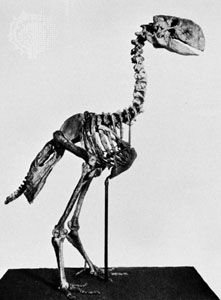
Diatryma was a giant flightless bird that lived during the Eocene Epoch, approximately 57.8 to 36.6 million years ago. Fossils of this genus have been discovered in North America—specifically in regions such as Wyoming and New Mexico—as well as in Europe.12
Regarding its diet and behavior, Diatryma was an active predator. It possessed a large head and a powerful beak, which it likely used to feed on small mammals. Physically, the bird stood about 2 1/4 meters (7 feet) tall and featured massively constructed legs, suggesting it was a strong and rapid runner capable of navigating its environment effectively.12
How has our understanding of Diatryma changed with new fossil discoveries?
Our understanding of Diatryma has been refined primarily through its classification alongside related extinct forms, such as the genus Gastornis3. While early descriptions focused on Diatryma as a distinct, giant flightless predator of the Eocene Epoch, modern paleontological study has clarified its place within the order Diatrymiformes.132
Current research suggests that Diatryma and its relatives are likely most closely related to the surviving cariamas and bustards, rather than being isolated evolutionary anomalies. These insights help place the bird within a broader context of avian evolution, distinguishing its lineage from other flightless groups that evolved through convergent evolution, such as the South American Phorusrhacos. By integrating these fossil findings, scientists have moved toward a more nuanced view of how these large, flightless birds fit into the ancient ecosystems of North America and Europe.134
We could dive deeper into how convergent evolution explains the similarities between Diatryma and other flightless birds, or perhaps explore the broader evolution of birds from theropod dinosaurs.
What is Diatryma and when did it live?
Diatryma was a genus of giant flightless birds that lived during the Eocene Epoch, which spanned from approximately 57.8 to 36.6 million years ago.1
Fossils of these birds have been discovered in North America—specifically in Wyoming and New Mexico—as well as in Europe. Standing about 2 1/4 meters (7 feet) tall, Diatryma possessed small, non-functional wings, massively constructed legs for running, and a large head with a powerful beak, indicating it was an active predator that likely fed on small mammals. Taxonomically, Diatryma belongs to the order Diatrymiformes and is considered closely related to the genus Gastornis, with modern research suggesting these birds are most nearly related to the surviving cariamas and bustards.132
How large was Diatryma compared to modern birds?
Diatryma was significantly larger than the vast majority of modern birds, standing approximately 2.25 meters (7 feet) tall. For comparison, the largest living bird, the ostrich, can reach heights of up to 2.7 meters (9 feet), though Diatryma was notably more robust and predatory in its build compared to modern ratites.16
While many modern birds are adapted for flight and possess relatively light skeletal structures, Diatryma was a specialized, flightless predator with massively constructed legs and a large, powerful beak designed for hunting small mammals. Its size was comparable to other extinct giant flightless birds, such as the moas of New Zealand and the elephant birds of Madagascar, which could reach heights of up to 3 meters (10 feet). Unlike modern birds that evolved to fill diverse ecological niches, Diatryma occupied a specific role as a major predator in the Northern Hemisphere during the Eocene Epoch, a niche that is largely filled by carnivorous mammals today.16
Sources
- Diatryma — Encyclopædia Britannica
- Diatryma — Merriam-Webster
- Gastornis — Merriam-Webster
- Bird - Fossil birds — Encyclopædia Britannica
- dinosaur - Dinosaur descendants — Encyclopædia Britannica
- Bird - Modern birds — Encyclopædia Britannica
Published on · 3 min read