Dilong
Dilong (Dilong paradoxus) was a small, primitive theropod dinosaur that lived during the Early Cretaceous. It reached a total length of approximately 1.6…
How large was Dilong, and what was its estimated weight?
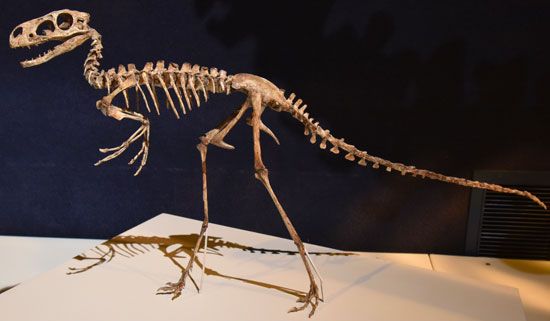
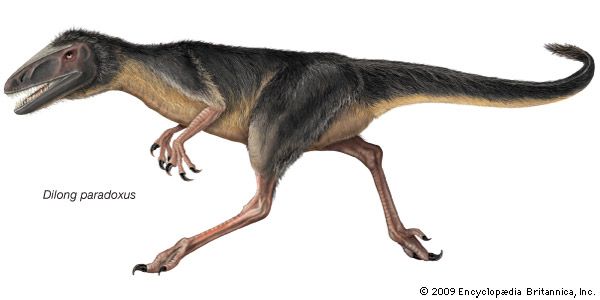
Dilong (Dilong paradoxus) was a small, primitive theropod dinosaur that lived during the Early Cretaceous. It reached a total length of approximately 1.6 metres (about 5 feet) and had an estimated mass of 5 kg (about 11 pounds).1
As one of the earliest known tyrannosaurs, Dilong is notable for being the first of its group discovered with feathers. Unlike the massive, later members of its lineage, Dilong possessed proportionally larger forelimbs and three-fingered hands, and its anatomy in many respects resembled that of juvenile specimens of larger tyrannosaurs.1
What does the name ‘Dilong’ mean, and why was it given this name?
The name Dilong is derived from a combination of two Mandarin Chinese words: di, which means “emperor,” and long, which means “dragon.”1
This name was chosen to reflect the dinosaur’s classification as a primitive member of the tyrannosaur group, which includes the famous Tyrannosaurus—often colloquially referred to as the “tyrant lizard king.” By using the term “emperor dragon,” paleontologists highlighted its evolutionary relationship to these later, more massive predators.1
How does Dilong contribute to our understanding of the tyrannosauroid family tree?
Dilong plays a pivotal role in our understanding of the tyrannosaur family tree by providing a clear look at the group’s early, primitive state. As one of the earliest known tyrannosauroids, its discovery demonstrates that these dinosaurs were anatomically distinct long before they evolved into the massive predators of the late Cretaceous.1
Key contributions include:
- Evidence of Feathers: Dilong was the first tyrannosauroid discovered with feathers. This suggests that early members of the lineage were covered in simple, hair-like protofeathers, raising the possibility that even giants like Tyrannosaurus may have possessed similar integument.1
- Evolutionary Anatomy: Unlike later, more robust tyrannosaurs, Dilong retained primitive features such as three-fingered hands and proportionally larger forelimbs. Its anatomy largely resembles that of juvenile specimens of later species, suggesting that the “tyrant” body plan underwent significant changes as the group grew in size.12
- Skull Development: Despite its primitive nature, Dilong shared advanced skull features with later relatives, such as fused nasal bones and D-shaped anterior teeth, which provided a specialized “cookie-cutter” bite.1
How do paleontologists determine the age and relationships of dinosaur fossils like Dilong?
Paleontologists determine the age and evolutionary relationships of dinosaur fossils like Dilong through a combination of geological dating and comparative analysis.
Determining Age
To establish the age of a fossil, scientists rely on geochronology. This process often involves:1
- Radiometric Dating: By measuring the decay of radioactive isotopes (such as uranium, potassium, or rubidium) within the surrounding rock, researchers can calculate the age of the specimen with high precision.13
- Stratigraphy: Paleontologists study the specific rock strata (layers) where a fossil is found to provide context for its temporal placement. For example, Dilong is dated to 128–127 million years ago based on its presence in the Yixian Formation of China.12
Determining Relationships
To understand how dinosaurs are related, the field has shifted from traditional classification to cladistics. This method involves:4
- Phylogenetic Analysis: Instead of a rigid hierarchy, researchers build “phylogenetic trees” that explicitly map evolutionary relationships. By comparing anatomical features—such as skull structure, tooth shape, and limb proportions—paleontologists can identify shared traits that indicate common ancestry.42
- Comparative Anatomy: Researchers analyze physical characteristics to distinguish between primitive and advanced features. For instance, Dilong is identified as a primitive tyrannosauroid because it retains three-fingered hands, unlike the more derived, two-fingered Tyrannosaurus.25
Sources
- Dilong — Encyclopædia Britannica
- tyrannosaur - Classification — Encyclopædia Britannica
- dinosaur - Modern studies — Encyclopædia Britannica
- dating: Top Questions — Encyclopædia Britannica
- Did you know? — Merriam-Webster
Published on · 3 min read