Old Red Sandstone
The Old Red Sandstone is a thick sequence of nonmarine Devonian rocks characterized by continental deposits rather than marine ones. Because these sediments…
What types of fossils are commonly found in Old Red Sandstone deposits?
The Old Red Sandstone is a thick sequence of nonmarine Devonian rocks characterized by continental deposits rather than marine ones. Because these sediments accumulated in freshwater or estuarine environments, the fossil record within them is distinct from marine facies.123
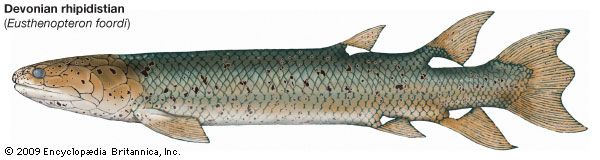
The most common fossils found in these deposits are primitive, heavily armoured fishes. These include:32
- Agnathans: Jawless fishes, such as ostracoderms, which were often covered in plates or scales.3
- Placoderms: Armoured, jawed fishes that characterized the Early Devonian, including arthrodires and antiarchs.3
- Bony fishes: Groups such as lungfishes, coelacanths, and rhipidistians.3
Additionally, these deposits contain evidence of early terrestrial life, including the first tetrapod vertebrates, which are believed to have inhabited freshwater streams and rivers, as well as widespread plant debris.24
What economic importance does Old Red Sandstone have in terms of natural resources?
Where are the main deposits of Old Red Sandstone found?
The Old Red Sandstone is a thick sequence of continental Devonian rocks primarily found across several regions in the Northern Hemisphere. Its main deposits are located in:
- Northwestern Europe: These deposits are extensively studied in Great Britain, particularly in Wales, southern Ireland, and the Scottish Lowlands.35
- Scandinavia: Significant occurrences are found throughout Norway.35
- The Arctic and North Atlantic: Deposits extend to Greenland, Spitsbergen, and Bear Island.35
- North America: The formation is present in northeastern Canada.3
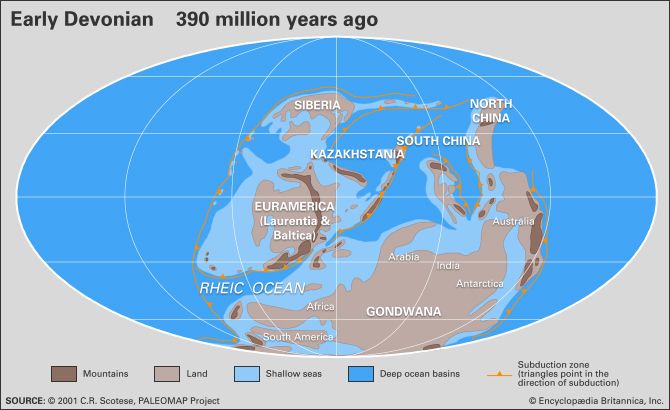
These rocks were deposited in structural basins created during the formation of the Caledonian Mountains, a process that occurred when northwestern Europe collided with a landmass comprising parts of modern-day North America and Greenland. In some areas, such as the Scottish Lowlands and parts of Wales, these sedimentary layers reached thicknesses of up to 6,100 to 11,000 metres.35
What are the characteristic features of Old Red Sandstone in terms of color and composition?
The Old Red Sandstone is a thick, continental sequence of Devonian rocks characterized by its distinct coloration and variable composition.3
Coloration
The characteristic red hue of these rocks is primarily caused by the presence of oxidized iron minerals. When deposited in well-drained, oxidizing environments—such as ancient river systems—the iron within the sediments oxidizes, resulting in the signature reddish appearance. While the sandstones are predominantly red, they can also appear green or gray, and the associated shales are typically gray.32
Composition and Features
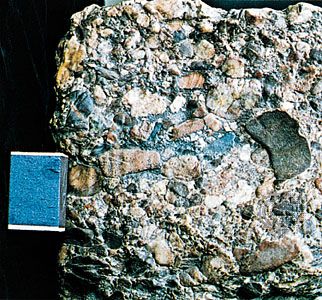
The Old Red Sandstone is a sequence of poorly sorted, nonmarine sedimentary rocks that accumulated in structural basins. Its composition is highly variable and includes:37
- Sedimentary Rock Types: The sequence consists of cross-bedded sandstones, siltstone, and shalebritannica.com/science/siltstone), and shale.3
- Physical Structures: The deposits often feature mud cracks and raindrop impressions, indicating their formation in terrestrial or shallow-water environments.3
- Fossil Content: These rocks contain fossils of primitive, often armored fishes, as well as evidence of some of the earliest terrestrial tetrapod vertebrates, which are believed to have inhabited freshwater rivers and streams.3
Sources
- Devonian Period - Vertebrates — Encyclopædia Britannica
- Old Red Sandstone — Merriam-Webster
- Old Red Sandstone — Encyclopædia Britannica
- Devonian Period - Devonian life — Encyclopædia Britannica
- Silurian Period - Clastic wedges — Encyclopædia Britannica
- Devonian Period - Europe — Encyclopædia Britannica
- Iron oxide - Composition and main forms — Encyclopædia Britannica
- sedimentary rock - Lithic arenites — Encyclopædia Britannica
Published on · 2 min read