Diplovertebron
Diplovertebron is a genus of extinct amphibians that lived during the Late Carboniferous period, approximately 318 million to 299 million years ago, with…
What is Diplovertebron?
Diplovertebron is a genus of extinct amphibians that lived during the Late Carboniferous period, approximately 318 million to 299 million years ago, with fossils discovered in North America and Europe.1
It is classified as an early member of the anthracosaurs, a group of tetrapods that exhibited certain reptile characteristics. However, because they were unable to produce amniotic eggs—a key feature of true reptiles—they are categorized as reptilelike amphibians. Morphologically, Diplovertebron and its primitive relatives are distinguished by their five-toed feet and a uniquely structured vertebral column and skull.1
What are anthracosaurs?
Anthracosaurs are a group of extinct tetrapods that lived from the Late Mississippian through the Permian Period. They are characterized as reptilelike amphibians because they possessed certain traits associated with reptiles but lacked the ability to produce amniotic eggs, which is a defining feature of true reptiles.12
Key characteristics and classifications include:
- Morphology: Primitive anthracosaurs, such as the genus Diplovertebron, are distinguished by a uniquely constructed vertebral column, a specific skull pattern, and five-toed feet.2
- Diversity: The group included several lineages, such as embolomers, baphetids, and limnoscelids. Some paleontologists also suggest that nectrideans and aistopods may be grouped with the anthracosaurs.1
- Evolutionary Significance: Anthracosaurs are often considered to be in the direct ancestral line of the reptiles. They emerged in the fossil record alongside other amphibians during the Late Mississippian Epoch and persisted into the early Permian Period, eventually declining as the climate became increasingly arid, which favored the rise of amniotes.31
How do reptilelike amphibians differ from true reptiles?
Reptilelike amphibians, such as anthracosaurs, differ from true reptiles primarily in their reproductive biology and developmental adaptations.
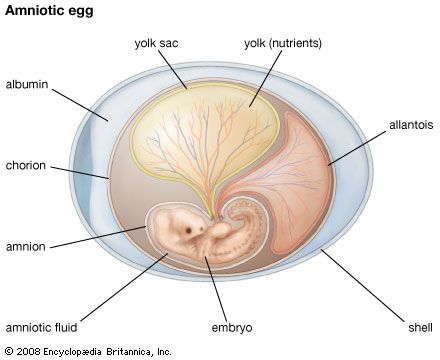
The fundamental distinction lies in the amniotic egg. True reptiles are amniotes, meaning their embryos develop within a set of protective extra-embryonic membranes—the amnion, chorion, and allantois. These membranes, often enclosed within a leathery or hard shell, allow the embryo to develop in terrestrial environments without drying out.71
In contrast, reptilelike amphibians are classified as anamniotes because they lack these specialized membranes. Like modern amphibians, they were generally restricted to moist habitats for reproduction, typically laying gelatinous eggs that require water to prevent desiccation and support the development of free-swimming larvae. While reptilelike amphibians possessed certain skeletal traits—such as specific skull patterns or limb structures—that resembled those of reptiles, they remained tethered to aquatic or semi-aquatic reproductive cycles.7689
What is the significance of the amniotic egg in evolution?
The evolution of the amniotic egg was a pivotal development in the history of life, as it provided the decisive solution for tetrapods to transition from aquatic environments to fully terrestrial habitats.108
The significance of this adaptation lies in the presence of three specialized extra-embryonic membranes: the amnion, chorion, and allantois. These structures function as follows:1011
- Protection and Support: The amnion creates a fluid-filled chamber that protects the embryo from desiccation and provides shock absorption against physical damage.1011
- Gas Exchange: The chorion and allantois facilitate the exchange of oxygen and carbon dioxide, allowing the embryo to breathe while enclosed within the egg.1011
- Waste Management: The allantois serves as a reservoir for nitrogenous waste, which is stored as insoluble uric acid in cleidoic (closed-system) eggs, preventing the accumulation of toxic substances.1011
By enclosing the embryo in a self-contained, protective environment, amniotes were no longer tethered to water for reproduction, unlike amphibians and other anamniotes. This evolutionary breakthrough enabled the colonization of diverse land environments and paved the way for the rise of reptiles, birds, and mammals.10128
Sources
- Diplovertebron — Encyclopædia Britannica
- anthracosaur — Merriam-Webster
- crurotarsan — Encyclopædia Britannica
- Anthracosaurus — Merriam-Webster
- dinosaur - Dinosaur ancestors — Encyclopædia Britannica
- amphibian - Evolution and classification — Encyclopædia Britannica
- Vertebrate: Top Questions — Encyclopædia Britannica
- Animal development - Adaptations in animals other than mammals — Encyclopædia Britannica
- reptile - Historical development — Encyclopædia Britannica
- Amniota — Encyclopædia Britannica
- amphibian — Encyclopædia Britannica
- frog and toad - Egg laying on land — Encyclopædia Britannica
Published on · 3 min read