Didymograptus
Didymograptus is a genus of extinct, colonial graptolites that lived during the Early and Middle Ordovician Period. These aquatic animals are characterized…
What is Didymograptus?
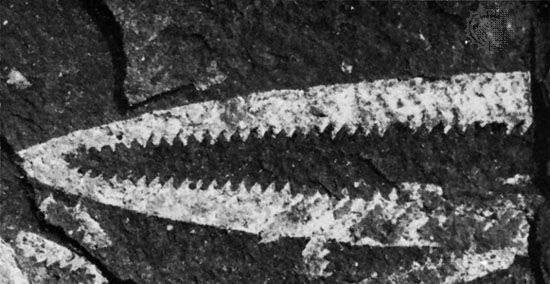
Didymograptus is a genus of extinct, colonial graptolites that lived during the Early and Middle Ordovician Period. These aquatic animals are characterized by a distinct two-branched form, which was often suspended from a circular, disk-shaped structure. Some species within this genus are recognized as being among the largest graptolites ever discovered.1
Because these organisms were widely distributed geographically but existed during relatively narrow time intervals, they serve as important guide fossils for correlating and dating rock units from the Ordovician. Like other graptolites, they are believed to be related to primitive hemichordates and are typically found as carbonaceous impressions in shale or in a less compressed state within limestone.12
What are guide fossils and why are they important?
Guide fossils, also known as index fossils, are the remains of plants or animals that are characteristic of a specific span of geologic time or a particular environment. They serve as essential tools for geologists to define boundaries in the geologic time scale and to correlate rock strata across different locations.34
To be considered an ideal guide fossil, a species should possess several key attributes:
- Short temporal range: The species must have existed for a relatively brief period, ensuring that its presence in a rock layer indicates a specific moment in Earth’s history.4
- Wide geographic distribution: Being “cosmopolitan” allows geologists to correlate separated outcrops across vast distances.4
- Abundance: The fossils should be common enough that they are likely to be discovered during field study.34
- Distinctiveness: They must be easily recognizable to prevent misidentification.34
The importance of these fossils lies in the principle of faunal succession, which establishes that different rock layers contain unique fossil assemblages that reflect the order of life over time. By identifying these markers, scientists can piece together the history of the Earth’s crust.4
How are graptolites related to modern hemichordates?
It has been suggested that graptolites are related to the hemichordates, a primitive group of marine invertebrates. This connection is primarily drawn from similarities in their colonial nature and feeding structures.2
Specifically, the class Pterobranchia within the phylum Hemichordata provides the strongest evidence for this relationship. Like graptolites, pterobranchs are small, colonial, tube-building organisms that use tentacles to filter food particles from the water. Some researchers believe that pterobranchs may be direct descendants of the extinct graptolites, which flourished in ancient oceans. Both groups share characteristics such as bilateral symmetry and the use of specialized tentacled structures for suspension feeding. While graptolites are known for their chitinous, colonial structures preserved in the fossil record, modern pterobranchs continue this tradition of living in secreted tubes, often organized into a colonial structure known as a coenecium.672
What defines the Ordovician Period in Earth’s history?
The Ordovician Period was the second period of the Paleozoic Era, spanning from approximately 485.4 million to 443.8 million years ago. It was established by geologist Charles Lapworth in 1879 to resolve a stratigraphic dispute between the Cambrian and Silurian systems.9
Key characteristics of the period include:
- Tectonics and Climate: Rapid seafloor spreading led to some of the highest global sea levels in the Phanerozoic Eon, flooding continents extensively. While atmospheric carbon dioxide levels were high, creating a warm greenhouse climate, the period ended with a brief, intense interval of glaciation.10911
- Biological Diversification: The period is defined by the Ordovician radiation, an intense diversification of marine life that saw the rise of almost every modern marine invertebrate phylum and the emergence of fish. Dominant life forms included brachiopods, trilobites, bryozoans, and graptolites.1019
- Mass Extinction: The period concluded with the second-largest mass extinction in Earth’s history, which claimed approximately 85 percent of species, largely driven by cooling and falling sea levels.10129
Sources
- Didymograptus — Encyclopædia Britannica
- graptolite — Encyclopædia Britannica
- index fossil — Encyclopædia Britannica
- dating - Principles and techniques — Encyclopædia Britannica
- geochronology - Stages and zones — Encyclopædia Britannica
- hemichordate — Encyclopædia Britannica
- Phyllograptus — Encyclopædia Britannica
- pterobranch — Encyclopædia Britannica
- A Journey Through Time Since the Precambrian - Ordovician Period: 485.4 million to 443.4 million years ago — Encyclopædia Britannica
- Ordovician Period - Paleoclimate — Encyclopædia Britannica
- Ordovician radiation — Encyclopædia Britannica
- Ordovician Period - Mass extinction at the end of the Ordovician — Encyclopædia Britannica
- Ordovician Period — Encyclopædia Britannica
Published on · 3 min read