Diptera
Members of the insect order Diptera, commonly known as "true flies," are defined by several distinct morphological and biological characteristics:
What are the defining characteristics of dipteran insects?
Members of the insect order Diptera, commonly known as “true flies,” are defined by several distinct morphological and biological characteristics:
- Wings: The most defining feature is the presence of only one pair of functional, membranous forewings. The hind wings are reduced to small, knoblike structures called halteres, which function as balancing organs during flight.123
- Mouthparts: Dipterans typically possess sucking mouthparts, often forming a proboscis. These are sometimes adapted for piercing, though mandibles are rarely present in adults.23
- Body Structure: They are generally small, soft-bodied insects. The thorax is dominated by the mesothorax, which contains the powerful muscles required to operate the forewings.413
- Life Cycle: Dipterans undergo complex metamorphosis, consisting of four stages: egg, larva, pupa, and adult. The larvae, often called maggots, are typically legless and morphologically distinct from the adults, frequently occupying different habitats.4253
These insects play diverse ecological roles, acting as pollinators, scavengers, predators, or parasites, while some species serve as significant vectors for disease.42
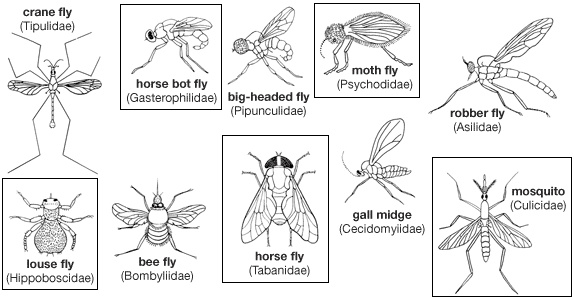
What are some common examples of dipteran insects?
The order Diptera, commonly referred to as “true flies,” encompasses over 160,000 species. While many insects are colloquially called “flies,” the term is scientifically reserved for members of this order, which are distinguished by having only one pair of functional wings.378
Common examples of dipteran insects include:
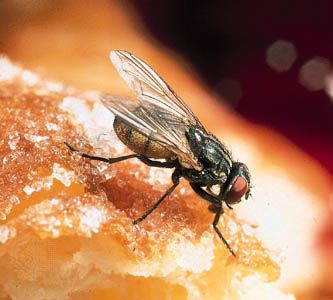
- Household and Agricultural Pests: The housefly (Musca domestica) is perhaps the most well-known, often found near human habitations. Other notable examples include fruit flies (such as the vinegar fly, Drosophila), stable flies, and horn flies fly), and horn flies.97
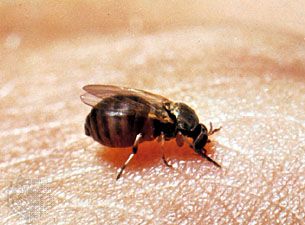
- Biting and Disease-Carrying Flies: This group includes various mosquitoes (genera Aedes, Anopheles, and Culex), horse flies, black flies, sand flies, and tsetse flies.31011
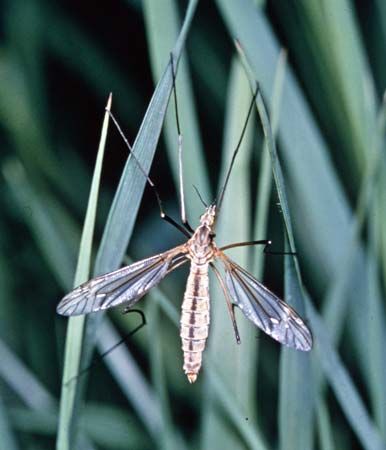
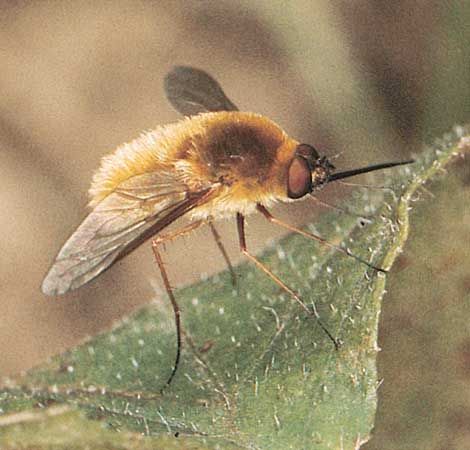
- Diverse Specialized Flies: The order also features crane flies, robber flies, bee flies, blow flies, midges, and gnats.3811
These insects are categorized into three major groups: Nematocera, Brachycera, and Cyclorrhapha, based on their evolutionary and morphological specializations.312
How do dipterans’ mouthparts vary among different species?
Dipteran mouthparts exhibit remarkable evolutionary diversity, reflecting specialized feeding strategies. While primitive insects typically possess chewing mouthparts, dipterans have evolved primarily for piercing and sucking fluids.5
The variation in these structures generally follows two distinct evolutionary paths:
- Piercing and Sucking: In primitive bloodsucking flies like the horsefly, the mandibles and maxillae function as serrated blades to cut skin, while the epipharynx and hypopharynx form a tube for blood ingestion. Mosquitoes have further refined this, with these components becoming slender stylets that form a fine bundle for piercing, while the labium acts as a protective sheath.5
- Surface Feeding and Specialized Piercing: In the housefly, mandibles and maxillae are lost, leaving a tonguelike labium for feeding on exposed surfaces. Some species, such as the stable fly and tsetse fly, have reacquired bloodsucking capabilities despite losing their original mandibles and maxillae. They utilize modified labial teeth or needlelike labial structures to penetrate host tissues.5
How have dipterans evolved and adapted over time?
Dipterans, or “true flies,” belong to the panorpoid complex and are believed to have evolved from a common ancestor that lived in moss. Fossil records indicate that four-winged insects resembling crane flies existed during the Permian Period (299–251 million years ago). By the Eocene Epoch, approximately 34 million years ago, most modern fly families had already evolved.14
A defining evolutionary adaptation of Diptera is the reduction of wings to a single functional pair, a departure from the ancestral four-winged state. Their mouthparts have also undergone striking modifications to support diverse feeding strategies:145
- Piercing and Sucking: Primitive flies like horseflies use serrated mandibles and maxillae to cut skin, while mosquitoes have evolved these into slender stylets for precise blood feeding.5
- Surface Feeding: In species like the housefly, mandibles and maxillae were lost, leaving a labium adapted for imbibing exposed fluids.5
- Secondary Adaptations: Some flies, such as the stable fly and tsetse fly, re-evolved bloodsucking mechanisms using specialized labial structures after losing their original mandibles.5
Sources
- Diptera: Top Questions — Encyclopædia Britannica
- Diptera - Distinguishing taxonomic features — Encyclopædia Britannica
- Diptera — Encyclopædia Britannica
- Diptera - General features — Encyclopædia Britannica
- insect - Head — Encyclopædia Britannica
- insect - Annotated classification — Encyclopædia Britannica
- fly — Encyclopædia Britannica
- insect - Medical significance — Encyclopædia Britannica
- List of insects - flies (order Diptera ) — Encyclopædia Britannica
- housefly — Encyclopædia Britannica
- List of flies — Encyclopædia Britannica
- Brachycera — Merriam-Webster
- homopteran - Head — Encyclopædia Britannica
- Diptera - Evolution and paleontology — Encyclopædia Britannica
- insect - Wings and flight — Encyclopædia Britannica
Published on · 3 min read