Disa
The term "Disa" can refer to two distinct subjects:
What is Disa?
The term “Disa” can refer to two distinct subjects:
Biological Genus
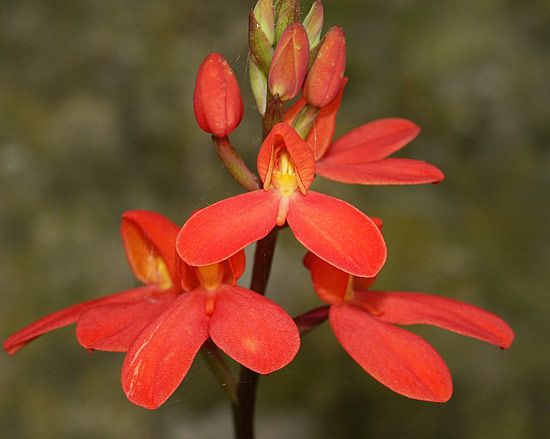
Disa is a genus comprising approximately 175 species of terrestrial orchids. These plants are primarily found in marshes and grasslands across southeastern Africa, Madagascar, and nearby islands. A notable example is the red disa (Disa uniflora), a South African species valued as an ornamental for its vibrant pink and scarlet flowers.1
Defense Intelligence Agency
The acronym DIA refers to the Defense Intelligence Agency, which serves as the primary producer and manager of military intelligence for the United States Department of Defense. Established in 1961, the agency was created to centralize and coordinate intelligence efforts that were previously scattered across individual military branches, thereby reducing duplication and inefficiency.2
What are some other unique characteristics of orchid species?
Orchid species exhibit several unique morphological and biological characteristics that distinguish them from other flowering plants. While individual traits like pollen masses or specific reproductive structures may appear in other groups, the combination of these features defines the Orchidaceae family.3
Key Morphological Features
- Floral Structure: The sexual organs—the stamens and pistil—are fused into a single structure called the column. Most orchids possess a single fertile anther at the column’s apex.34
- Pollinia: Instead of loose pollen, orchids produce masses of pollen grains bound together by sticky threads, known as pollinia.34
- Resupination: During development, the flower often undergoes a process called resupination, where the pedicel or ovary twists to orient the lip (labellum) downward.4
- Bilateral Symmetry: The presence of a fertile stamen on one side of the flower, opposite the lip, results in a bilaterally symmetrical bloom.4
Reproductive and Ecological Traits
- Seed Development: Orchid seeds are extremely small, dustlike, and lack endosperm, the nutrient-rich tissue found in most other angiosperm seeds.356
- Symbiotic Germination: Because they lack endosperm, orchid seeds require a symbiotic relationship with a fungus (mycorrhiza) to provide the necessary nutrients for germination and early growth.56
- Diverse Habitats: Orchids show remarkable ecological tolerance, thriving in environments ranging from sea level to high-altitude cloud forests, and even in desert conditions or on bare rocks. While many tropical species are epiphytic (growing on other plants), temperate species are typically terrestrial.78
How do terrestrial orchids differ from epiphytic orchids?
Terrestrial and epiphytic orchids differ primarily in their growth habits and environmental adaptations. While the majority of tropical orchid species are epiphytes, nearly all orchids found in temperate zones are terrestrial.95
Terrestrial Orchids
Terrestrial orchids grow directly in the soil and are the dominant form in temperate regions. They are frequently found in diverse habitats such as bogs, prairies, grasslands, and hardwood forests.510
Epiphytic Orchids
Epiphytic orchids grow upon other plants or objects for physical support rather than for nutrition, meaning they are not parasitic. They are most common in moist tropical areas, particularly in cloud-forest associations, where they access sunlight by growing high in the tree canopy.310
Key differences include:
- Nutrient and Water Acquisition: Epiphytes obtain water from rain and water vapor, often absorbing moisture through their roots or specialized leaves, and derive nutrients from organic debris collected on their host.3
- Morphological Adaptations: Many epiphytes feature thickened stems known as pseudobulbs to store water, a trait that is more common in epiphytic groups than in terrestrial ones.9
What is the primary purpose of the Defense Information Systems Agency (DISA)?
Sources
- Disa — Encyclopædia Britannica
- Defense Intelligence Agency — Encyclopædia Britannica
- orchid - Structural diversity — Encyclopædia Britannica
- orchid - Natural history — Encyclopædia Britannica
- orchid - Ecology — Encyclopædia Britannica
- orchid - Floral structure — Encyclopædia Britannica
- orchid - Seeds — Encyclopædia Britannica
- orchid: Top Questions — Encyclopædia Britannica
- epiphyte — Encyclopædia Britannica
- orchid - Growth forms — Encyclopædia Britannica
- list of plants in the family Orchidaceae — Encyclopædia Britannica
Published on · 3 min read