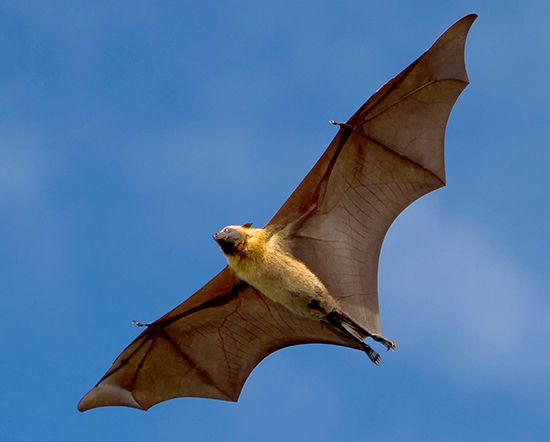
Disk-winged Bat
The disk-winged bat (family Thyropteridae) refers to any of three species of bats found in Central and South America. These small, reddish-brown mammals are…
What is disk-winged bat?
The disk-winged bat (family Thyropteridae) refers to any of three species of bats found in Central and South America. These small, reddish-brown mammals are uniquely characterized by round, suction-cup-like disks located at the base of their thumbs and on the soles of their feet.12
These specialized disks allow the bats to cling securely to smooth surfaces, with a single disk being strong enough to support the animal’s entire body weight. Measuring only 3.4 to 5.2 cm in length, these bats are known for their distinct behavior; for instance, Spix’s disk-winged bat (Thyroptera tricolor) lives in small, cohesive colonies and is notable for its “heads-up” roosting posture within rolled-up leaves.1
Why do these bats prefer to roost in rolled-up leaves?
Disk-winged bats (family Thyropteridae) prefer to roost in rolled-up leaves because their specialized anatomy is uniquely adapted for such environments. These bats possess suction-cup-like disks on their thumbs and the soles of their feet, which allow them to cling securely to the smooth, waxy surfaces of young, unfurling leaves.12
By roosting inside these rolled-up structures, the bats gain a protected, stable environment that accommodates their distinct “heads-up” roosting posture. This behavior is an evolutionary specialization that enables them to utilize surfaces that would be difficult for other species to navigate, providing them with a secure place to rest within their tropical habitats.12
How does the ‘heads-up’ roosting posture help them survive?
The “heads-up” roosting posture of the disk-winged bat (family Thyropteridae) is a unique evolutionary adaptation that allows these small mammals to thrive within their specific microhabitats—specifically, the interiors of rolled-up, unfurling leaves.5
While many other bat species roost hanging upside down, which utilizes a tendon-locking mechanism to save energy and allows for a quick, gravity-assisted takeoff, the disk-winged bat’s posture is tailored to its environment. By roosting head-up, these bats can effectively utilize their specialized suction-cup-like disks on their thumbs and feet to maintain a secure grip on the smooth, waxy surfaces of these leaves. This position provides them with a stable, protected, and secluded environment that is difficult for predators to access, offering a significant survival advantage by keeping them concealed within the forest canopy.156
What other physical adaptations do bats have for roosting?
Beyond the specialized suction disks found in species like the disk-winged bat, bats have evolved several physical adaptations to facilitate roosting in diverse environments:
- Tendon-Locking Mechanism: Most bats hang upside down using a specialized tendon-locking mechanism in their feet. This allows them to clench onto surfaces automatically, enabling them to remain attached without muscular effort, which is essential for energy conservation while resting.5
- Claws and Thumb Adaptations: Many bats possess claws on their thumbs or index fingers to assist in climbing or clinging to surfaces. Some species, such as the sheath-tailed bat, use their thumbs and wrists to prop themselves against vertical surfaces, allowing them to scramble rapidly in multiple directions.86
- Camouflage and Countershading: The coloration of a bat’s fur often serves as a physical adaptation for concealment while roosting. Mottled or speckled patterns can mimic lichen-covered bark or rock, while bright spots may simulate dappled sunlight. Some bats exhibit countershading or shapes that allow them to blend in with their surroundings, such as hanging from a branch by one foot to resemble a plant stem.8
- Circulatory Efficiency: To prevent blood from pooling in the head while hanging inverted, bats have evolved efficient circulatory systems that allow for normal blood flow in an upside-down position.5
Sources
- disk-winged bat — Encyclopædia Britannica
- disk bat — Merriam-Webster
- Bat-loving flowers — Encyclopædia Britannica
- bat - Locomotion — Encyclopædia Britannica
- Why do bats sleep upside down? — Encyclopædia Britannica
- bat - Anatomical specializations — Encyclopædia Britannica
- bat - Life cycle — Encyclopædia Britannica
- bat - Roosting — Encyclopædia Britannica
- bat - General features — Encyclopædia Britannica
Published on · 3 min read