Dodder
It is a common misconception that there are multiple genera of dodder plants; in fact, all plants commonly known as dodders belong to a single genus, Cuscuta.
What are the main genera of dodder plants and how are they classified?
It is a common misconception that there are multiple genera of dodder plants; in fact, all plants commonly known as dodders belong to a single genus, Cuscuta.12
Classification
Dodders are classified within the morning glory family, Convolvulaceae, which is part of the order Solanales. Historically, Cuscuta was placed in its own distinct family, Cuscutaceae, but it is now taxonomically grouped within the Convolvulaceae.13
Characteristics
The genus comprises approximately 145 species of leafless, parasitic herbs. These plants are characterized by:12
- Parasitism: They lack chlorophyll and derive nutrients and water from host plants using specialized rootlike structures called haustoria.32
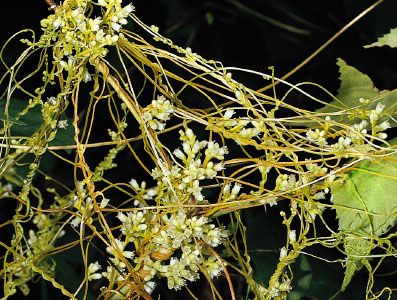
- Appearance: They feature wiry, threadlike stems that range in color from yellow and orange to pink or brown, often forming dense, tangled webs over their hosts.42
- Leaves: Their leaves are reduced to minute, non-functional scales.52
Because they are often introduced into new regions as contaminants in crop seeds, many species are considered invasive species globally1.2
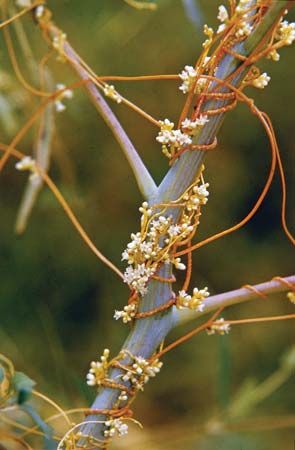
How do dodder plants detect and locate their host plants?
Dodder plants (Cuscuta) are obligate parasites that must locate a host within a few days of germination before their limited energy reserves are exhausted. To accomplish this, they utilize sophisticated sensory mechanisms to detect and orient themselves toward suitable host plants.678
Sensory Mechanisms
- Chemical Detection: Dodder seedlings are capable of detecting airborne volatile organic compounds (VOCs) released by nearby plants. By “smelling” these chemical signals, the dodder can orient its growth toward a potential host.7
- Visual Cues: In addition to chemical sensing, dodder seedlings use information regarding the color of the host to help orient their growth.8
- Host Selection: These plants exhibit a degree of host preference. Research has demonstrated that dodder can distinguish between different plant species, actively growing toward preferred hosts while bypassing others that are unsuitable.7
Once the threadlike stem of the dodder successfully reaches a host, it coils around the plant and develops haustoria—specialized rootlike organs that penetrate the host’s tissue to establish a vascular connection. After this connection is secured, the dodder’s original root system withers, and the parasite becomes entirely dependent on the host for water and nutrients.687
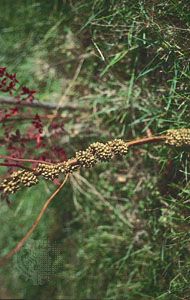
How does dodder parasitize other plants for survival?
Dodder (Cuscuta) is an obligate parasite that survives by completely depending on a host plant for water and nutrients, having lost the ability to perform photosynthesis6.69
The Parasitic Process
- Host Location: After germination, the dodder seedling must locate a host within 5–10 days. It uses its “sense of smell” to detect airborne volatile organic compounds released by nearby plants, allowing it to orient its growth toward a suitable host.769
- Attachment: Once it reaches a host, the dodder twines around the stem and develops haustoria. These specialized, rootlike organs penetrate the host’s tissues to form a vascular union, drawing water from the xylem and nutrients from the phloem.789
- Independence: After the haustorial connection is established, the dodder’s original root system rots away, and the plant continues to branch and twine, forming a dense, web-like network over the host.76
- Biohacking: Dodder employs a sophisticated “biohacking” strategy by passing microRNAs into the host. These molecules regulate host gene expression, specifically blocking the host’s wound-healing proteins to ensure a continuous flow of nutrients.6
What impact does dodder have on agriculture and ecosystems?
Dodder (Cuscuta) exerts a significant impact on both agricultural systems and natural ecosystems, primarily due to its role as an obligate parasite that siphons water and nutrients from host plants.67
Agricultural Impact
Dodder is considered a major agricultural pest, causing millions of dollars in crop losses annually. Because it lacks chlorophyll and cannot photosynthesize, it relies entirely on its host, often severely weakening or killing the plants it infests.867
- Affected Crops: It poses a serious threat to a wide variety of broadleaf crops, including clover, alfalfa, flax, hops, beans, and various solanaceous crops like tomatoes and potatoes.67
- Control Challenges: Controlling dodder is difficult because of its intimate physical connection to the host and its ability to spread rapidly. Management typically relies on manual removal and preventing the accidental introduction of seeds into fields.67
Ecological Role
While often viewed as a menace, dodder is a natural component of its ecosystem. is a natural component of its ecosystem.7
- Invasive Species: Many species have been introduced to new regions alongside their hosts, where they are classified as invasive species that can disrupt local plant communities.68
- Ecosystem Function: Like other parasitic plants, dodder interacts with its environment by influencing host health and resource distribution. While it can be destructive, it is part of the complex web of interactions that define biodiversity.8
Sources
- Convolvulaceae — Encyclopædia Britannica
- Cuscuta — Merriam-Webster
- Solanales - Convolvulaceae — Encyclopædia Britannica
- Plant disease - Dodder — Encyclopædia Britannica
- dodder — Merriam-Webster
- Dodder — Encyclopædia Britannica
- Doting on Dodder — Encyclopædia Britannica
- Parasitic plant — Encyclopædia Britannica
- Haustorium — Encyclopædia Britannica
Published on · 4 min read