Donkey
Donkeys, horses, and mules are distinct animals with unique physical and behavioral traits.
How do donkeys differ from horses and mules?
Donkeys, horses, and mules are distinct animals with unique physical and behavioral traits.
Donkeys vs. Horses
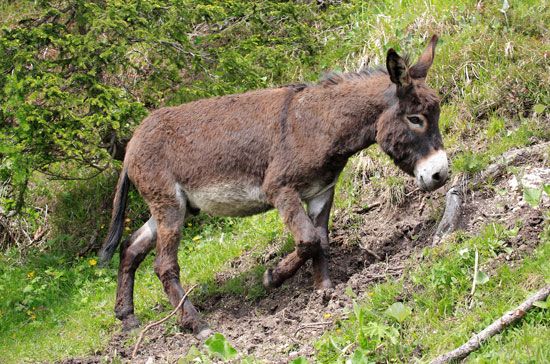
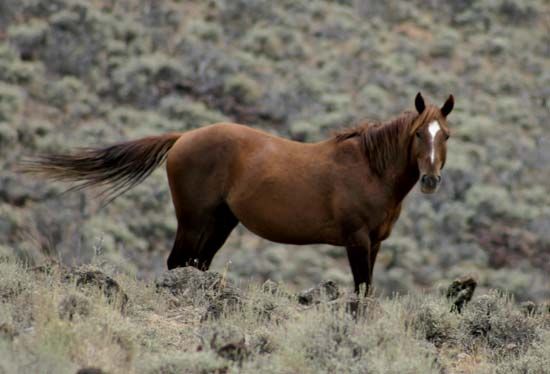
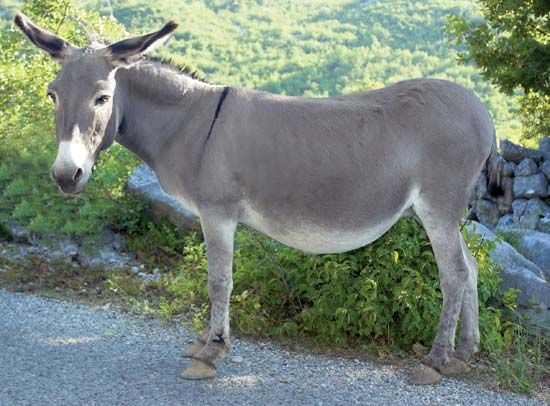
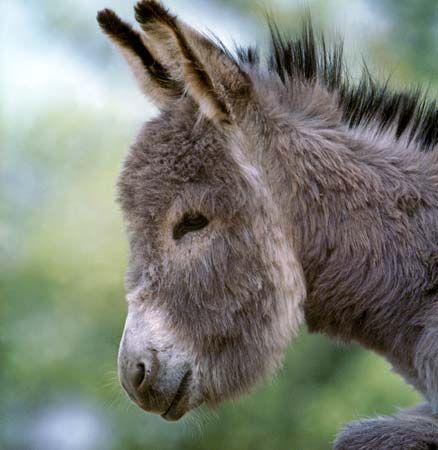
The donkey (or ass) is a hardy animal adapted to arid, sparse environments where horses often cannot thrive. While horses are typically larger and more uniform in coat, donkeys are characterized by their short, thick heads, long ears, thin limbs, and small hooves. Behaviorally, donkeys are patient and persevering; their reputation for “obstinacy” is often a reaction to mistreatment rather than a lack of intelligence.12
The Role of Mules
A mule is a hybrid offspring of a male donkey and a female horse. Mules combine traits of both parents: they resemble the horse in size and shape, but inherit the donkey’s long ears and thin limbs.21
Key differences include:
- Hardiness: Mules are valued for their ability to withstand heat, irregular feeding, and severe working conditions.21
- Intelligence: Mules are considered more intelligent and surer-footed than horses, making them ideal for precarious terrain.1
- Temperament: Unlike horses, mules are less likely to overeat or thrash when in danger.1
- Reproduction: Both mules and the hinny—the offspring of a male horse and female donkey—are typically sterile.21
How are donkeys used in different parts of the world today?
Donkeys have served as essential beasts of burden for thousands of years, particularly in regions where horses struggle to survive. Their hardiness allows them to thrive on coarse food and endure rough, arid conditions, making them vital for transportation and labor in areas such as the mountains of Ethiopia, the high plains of Tibet, and the arid regions of Mongolia2.23
In many parts of the world, donkeys remain the primary source of transportation and labor, especially in communities where extreme poverty makes horse ownership impractical. Beyond their role as working animals, donkeys have been selectively bred for specific tasks, such as the American Mammoth Jackstock, which was developed to produce large, strong mules for industry.32
However, the presence of feral donkeys—descendants of escaped or abandoned domestic animals—has created environmental challenges. In the western United States, they compete with native wildlife for limited resources, while on tropical islands, they can threaten native plant biodiversity. These issues often spark debate between animal rights advocates and conservationists.3
What sounds do donkeys make, and why are they known for braying?
The characteristic sound made by a donkey is known as a bray. This sound is described as a loud, harsh cry, which the animal utters to communicate. The term “bray” itself dates back to the 14th century and originates from the Middle English and Anglo-French word braire, meaning to cry, bellow, or roar.4
While the term is specifically associated with the vocalizations of donkeys, it is also used metaphorically to describe any sound that is similarly loud, harsh, or discordant. The biological purpose of this vocalization is rooted in the donkey’s need to signal others, often across the vast or rugged terrains where they are naturally adapted to live.
What is the difference between a mule and a hinny?
The primary difference between a mule and a hinny lies in the parentage of the hybrid animal:
- Mule: The offspring of a male ass (jackass) and a female horse (mare).12
- Hinny: The offspring of a male horse (stallion) and a female ass (jenny).12
In terms of physical characteristics, a hinny is typically smaller than a mule. Both hybrids are generally sterile and are valued for their hardiness, intelligence, and sure-footedness, which allow them to perform work in conditions that might be too difficult for horses. While mules were historically categorized by their specific utility—such as draft, farm, or mining mules—they all share the hybrid vigor that makes them excellent pack and saddle animals in precarious terrain.12
Sources
- mule — Encyclopædia Britannica
- Livestock farming - Donkeys and mules — Encyclopædia Britannica
- donkey — Encyclopædia Britannica
- bray — Merriam-Webster
Published on · 3 min read