Giraffe
Giraffes possess several unique physical characteristics that distinguish them from other mammals:
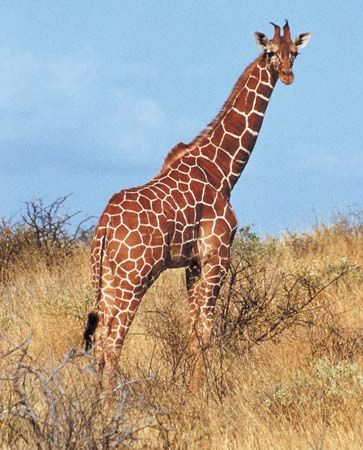
What are the unique physical characteristics of giraffes that set them apart from other mammals?
Giraffes possess several unique physical characteristics that distinguish them from other mammals:
- Stature: As the tallest land animals, they reach heights of up to 5.5 meters (18 feet). Their anatomy features extremely long legs and necks, supported by specialized muscles attached to elongated spines on the upper back vertebrae.12
- Ossicones: Both males and females have ossicones—short, skin-covered, hair-topped protuberances on the head composed of ossified cartilage that fuse to the skull as the animal ages.32
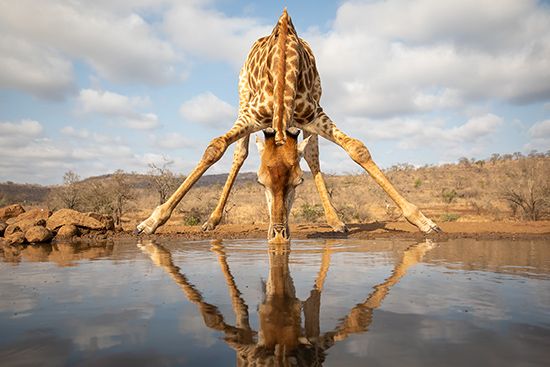
- Cardiovascular Adaptations: To manage blood flow to the brain at such heights, they have a specialized cardiovascular system with thick-walled arteries containing extra valves to counteract gravity. When they lower their heads, specialized vessels at the base of the brain regulate blood pressure.12
- Feeding Anatomy: They utilize prehensile tongues that can reach nearly half a meter in length, and their mouths are lined with tough tissue to protect against thorny acacia foliage.2
What are the different species or subspecies of giraffes, and where are they found?
The genus Giraffa is currently recognized as consisting of four distinct species, all of which are native to the continent of Africa. While giraffes were historically classified as a single species with multiple subspecies, genetic studies conducted by the 2010s identified significant reproductive isolation, leading to the current four-species classification.3
The four species are:
- Northern giraffe (G. camelopardalis): Found in parts of Africa, including a small population of the West African subspecies located in Niger.3
- Southern giraffe (G. giraffa): Inhabits regions within Southern Africa.3
- Masai giraffe (G. tippelskirchi): Primarily found in East Africa, including areas like Tanzania’s Serengeti National Park.3
- Reticulated giraffe (G. reticulata): Also native to East Africa, notably seen in Kenya’s Amboseli National Park.3
Generally, these animals are found in grasslands and open woodlands across the continent.35
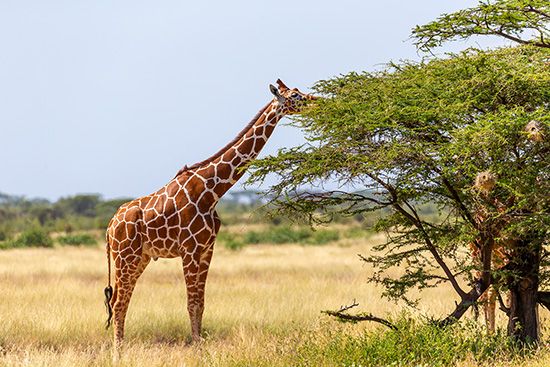
How tall can giraffes grow, and how does their height compare to other mammals?
Giraffes are the tallest of all land mammals. Male giraffes (bulls) can exceed 5.5 meters (18 feet) in height, while females (cows) typically reach about 4.5 meters (approximately 14.8 feet).136
To put their stature into perspective, a bull’s height is comparable to a two-story building, whereas a cow is equivalent to a one-and-a-half-story building. Giraffes reach nearly their full height by the time they are four years old.136
Their extreme height is a vital evolutionary adaptation, allowing them to browse foliage up to 6 meters (20 feet) above the ground—a food source inaccessible to most other animals. Additionally, this height provides a significant vantage point for spotting predators across the grasslands and open woodlands they inhabit. To support this unique anatomy, giraffes have evolved a specialized cardiovascular system with thick-walled arteries and valves that efficiently manage blood flow to the brain against the force of gravity.13
How does the okapi compare to its relative, the giraffe?
The okapi (Okapia johnstoni) and the giraffe are the only two living members of the family Giraffidae. While they share a common ancestry, they have evolved to occupy very different ecological niches.73
Key Comparisons
- Physical Stature: The most striking difference is size. Giraffes are the tallest land animals, with males reaching over 5.5 meters (18 feet) in height, whereas okapis are much smaller, standing about 1.5 meters (5 feet) at the shoulder. The okapi also possesses a significantly shorter neck and shorter legs compared to the giraffe.73
- Appearance: While giraffes are famous for their irregular brown patches, the okapi has a sleek, deep brown coat. A unique feature of the okapi is the black-and-white horizontal striping on its thighs and upper legs, which provides camouflage in the dense forest.78
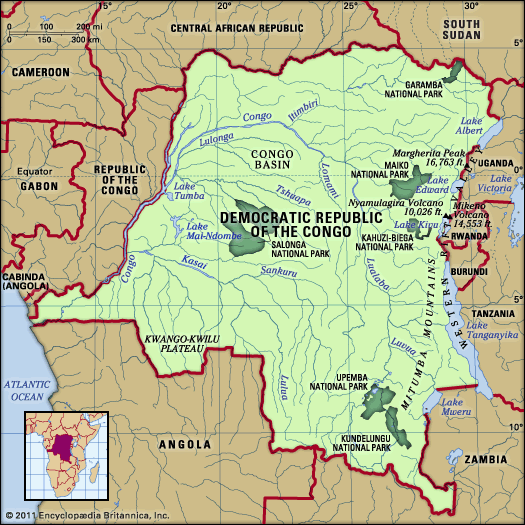
- Habitat and Behavior: Giraffes are gregarious animals found in the open grasslands and woodlands of Africa, where their height helps them spot predators. In contrast, the okapi is a shy, solitary, and elusive creature restricted to the dense rainforests of the Democratic Republic of the Congo.73
- Shared Traits: Both species possess long, prehensile tongues used for browsing foliage and have evolved specialized adaptations for their respective environments.73
Sources
- How tall are giraffes? — Encyclopædia Britannica
- ossicone — Merriam-Webster
- giraffe — Encyclopædia Britannica
- Why do giraffes have long necks? — Encyclopædia Britannica
- giraffe: Top Questions — Encyclopædia Britannica
- List of Female Animals Called Cows — Encyclopædia Britannica
- okapi — Encyclopædia Britannica
- okapi — Merriam-Webster
Published on · 4 min read