Dory
The term "dory" refers to two distinct subjects: a type of watercraft and a family of marine fish.
What is dory?
The term “dory” refers to two distinct subjects: a type of watercraft and a family of marine fish.
The Dory Boat
A dory is a small, seaworthy boat characterized by its pointed ends, high flaring sides, and narrow, flat bottom. Typically reaching up to 22 feet in length, these vessels often feature a narrow, V-shaped stern. They are widely used in the New England and Maritime Provinces fisheries and can be rowed, sailed, or powered by an engine. A related, smaller version with lower sides and a square stern is known as a dory skiff.12
The Dory Fish
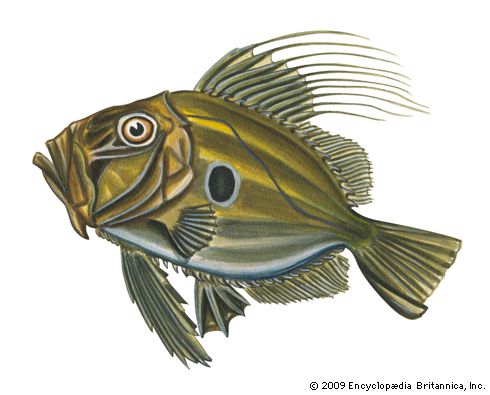
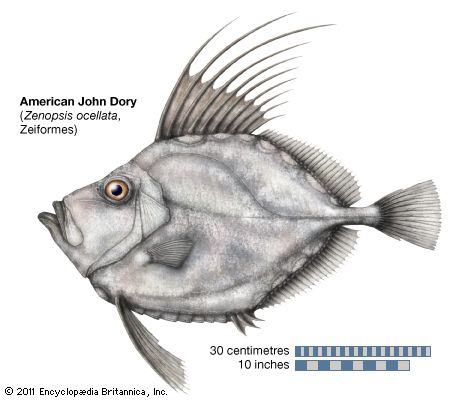
In biology, a dory is any marine fish belonging to the family Zeidae. These fish are typically deep-bodied but thin from side to side, with large mouths. A well-known species is the John Dory, a food fish found in the Atlantic and Mediterranean that is recognized by a distinctive yellow-ringed black spot on its sides.3
How were dory boats historically used in the New England fishing industry?
Historically, the dory has been a staple of the New England and Maritime Provinces fishing industries. These small, seaworthy vessels were designed with a flat bottom, pointed ends, and high, flaring sides, which allowed them to be easily nested and stored on larger fishing ships before being deployed for work.14
Fishermen, known as dorymen, utilized these boats to conduct their work at sea, often rowing them to reach specific fishing grounds. While traditionally rowed, dories were also adapted for sailing by fitting them with centreboards. Over time, the design evolved to accommodate engines, leading to modifications such as rounded side frames to improve performance. Their versatility and ability to handle various conditions made them essential for the regional shore and commercial fisheries.154
What are the unique physical features of the John Dory fish?
The John Dory (Zenopsis conchifera or Zeus faber) is a marine fish belonging to the family Zeidae, known for several distinct physical characteristics:
- Body Shape: It has a deep, oval-shaped body that is laterally compressed, meaning it is very thin from side to side.26
- Coloration and Markings: The fish is typically grayish, yellow, or olive in color. Its most recognizable feature is a distinctive, yellow-ringed black spot located on each side of its body.26
- Fins and Spines: It possesses long pelvic fins and long, filamentous dorsal-fin spines. Additionally, it features rows of spines along its belly and at the bases of its dorsal and anal fins.26
- Mouth: Like other members of the Zeidae family, the John Dory is characterized by a large mouth.27
These fish can reach a maximum length of approximately 90 cm (3 feet) and are found in the Atlantic and Mediterranean, ranging from shore waters to depths of about 200 meters (650 feet).2
How do dory boats differ from other small watercraft like skiffs or canoes?
Dories are distinguished from other small watercraft by their specific construction and design features. A traditional dory is characterized by its narrow, flat bottom, pointed ends, and high, flaring sides, which provide significant seaworthiness. In contrast, a dory skiff is a variation that is shorter, features lower sides, and possesses a square stern.13
Other small watercraft differ in their structural intent and heritage:
- Canoes: Historically, vessels like the maitre canot (a large version of the Indian canoe) were designed for different environments, such as navigating shallow swamplands or inland waterways, often utilizing a dugout or bark-based construction rather than the planked, flat-bottomed design of a dory.3
- Skiffs: While the term “skiff” is sometimes used broadly—such as the New Jersey Seabright skiff—these often evolved into specialized motorboats with rounded side frames and narrow bottoms, differing from the straight-framed, traditional fishing dory.3
- Other Types: Boats like the New Haven sharpie or the New Jersey garvey utilized different hull forms, such as scow-like shapes or specific rigging, to suit regional fisheries.3
Sources
- dory — Encyclopædia Britannica
- dory — Encyclopædia Britannica
- boat - North America — Encyclopædia Britannica
- dory — Merriam-Webster
- doryman — Merriam-Webster
- atheriniform - Annotated classification — Encyclopædia Britannica
- John Dory — Merriam-Webster
Published on · 3 min read