Dreadnoughtus
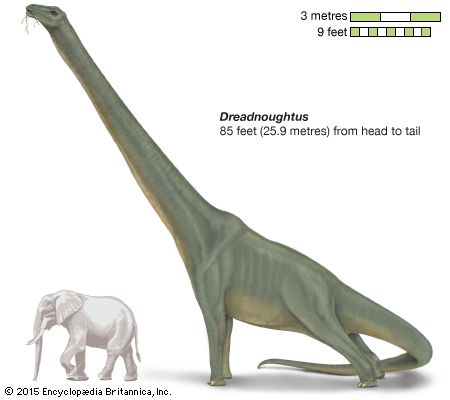
Dreadnoughtus achieved its massive size through a combination of specialized anatomical features characteristic of the titanosaur group. Key adaptations…
What adaptations did Dreadnoughtus have that allowed it to reach such an enormous size?
Dreadnoughtus achieved its massive size through a combination of specialized anatomical features characteristic of the titanosaur group. Key adaptations included:
- Skeletal Efficiency: Like other sauropods, Dreadnoughtus possessed vertebrae with a honeycomb-like internal structure, which significantly reduced bone weight while maintaining the structural strength necessary to support its 59-metric-ton mass.12
- Weight-Bearing Limbs: It featured thick, pillarlike legs positioned vertically beneath its body, which were highly adapted for supporting great weight on land. Titanosaurs specifically evolved a stockier body and a wider limb stance compared to other sauropods, providing a stable base for their immense bulk.231
- Feeding Strategy: Its 11-meter (37-foot) neck allowed it to reach vegetation at various heights, including the tops of trees, which minimized the energy expenditure required for walking to find food.42
- Supportive Anatomy: A massive hip girdle fused to the backbone provided solid support for its body and tail, while the tail itself served as a critical anchor for the powerful hind leg muscles used for locomotion.23
When and where did Dreadnoughtus live?
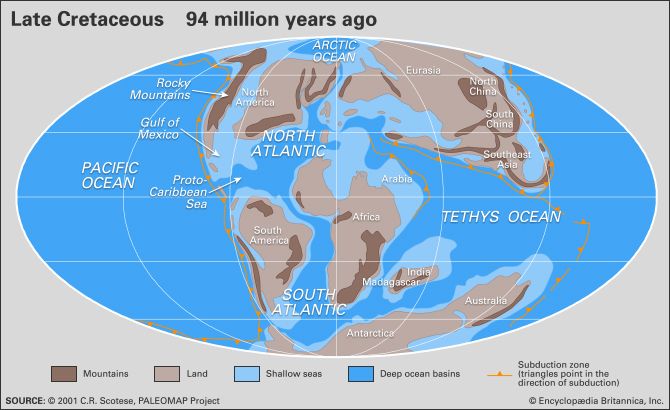
Dreadnoughtus lived approximately 77 million years ago during the Late Cretaceous Period. Its remains were discovered in rock deposits located in southern Patagonia, Argentina.11
How was Dreadnoughtus discovered, and what is the significance of its fossil remains?
Dreadnoughtus was described in 2014 following the discovery of two fossils in southern Patagonia, Argentina.1
The significance of these remains lies in their exceptional completeness. The larger specimen consists of 115 bones, representing approximately 70 percent of the dinosaur’s skeleton behind the head, along with portions of the skull and teeth. Because many other titanosaur species are known only from fragmentary remains, the discovery of such a substantial skeleton provided paleontologists with a rare opportunity to make highly confident estimates regarding the animal’s total length, mass, and physical proportions. These findings have been instrumental in advancing scientific understanding of the lifestyle, feeding habits, and defensive capabilities of these gargantuan sauropods.12
What can Dreadnoughtus tell us about the evolution of titanosaurs?
The discovery of Dreadnoughtus has significantly advanced our understanding of titanosaur evolution and biology. Because many titanosaur species are known only from fragmentary remains—often leading to their classification as “wastebin taxa”—the recovery of a skeleton that is approximately 70 percent complete provides a rare, high-confidence benchmark for the group.12
This completeness allows paleontologists to move beyond conjecture, providing reliable data on the physical proportions, mass, and length of these massive sauropods. By studying Dreadnoughtus, scientists have gained clearer insights into:
- Physical Structure: It confirms the characteristic titanosaur body plan, which featured a stockier build and a wider stance than other sauropods.2
- Lifestyle and Feeding: The skeletal evidence supports the theory that these animals used their long necks to efficiently browse high-canopy vegetation, minimizing the energy required for movement.13
- Defense: The presence of a long, muscular tail suggests that these giants possessed significant defensive capabilities against predators.1
Ultimately, Dreadnoughtus serves as a critical reference point for comparing the size and evolutionary adaptations of other gargantuan titanosaurs, such as Patagotitan and Argentinosaurus.12
Sources
- Dreadnoughtus — Encyclopædia Britannica
- titanosaur — Encyclopædia Britannica
- sauropod — Encyclopædia Britannica
- Titanosaurs: 8 of the World’s Biggest Dinosaurs — Encyclopædia Britannica
- dinosaur - Sauropoda — Encyclopædia Britannica
Published on · 2 min read