Drongo
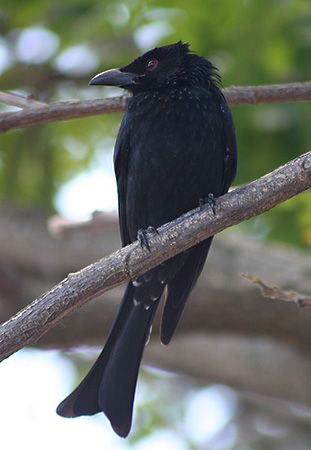
Drongo birds are insectivorous passerines belonging to the family Dicruridae. Their diet consists primarily of large insects and termites.
What is the diet of drongo birds, and how do they hunt for food?
Drongo birds are insectivorous passerines belonging to the family Dicruridae. Their diet consists primarily of large insects and termites.12
When hunting for food, drongos employ strategies similar to those of flycatchers or shrikes, typically catching their prey while in flight or by swooping down from a perch. These birds are known for their bold behavior and are often observed in various habitats, including forests, open country, and gardens, across Africa, Asia, and Australia.12
How many species of drongo birds exist, and which are the most well-known?
There are approximately 26 species of drongo birds, which make up the family Dicruridae. These Old World woodland birds are primarily known for their glossy black plumage, fiery red eyes, and long, forked tails.
Among the most well-known species are:
- Black drongo (Dicrurus macrocercus): One of the most common birds in southern Asia, it is often called the “king crow” because of its ability to intimidate larger birds like crows.13
- African drongo (Dicrurus adsimilis): A widespread species found throughout sub-Saharan Africa, which is sometimes considered to be the same species as the black drongo.1
- Racket-tailed drongo (Dicrurus paradiseus): A notable Southeast Asian species recognized for its distinctive tail, which features long, wire-like outer feathers that end in large vanes.1
These birds are highly regarded for their protective nature, often defending their nests against much larger predators, which leads other, more vulnerable birds to nest nearby for safety.1
Where are drongo birds typically found in the world?
Drongo birds are native to the Old World, with a distribution that spans across Africa, Asia, Australia, and various western Pacific islands.12
Within these regions, they inhabit a diverse range of environments, including:
- Forests: They are commonly found in woodland areas.1
- Open Country: They frequently occupy more exposed landscapes.1
- Gardens: These birds are also known to inhabit human-altered environments like gardens.1
Their range extends from sub-Saharan Africa through to Central Asia, demonstrating their adaptability to different climates and terrains across these continents.1
How do drongo birds interact with other species in their ecosystems?
Drongo birds interact with other species in their ecosystems through both protective and assertive behaviors:
- Protective Associations: Drongos are known for their aggressive defense of their nests. They frequently attack much larger birds, such as hawks and crows, that pose a threat to their eggs or young. Because of this defensive behavior, more innocuous species—including doves and orioles—often choose to nest near drongos to gain protection from potential predators.1
- Intimidation: Some species, such as the black drongo (Dicrurus macrocercus), are known for their ability to intimidate other birds. The black drongo is frequently referred to as the “king crow” because it can successfully challenge and intimidate the true crow.1
While drongos are primarily known for these interactions, it is important to note that the broader ecological concept of kleptoparasitism—a strategy where animals steal food or resources from others—is a common survival behavior observed across many different species of birds, mammals, and insects, though it is not the defining characteristic of drongo-specific interactions mentioned in the provided records.4
Sources
- Drongo — Encyclopædia Britannica
- drongo — Merriam-Webster
- black drongo — Merriam-Webster
- kleptoparasitism — Encyclopædia Britannica
Published on · 2 min read