Dunnock
The dunnock (Prunella modularis) is a small, unobtrusive songbird widely distributed across Europe. Its range also extends into Lebanon, Turkey, northern…
Where is the dunnock typically found, and what is its natural habitat?
The dunnock (Prunella modularis) is a small, unobtrusive songbird widely distributed across Europe. Its range also extends into Lebanon, Turkey, northern Iran, and the Caucasus region.1
Regarding its natural habitat, the dunnock is typically found in areas that provide dense cover, such as:
This species is known for its “skulking” behavior, spending much of its time hidden among shrubs or foraging on the ground for small arthropods.1
What is unique about the dunnock’s mating behavior and social structure?
The dunnock is noted for an exceptionally flexible mating and territorial system that adapts based on food availability. Depending on local resources, these birds may be monogamous, polygamous, or polyandrous. When food is abundant, a male’s territory may overlap with those of multiple females; conversely, when food is scarce, females maintain larger territories that overlap with multiple males.1
A particularly unique aspect of their reproductive strategy is the intense sperm competition that occurs during the 10-day mating period. Because females often solicit copulations from multiple suitors, males have evolved a specific behavior to increase their chances of paternity: a male will peck at the female’s cloaca, which triggers her to eject a droplet of sperm from a previous mate before he begins his own copulation.12
Following mating, both sexes participate in raising the young, and in some cases, multiple males will cooperate to help feed a single brood.1
How do dunnocks build their nests, and what materials do they use?
The dunnock constructs a well-concealed nest designed to protect its clutch of three to six bluish eggs. These nests are typically built on the ground, though they are occasionally situated several feet above the ground within dense vegetation.1
While the provided information notes the location and the purpose of the nest, it does not specify the exact materials used in its construction.
What are the distinguishing physical characteristics of the dunnock bird?
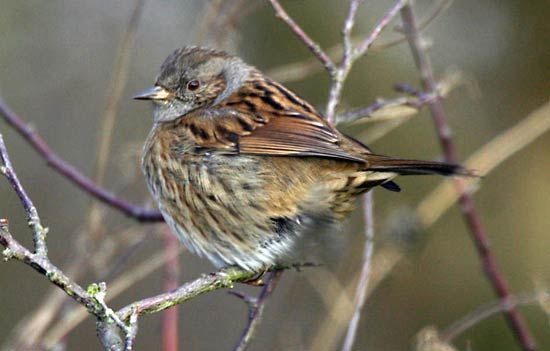
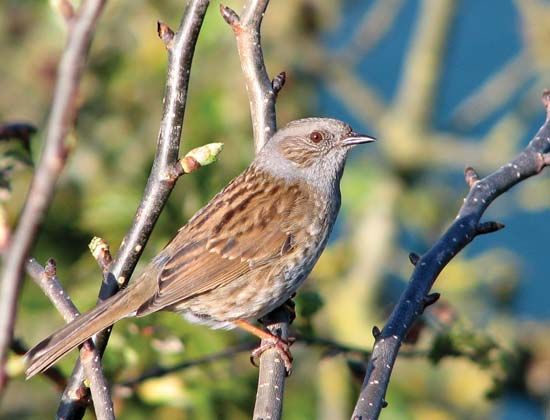
The dunnock (Prunella modularis) is a small, drab songbird belonging to the accentor family. It is characterized by an unobtrusive appearance and a distinctively jerky, shuffling gait as it moves through its environment.1
While the dunnock is often described as a “skulking” bird, its physical presence is defined by its preference for dense cover, such as hedgerows, scrub, and heathland, where it forages for tiny soil arthropods. Beyond its general coloration and size, the species is known for specific behaviors—such as wing-flicking and the use of staccato calls—that accompany its communal displays during the spring.1
Sources
- Dunnock — Encyclopædia Britannica
- Sperm competition — Encyclopædia Britannica
Published on · 2 min read