Elephant Bird
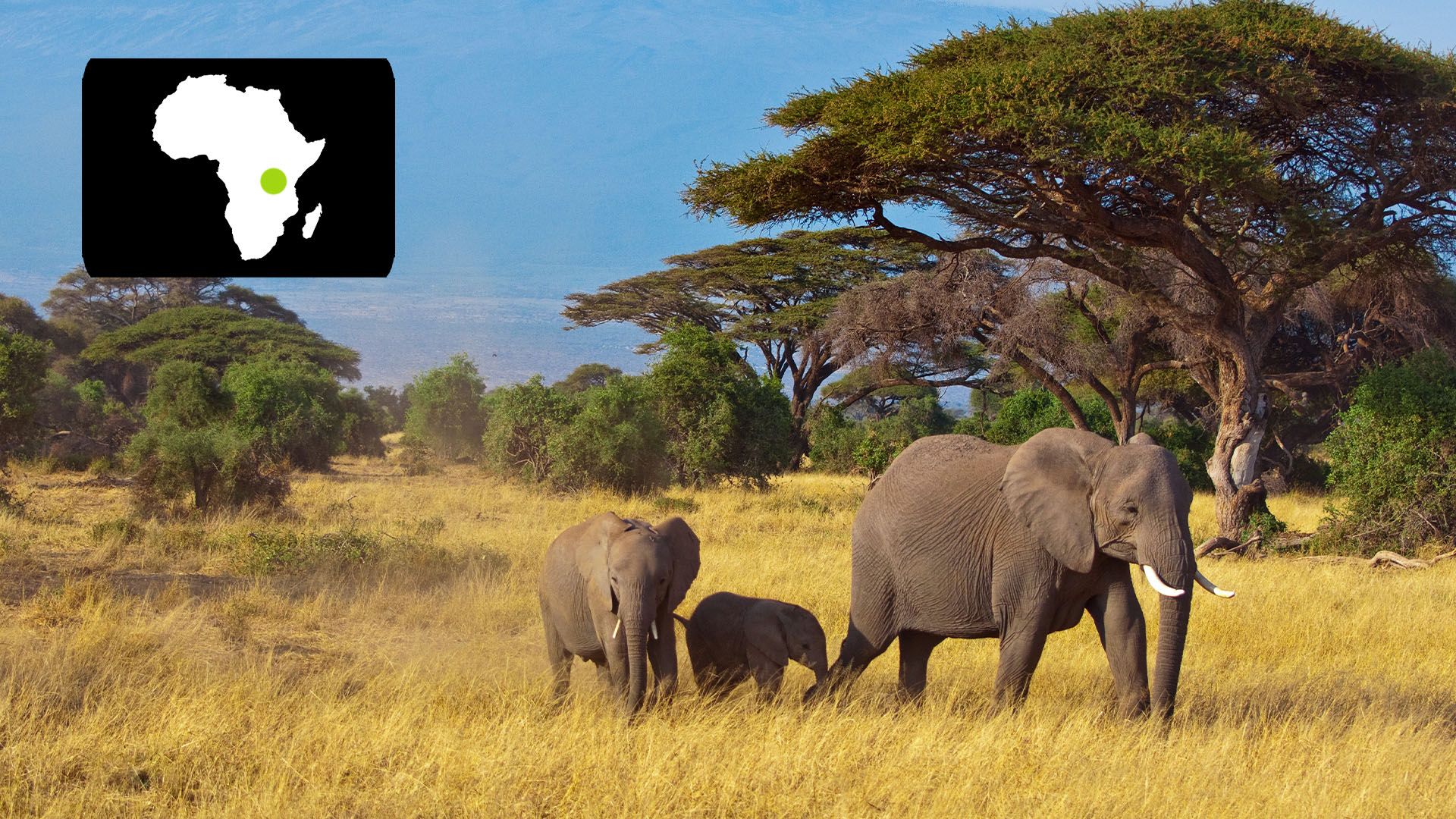
The elephant bird (family Aepyornithidae) refers to several species of extinct, giant flightless birds that once inhabited the island of Madagascar. These…
What is elephant bird?
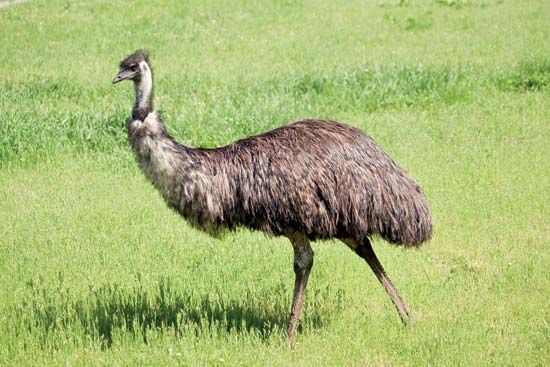
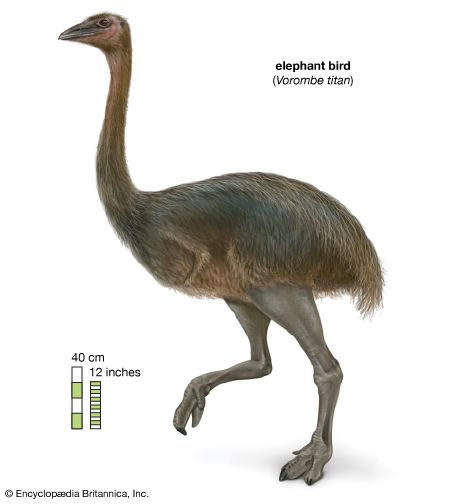
The elephant bird (family Aepyornithidae) refers to several species of extinct, giant flightless birds that once inhabited the island of Madagascar. These birds were primitive members of the ratite lineage, which also includes ostriches, rheas, and emus.12
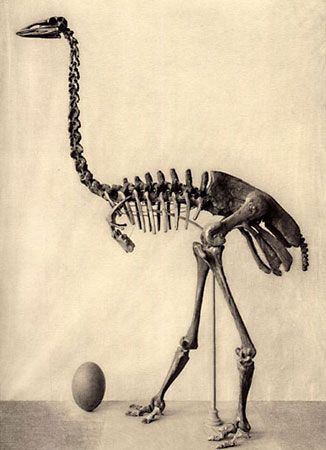
Characterized by their massive build, elephant birds possessed conical beaks, short thick legs, and small, useless wings. They were likely slow-moving forest dwellers. The largest species, Vorombe titan, stood at least 3 metres (10 feet) tall and could weigh up to 860 kg (1,900 pounds), making it the largest bird known to have lived. Additionally, they laid the largest eggs of any known animal.1
Elephant birds survived until relatively recently, with some species persisting until roughly 1,300 to 1,560 years ago. Their extinction is attributed to a combination of climate change, habitat loss, and hunting pressure from humans.1
What are some other examples of flightless birds that have gone extinct?
Beyond the elephant birds of Madagascar, several other flightless birds have gone extinct, often due to human activity and the introduction of invasive predators to their isolated island habitats.5
- Dodo: A stocky, flightless bird native to Mauritius, the dodo became extinct by 1681. Its decline was driven by hunting and the introduction of invasive species like pigs, dogs, and rats, which preyed on their eggs and young. Related species, the solitaires of Réunion and Rodrigues, also went extinct in the 18th century.56
- Moas: These ostrich-like birds were native to New Zealand. Ranging from turkey-sized to giants standing 3 metres tall, all 11 known species were hunted to extinction by the ancestors of the Māori people between 1250 and 1350.57
- Great auk: This flightless seabird inhabited rocky islands across the North Atlantic. Because they were defenseless on land, they were slaughtered in massive numbers by hunters for food and bait, leading to their final extinction in 1844.8
How do the eggs of elephant birds compare in size to those of modern ostriches?
The elephant bird (family Aepyornithidae) produced the largest eggs of any known animal, significantly exceeding those of the ostrich, which is the largest living bird today.
For the species Aepyornis maximus, egg dimensions ranged from 26.4 to 34 cm (10.4 to 13.4 inches) in length and 19.4 to 24.5 cm (7.6 to 9.6 inches) in width. In contrast, the ostrich egg averages approximately 15 cm (6 inches) in length and 12.5 cm (5 inches) in diameter, with a weight of about 1.35 kg (3 pounds).19
While the ostrich egg is currently the largest produced by any living bird, the fossilized remains of elephant bird eggs demonstrate that these extinct relatives laid eggs of substantially greater volume and size.19
What are ratites, and which living birds belong to this group?
Ratites are a group of birds characterized by a smooth, or raftlike, sternum (breastbone). Unlike most birds, they lack a keel—a ridge on the breastbone to which flight muscles are anchored—which renders all species in this group unable to fly.10
While the group includes some of the largest birds to have ever lived, such as the extinct moa and the elephant bird, several species remain extant today. The living birds that belong to the ratite group include:
Although these birds differ significantly in their morphology, they share remarkable similarities in their palate and bill structures. It is now generally accepted that all ratites descended from ancestors that were once capable of flight.11
Sources
- elephant bird — Encyclopædia Britannica
- elephant bird — Merriam-Webster
- Bird - Modern birds — Encyclopædia Britannica
- Gruiform - Annotated classification — Encyclopædia Britannica
- Flightless bird — Encyclopædia Britannica
- Great auk — Encyclopædia Britannica
- Moa — Encyclopædia Britannica
- Dodo — Encyclopædia Britannica
- Ostrich — Encyclopædia Britannica
- Ratite — Encyclopædia Britannica
- Bird - Critical appraisal — Encyclopædia Britannica
- rat — Encyclopædia Britannica
Published on · 3 min read