Elaenia
Elaenia (genus Elaenia) refers to a group of approximately 20 species of plain-colored, insectivorous birds belonging to the family Tyrannidae (the tyrant…
What is Elaenia?
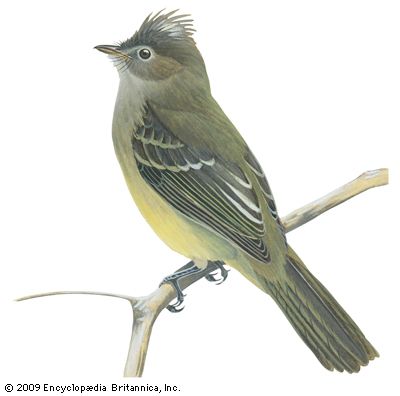
Elaenia (genus Elaenia) refers to a group of approximately 20 species of plain-colored, insectivorous birds belonging to the family Tyrannidae (the tyrant flycatchers). These birds are native to Central America, South America, and the West Indies.12
Physically, these birds are characterized by their modest, ragged crests—which often conceal a white or yellow crown patch—and short bills. Their plumage is typically olive-colored on the upper parts with yellowish underparts, a coloration that inspired their name, derived from the Greek word for olive. Because many species share similar appearances, field identification often relies on their distinctive vocal patterns. Some taxonomists classify the yellow-crowned species within the separate genus Myiopagis.12
What defines the family Tyrannidae?
The family Tyrannidae, commonly known as the tyrant flycatchers, is a large and diverse group of approximately 400 species of New World birds belonging to the order Passeriformes. They are primarily found in Central and South America, though about 30 species breed in North America.34
Key characteristics that define the family include:
- Physical Appearance: They range from 7.5 to 40.5 cm (3 to 16 inches) in length. Most are modestly colored in shades of gray, brown, or olive, though some exhibit black, white, or yellow patterns. Many species possess an erectile crown or crest, which is often more brightly colored than the rest of their plumage.34
- Bill Structure: Their bills are highly variable but are typically broad, flattened, and slightly hooked at the tip. Most species have well-developed rictal bristles—stiff, hairlike feathers at the base of the bill—which aid in capturing insects.34
- Diet and Behavior: While most are insectivorous and catch prey on the wing, some species also consume berries and fruit. They are generally territorial during the breeding season and are known for their aggressive behavior toward larger birds.35
- Classification: They are part of the suborder Tyranni and are closely related to the manakins (Pipridae) and cotingas (Cotingidae).354
How do birds use vocal patterns to identify their species?
Birds utilize vocal patterns as a primary mechanism for species identification, territorial defense, and mate attraction. Because many closely related species exhibit nearly identical physical appearances, their unique songs and calls often serve as the most reliable way to distinguish them in the field.789
The development of these vocalizations is a combination of hereditary and learned behaviors. Many songbirds possess an innate, relatively crude “template” of their species-typical song, which they refine through practice and exposure to adult models during a sensitive period. This learning process ensures that individuals can accurately reproduce the specific vocalizations of their own species.810
In some instances, such as with parasitic whydahs, birds learn the vocal patterns of their host species, which then acts as a species-isolating mechanism to prevent hybridization. Furthermore, because songs can vary by region, birds may develop local “dialects,” allowing them to recognize not only their species but also their neighbors and mates through individual variations in their vocal output.117108
What are some other types of New World flycatchers?
The family Tyrannidae, or tyrant flycatchers, is a diverse group of approximately 400 species found throughout the Americas. While many are commonly referred to as “flycatchers,” the family includes a wide variety of birds with names that reflect their specific habitats, behaviors, or physical characteristics rather than a singular fly-catching habit.3
Some other types of New World flycatchers within this family include:
- Kingbirds: Known for their aggressive territorial behavior, often harassing much larger birds like crows or hawks.3
- Phoebe and Pewee: Groups named for their distinct vocalizations or behaviors; for example, the pewee (Contopus) is noted for having a more melodious song compared to the grating sounds of many other tyrannids.3
- Elaenias: A group of tyrant flycatchers that feed extensively on berries and other fruit rather than relying solely on insects.3
- Specialized Bill Types: Several members are named for their unique bill shapes, such as the spadebill, flatbill, and bent bill.3
- Habitat-based Names: Some species are named for their environments, such as the bush tyrant and marsh tyrant.3
- Other Notable Groups: The family also includes the kiskadee, tyrannulet, attila, and the genus Myiarchus, which consists of large, plainly colored birds.36
Sources
- Elaenia — Encyclopædia Britannica
- elaenia — Merriam-Webster
- Tyrant flycatcher — Encyclopædia Britannica
- Tyrannidae — Merriam-Webster
- Tyrannulet — Encyclopædia Britannica
- Passeriform - Annotated classification — Encyclopædia Britannica
- Bird - Sound — Encyclopædia Britannica
- Animal learning - Song learning — Encyclopædia Britannica
- Birdsong — Encyclopædia Britannica
- mimicry - Parasitic weaverbirds — Encyclopædia Britannica
- Passeriform - Sound production — Encyclopædia Britannica
- Flycatcher — Encyclopædia Britannica
- Myiarchus — Merriam-Webster
Published on · 3 min read