Dwarf Mistletoe
Dwarf mistletoes, members of the genus Arceuthobium, are parasitic plants that primarily infect coniferous trees in forest ecosystems. Unlike other…
What role do dwarf mistletoes play in forest ecosystems?
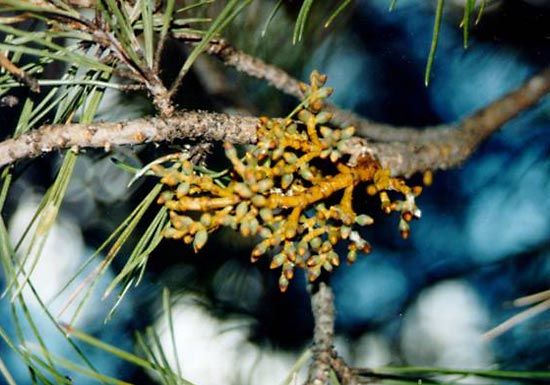
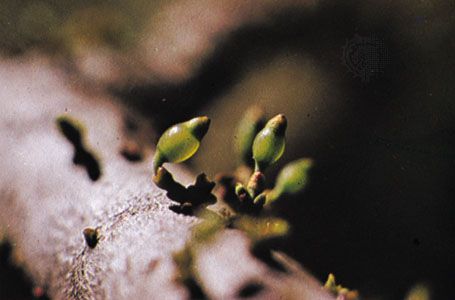
Dwarf mistletoes, members of the genus Arceuthobium, are parasitic plants that primarily infect coniferous trees in forest ecosystems. Unlike other mistletoes that rely on birds for seed dispersal, dwarf mistletoes utilize hydrostatic pressure to explosively discharge their sticky seeds onto nearby branches.123
Within the forest, these plants act as significant pathogens. By inserting rootlike structures called haustoria into the host’s vascular tissue, they extract water and nutrients, which can stunt, deform, or kill young trees. A hallmark of their presence is the formation of witches’-brooms—abnormal, dense clusters of branches—which can decrease the host’s reproductive capacity. Furthermore, the wounds caused by these parasites often serve as entry points for canker and wood-rotting fungi, further impacting tree health. Consequently, while they are a natural component of these environments, they are frequently viewed as destructive pests in the context of timber and ornamental tree management.321
What are some traditional or medicinal uses of dwarf mistletoe by indigenous peoples?
Sorry, the Britannica knowledge base does not contain information regarding the traditional or medicinal uses of dwarf mistletoe by indigenous peoples.
What adaptations do dwarf mistletoes have for parasitism?
Dwarf mistletoes (Arceuthobium) have evolved highly specialized adaptations to thrive as parasites on coniferous trees.
Their primary mechanism for parasitism involves the development of haustoria, which are rootlike structures that penetrate the host’s inner bark to tap into its vascular system. This allows the mistletoe to extract essential water and mineral salts directly from the host tree.1
To ensure successful colonization of new hosts, these plants utilize a remarkable method of explosive seed dispersal. As the fruit matures, high osmotic pressure builds up within the cell membranes until the thick skin ruptures. This force ejects a bullet-shaped, sticky seed at high velocities—up to 95 km (60 miles) per hour—allowing it to travel distances of up to 15–18 meters. The sticky coating ensures the seed adheres firmly to the bark of a nearby branch upon impact, where it can then germinate and begin its parasitic cycle.621
How do forest managers control or manage dwarf mistletoe infestations?
Forest managers employ specific strategies to mitigate the impact of dwarf mistletoe (Arceuthobium species) on coniferous trees, as these parasites can cause significant stunting, deformation, and tree mortality.72
For individual trees, the primary control method is the physical removal of infected branches. To be effective, this must be done by cutting the branch at least one foot beyond any visible evidence of the parasite, and it must be completed before the mistletoe fruits ripen and disperse their seeds.7
On a broader forest scale, management focuses on long-term silvicultural practices that promote forest health and reduce the spread of pests:
- Sanitation and Salvage: Foresters conduct routine monitoring to identify and harvest infested trees, which helps limit the spread of the parasite to healthy stands.8
- Selective Cutting: Removing susceptible or heavily infested trees reduces the host material available for the parasite to colonize.8
- Preventive Planting: In areas known for high mistletoe incidence, foresters prioritize planting tree species that are resistant to the parasite.8
- Growth Stimulation: Practices such as thinning are used to accelerate tree growth, creating more vigorous stands that are generally more resistant to widespread infestation.8
Sources
- dwarf mistletoe — Encyclopædia Britannica
- Plant disease - Mistletoe — Encyclopædia Britannica
- mistletoe — Encyclopædia Britannica
- dwarf mistletoe — Merriam-Webster
- American mistletoe — Merriam-Webster
- Seed dispersal - Self-dispersal — Encyclopædia Britannica
- forestry - Insect and disease control — Encyclopædia Britannica
- witches'-broom — Merriam-Webster
- Witches’-broom — Encyclopædia Britannica
Published on · 2 min read