Viscaceae
The Viscaceae family, traditionally recognized as a distinct group of semiparasitic shrubs, is now frequently classified as a subfamily within the…

How are plants in the Viscaceae family different from other mistletoe families?
The Viscaceae family, traditionally recognized as a distinct group of semiparasitic shrubs, is now frequently classified as a subfamily within the Santalaceae family to ensure a monophyletic classification.12
While they share the Santalales order’s characteristic haustorium—a specialized organ used to extract water and nutrients from host trees—Viscaceae members are distinguished from other mistletoe families, such as Loranthaceae, by several features:
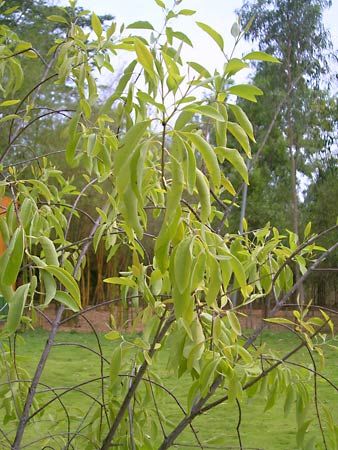
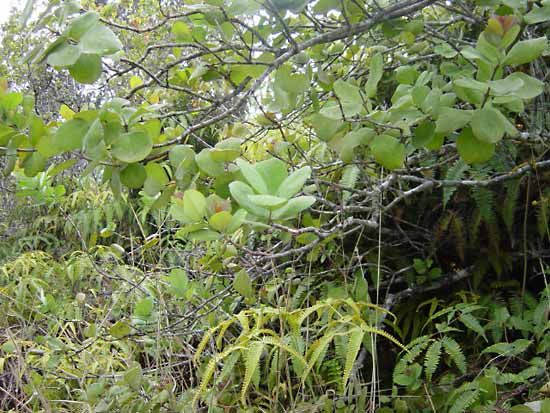
- Leaf Structure: Viscaceae leaves are typically arranged in opposite pairs and possess parallel veins, whereas many Loranthaceae species have thick, brittle leaves with inconspicuous venation.12
- Floral Characteristics: Viscaceae produce tiny, unisexual flowers. In contrast, Loranthaceae flowers are often long-tubular, brightly colored, and possess an inferior ovary.12
- Growth Habit: Viscaceae are primarily stem parasites on tree branches, often featuring scalelike leaves in many species.1
It is important to note that all these plants play a complex role in their ecosystems, sometimes causing significant damage to host trees while serving as vital components of forest biodiversity.32
How do Viscaceae plants reproduce and spread their seeds?
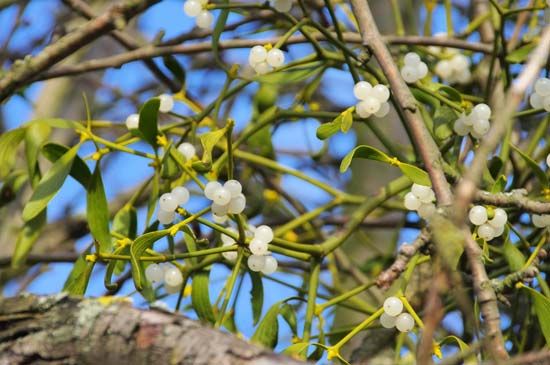
Plants in the Viscaceae family reproduce by producing tiny, unisexual flowers that develop into one-seeded berries. These seeds are coated in a sticky, viscid substance that is essential for their survival and dispersal.1
The methods of seed dispersal vary significantly among genera within the family:
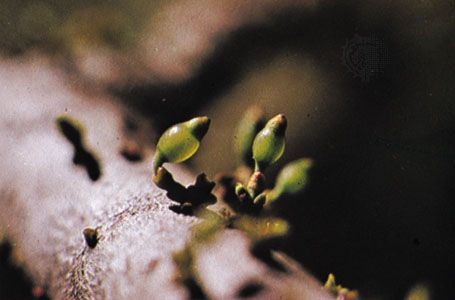
- Mechanical Ejection: In the genus Arceuthobium (dwarf mistletoe), the maturing fruit builds up internal pressure. This causes the thick skin to rupture, forcefully shooting the bullet-shaped seed away from the parent plant at high velocity. Once the seed lands on a suitable surface, such as a tree branch, the sticky coating dries and anchors it firmly in place.4
- Animal-Mediated Dispersal: Other members, such as the European mistletoe (Viscum album) and North American Phoradendron species, rely on birds for dispersal. Birds consume the berries and later deposit the sticky seeds onto host branches, either by regurgitating them or by wiping their bills on the bark after feeding.15
These specialized mechanisms ensure that the seeds are effectively positioned on host trees to begin their parasitic growth.45
What is the evolutionary history of the Viscaceae family?
The evolutionary history of the Viscaceae family is best understood through its placement within the order Santalales, a group of flowering plants characterized by their parasitic nature and the development of a haustorium—a specialized organ used to extract water and nutrients from host plants.1
Historically, the Viscaceae were classified as a distinct family of semiparasitic shrubs. However, modern botanical classification, specifically the Angiosperm Phylogeny Group IV system, now includes the former Viscaceae within the Santalaceae (sandalwood family). This taxonomic shift was implemented to ensure that the Santalaceae family remains a monophyletic group, meaning it includes all descendants of a common ancestor.61
Within this broader evolutionary context, the plants formerly known as Viscaceae evolved as specialized stem parasites, distinct from the primarily root-parasitic members of the Santalaceae. This lineage includes well-known genera such as Viscum, Phoradendron, and Arceuthobium, which have adapted to thrive on the branches of various tree species across tropical and temperate regions.613
What are some common species within the Viscaceae family, and where are they typically found?
The Viscaceae family includes approximately 11 genera and over 450 species of semiparasitic shrubs that primarily inhabit tropical regions, though they are found in various environments across the globe. These plants are typically found growing on the branches of many different tree species.1
Some well-known members of the family include:
- European mistletoe (Viscum album): Distributed throughout Eurasia, from Great Britain to northern Asia, this species is commonly found on apple trees, poplars, willows, lindens, and hawthorns.4
- Oak mistletoe (Phoradendron serotinum): This North American counterpart to the European mistletoe is known to parasitize various deciduous trees, including oaks.4
- Dwarf mistletoe (Arceuthobium): These species are primarily parasitic on coniferous trees and are distributed throughout the Northern Hemisphere, with some tropical species occurring in the Caribbean, Mediterranean, and Southeast Asian regions.84
Sources
- Viscaceae — Encyclopædia Britannica
- Plant disease - Mistletoe — Encyclopædia Britannica
- Santalales — Encyclopædia Britannica
- dwarf mistletoe — Encyclopædia Britannica
- Seed - Dispersal by birds — Encyclopædia Britannica
- Santalales — Merriam-Webster
- Santalaceae — Encyclopædia Britannica
- mistletoe — Encyclopædia Britannica
Published on · 3 min read