Bastard Toadflax
Bastard toadflax refers to several small annual or perennial herbs belonging to the sandalwood family (Santalaceae). These plants are named for their narrow…
What is bastard toadflax?
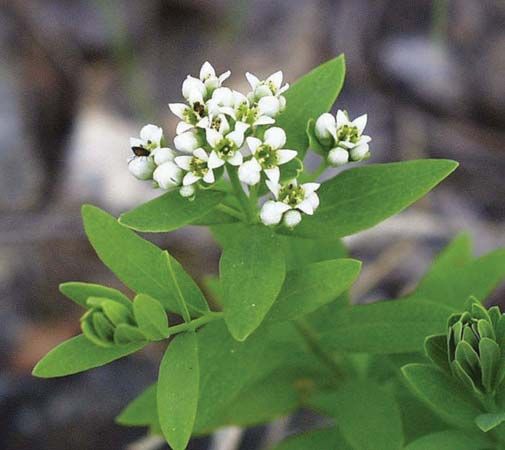
Bastard toadflax refers to several small annual or perennial herbs belonging to the sandalwood family (Santalaceae). These plants are named for their narrow leaves, which resemble those of true toadflax (Linaria).1
The term applies to different genera depending on the region:
- North America: It typically refers to Comandra umbellata. This plant features creeping roots, small white flowers in terminal clusters, and one-seeded fruits.12
- Europe: The name is used for plants of the genus Thesium, such as Thesium humifusum. These plants produce bisexual yellow or yellowish-green flowers and dry, green, one-seeded fruits.12
Notably, these plants are often parasitic, drawing nutrients from the roots of other plants.1
How do parasitic plants obtain nutrients from their hosts?
Parasitic plants obtain nutrients and water from their hosts through a specialized organ called a haustorium. This structure, which can develop from the stem or root of the parasite, penetrates the tissues of the host plant to establish a direct vascular union.34
Once this connection is formed, the parasite redirects the host’s resources to support its own growth. The extent of this dependence varies:3
- Hemiparasites: These plants retain some ability to photosynthesize but rely on the host primarily for water and mineral nutrients.4
- Holoparasites: These are nonphotosynthetic and depend entirely on the host for all their nutritional needs.4
To ensure survival, these plants have evolved sophisticated methods to locate hosts, such as detecting chemical signals (like strigolactones) or sensing volatile chemicals and light cues. While many exist as botanical curiosities, some species act as weedy pests that can severely damage agricultural crops by arresting their growth and reducing yields.4
What are some other examples of plants in the sandalwood family?
The Santalaceae family, commonly known as the sandalwood family, includes over 1,000 species of semiparasitic herbs, shrubs, and trees. Beyond the well-known sandalwood trees and bastard toadflax, other notable members include:
- Mistletoes: Several genera within the family are classified as mistletoes, including Phoradendron (tropical mistletoe), Viscum, and Arceuthobium (dwarf mistletoe). These plants are stem parasites that attach to the branches of host trees, such as oaks, walnuts, and various conifers.56
- Dendrophthora: A genus containing approximately 65 species, often found in tropical regions.56
- Thesium: The largest genus in the family, comprising about 325 species of herbaceous plants.56
- Oil nut (Pyrularia pubera): A North American parasitic plant known for its pear-shaped, oil-filled fruit.5
- Santalum: In addition to the economically important aromatic sandalwood (S. album), this genus includes other species such as the Australian quandong (S. acuminatum) and plumbush (S. lanceolatum).57
How does the life cycle of an annual plant differ from a perennial?
The primary difference between annual and perennial plants lies in the duration of their life cycles and their survival strategies across growing seasons.
Annual Plants
An annual is a plant that completes its entire life cycle—germination, growth, flowering, and death—within a single growing season. Because the entire plant dies at the end of this cycle, the seed is the only part that survives to ensure the next generation. Many common food crops, such as corn, wheat, and beans, are annuals.89
Perennial Plants
A perennial is a plant that persists for several years. Unlike annuals, perennials do not die after one season; instead, they regrow and rebloom year after year. In temperate climates, the aboveground portions of herbaceous perennials often die back in autumn, but the plant survives through specialized underground structures—such as bulbs, rhizomes, corms, or tubers—which produce new shoots the following season. All trees and shrubs are perennials.10119
While annuals divert most of their energy into rapid seed production, perennials must allocate energy to both their root systems and long-term survival, which can result in different yield characteristics in agricultural settings.12
Sources
- bastard toadflax — Encyclopædia Britannica
- bastard toadflax — Merriam-Webster
- Haustorium — Encyclopædia Britannica
- Parasitic plant — Encyclopædia Britannica
- Santalaceae — Encyclopædia Britannica
- Santalales — Encyclopædia Britannica
- sandalwood — Encyclopædia Britannica
- Is That Plant 'Perennial' or 'Annual'? — Merriam-Webster
- Annual — Encyclopædia Britannica
- Perennial — Encyclopædia Britannica
- Perennial agriculture — Encyclopædia Britannica
- Angiosperm - General features — Encyclopædia Britannica
Published on · 3 min read