Flatworm
The phylum Platyhelminthes, commonly known as flatworms, is divided into four distinct classes. While most flatworms are parasitic, members of the class…
What are the major groups or classes of flatworms?
The phylum Platyhelminthes, commonly known as flatworms, is divided into four distinct classes. While most flatworms are parasitic, members of the class Turbellaria are primarily free-living.1
The four major classes are:
- Turbellaria: This group consists of planarians, which are generally free-living organisms. Unlike the parasitic classes, they possess an epidermis typically composed of a single layer of ciliated cells.12
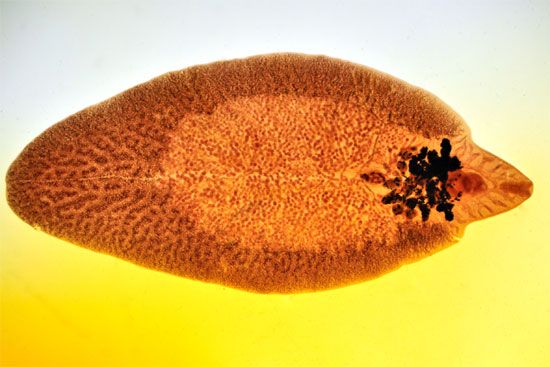
- Trematoda: Commonly known as flukes, these are parasitic, usually hermaphroditic flatworms. They utilize specialized suckers for attachment to their hosts.13
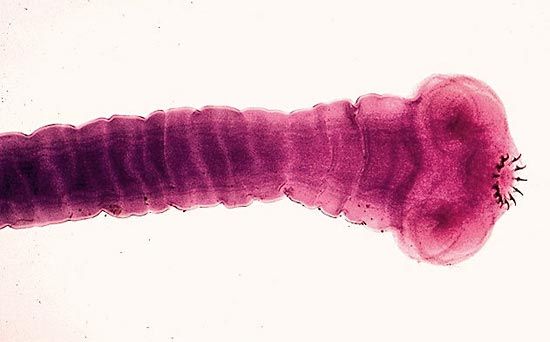
- Cestoda: This class comprises tapeworms, which are internal parasites that lack a mouth and digestive tract, instead absorbing nutrients through a tough body covering.14
- Monogenea: These are parasitic flatworms. It is important to note that some scientific authorities classify Monogenea as a subclass within Trematoda rather than a separate class.1
What are the main characteristics that define flatworms?
Flatworms, belonging to the phylum Platyhelminthes, are defined by several key biological characteristics:
- Body Structure: They are soft-bodied, unsegmented, and typically flattened invertebrates. They are acoelomate, meaning they lack a body cavity (coelom), and the space between their organs is filled with a spongy connective tissue called mesenchyme.15
- Symmetry and Layers: Flatworms exhibit bilateral symmetry, with distinct right and left sides. They are triploblastic, possessing three embryonic tissue layers: endoderm, mesoderm, and ectoderm.15
- Physiology: They lack specialized respiratory, skeletal, and circulatory systems; gas exchange occurs through simple diffusion across the body wall.16
- Nervous System: They were the first invertebrates to develop a centralized nervous system, featuring a brain located in the head region, which contains concentrated nervous tissue and sensory organs.17
- Reproduction: Most flatworms are hermaphroditic, possessing functional reproductive organs of both sexes within a single individual. They often utilize complex reproductive strategies, including cross-fertilization, self-fertilization, or asexual reproduction through budding.189
While some species are free-living, approximately 80 percent of flatworms are parasitic during all or part of their life cycle.1
How have flatworms evolved over time, and what is their evolutionary history?
The evolutionary history of flatworms (phylum Platyhelminthes) remains a subject of scientific debate, as their soft bodies have left an uninformative fossil record.110
Evolutionary Origins
There are two primary theories regarding the position of flatworms in animal evolution:
- Ancestral Status: A widely accepted view suggests that the Turbellaria (free-living flatworms) represent the ancestors of all other animals with three tissue layers (triploblasts) and are considered the ancestors of all other Bilateria.510
- Secondary Simplification: Conversely, some evidence suggests that flatworms may be “secondarily simplified,” meaning they evolved from more complex ancestors and experienced a reduction in anatomical complexity over time.1110
Development of Parasitism
It is generally believed that the parasitic classes—Trematoda, Cestoda, and Monogenea—evolved from free-living turbellarian ancestors that developed close associations with other animals. For example, digeneans likely began as commensals of mollusks before evolving into parasites that incorporated vertebrates into their life cycles.10
While traditional classification relied on morphology, modern molecular and ultrastructural studies are currently reshaping our understanding of these evolutionary relationships.12
How do flatworms reproduce and regenerate?
Flatworms (phylum Platyhelminthes) exhibit complex reproductive strategies and remarkable regenerative capabilities.
Reproduction
Most flatworms are hermaphrodites, possessing both male and female reproductive organs within a single individual. While many species engage in copulation, some are capable of asexual reproduction by splitting their bodies in two. In certain freshwater planarians, reproduction is adapted to environmental conditions through the production of thin-shelled summer eggs and thick-shelled winter eggs, which are resistant to freezing.1314
Regeneration
Flatworms are widely studied for their ability to regenerate missing body parts, such as heads and tails, from cut ends. This process involves the formation of a blastema—a mass of cells at the wound site that differentiates into the necessary tissues.1516
- Mechanism: Regeneration occurs in a stepwise, polarized fashion. The brain typically differentiates first, which then stimulates the development of the pharynx and subsequent reproductive organs.1516
- Cellular Source: There is ongoing scientific discussion regarding the origin of blastema cells. Some researchers point to neoblasts—undifferentiated reserve cells rich in RNA—while others suggest that specialized cells near the wound site dedifferentiate to form the blastema.1516
- Control: The process is governed by a complex interplay of stimulators and inhibitors; for instance, a developing head inhibits the production of additional heads.1715
Sources
- flatworm — Encyclopædia Britannica
- tapeworm — Encyclopædia Britannica
- trematode — Merriam-Webster
- flatworm - External features — Encyclopædia Britannica
- nervous system - Simple bilateral systems — Encyclopædia Britannica
- flatworm - Distinguishing taxonomic features — Encyclopædia Britannica
- flatworm - Reproduction — Encyclopædia Britannica
- planarian — Encyclopædia Britannica
- flatworm - Internal features — Encyclopædia Britannica
- Animal - Acoelomates — Encyclopædia Britannica
- Animal - Appearance of animals — Encyclopædia Britannica
- flatworm - Evolution — Encyclopædia Britannica
- Reproductive behaviour - Flatworms and rotifers — Encyclopædia Britannica
- Regeneration - Polarity and gradient theory — Encyclopædia Britannica
- flatworm - Annotated classification — Encyclopædia Britannica
- Regeneration - Flatworms — Encyclopædia Britannica
- flatworm - Turbellaria — Encyclopædia Britannica
Published on · 3 min read