East Falkland
East Falkland is one of the two primary islands that make up the Falkland Islands, an internally self-governing overseas territory of the United Kingdom…
What is East Falkland?
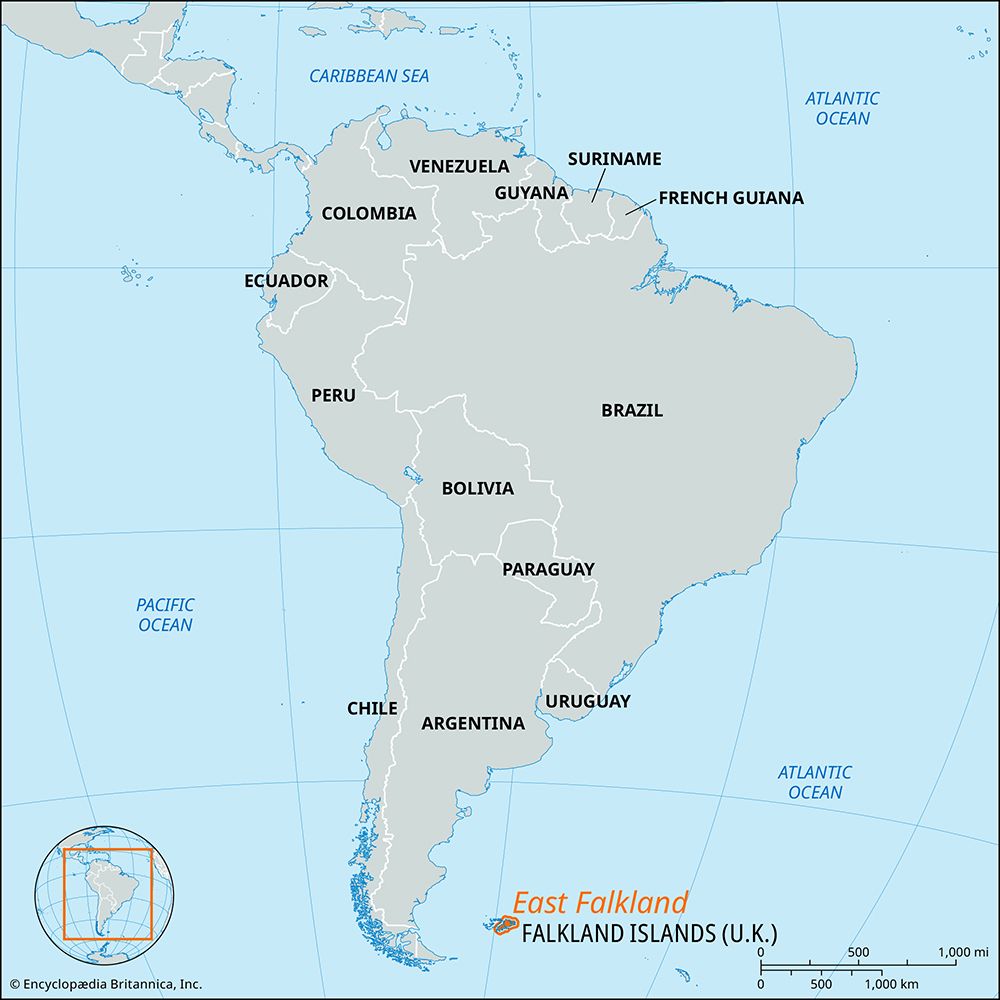
East Falkland is one of the two primary islands that make up the Falkland Islands, an internally self-governing overseas territory of the United Kingdom located in the South Atlantic Ocean1.1
Spanning approximately 2,550 square miles (6,605 square km), the island features a deeply indented coastline and a mountainous interior that reaches an elevation of 2,312 feet (705 meters) at Mount Usborne. The island is divided into northern and southern regions by a narrow land bridge, which hosts small settlements such as Darwin and Goose Green.23
Stanley, the capital of the territory, is situated on the island’s northeast shore. Historically, East Falkland has been a focal point of international interest, serving as the site of the first settlement in 1764 and remaining a central location during the Falkland Islands War in 1982. Today, it remains a vital part of the archipelago’s infrastructure and community.241
What is the significance of the Falkland Islands War?
The Falkland Islands War (1982) was a brief, undeclared conflict between Argentina and the United Kingdom that carried profound political and historical consequences for both nations.
Political Impact
- Argentina: The military junta, led by Lieut. Gen. Leopoldo Galtieri, initiated the invasion to bolster domestic support amid economic mismanagement and human rights criticisms. The failure of the military to defend the islands severely discredited the regime, leading to the restoration of civilian rule and the election of Raúl Alfonsín in 1983.53
- United Kingdom: Prime Minister Margaret Thatcher utilized the victory to galvanize patriotic support, which was instrumental in securing a landslide reelection for the Conservative Party in 1983, despite her previous unpopularity due to economic policies.56
Strategic Significance
The war served as a case study for modern military strategy, highlighting the critical roles of submarines, antiship missiles, and the necessity of air superiority. It also underscored the logistical challenges of operating at extreme ranges, as both nations fought thousands of miles from their home bases.5
Sovereignty
While the conflict ended with a British victory, the underlying dispute over sovereignty remains a point of contention. The war reaffirmed Britain’s commitment to the principle of self-determination for the islanders, who have since voted nearly unanimously to remain a British overseas territory.75
How does the geography of West Falkland differ from East Falkland?
While both East Falkland and West Falkland share a similar cool, windy climate and a landscape dominated by peat-covered valleys and grasslands, they differ significantly in size and topography.9
Comparison of Geography
Feature
East Falkland
West Falkland
Total Area
2,550 sq miles (6,605 sq km)
1,750 sq miles (4,532 sq km)
Dimensions
90 miles long, 55 miles wide
80 miles long, 45 miles wide
Highest Point
Mount Usborne (2,312 feet)
Mount Adam (2,297 feet)
Key Features
Deeply indented, divided by a narrow land bridge
Deeply indented coastline
East Falkland is the larger of the two islands and is uniquely characterized by a narrow land bridge that connects its northern and southern regions. In contrast, West Falkland is smaller and features a slightly lower maximum elevation. Both islands possess deeply indented coastlines that form protected harbours, and both feature ranges of hills running east-west across their northern sections.419
Why are the islands also known as the Islas Malvinas?
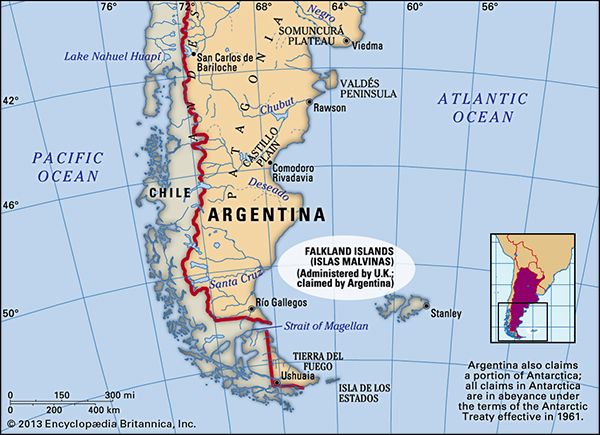
The islands are known as the Islas Malvinas in South America due to their history with early French settlers. In 1764, the French navigator Louis-Antoine de Bougainville established the first settlement on East Falkland and named the archipelago the Malouines (or Malovines) after the settlers’ home port of Saint-Malo, France.23
This name was later adapted into Spanish as Islas Malvinas. While the British name for the islands originated from the English captain John Strong, who named the sound between the two main islands after Viscount Falkland in 1690, the name Malvinas became the standard reference used by Argentina as part of its long-standing sovereignty claim over the territory.10113
Sources
- East Falkland — Encyclopædia Britannica
- Falkland Islands — Encyclopædia Britannica
- Falkland Islands - History of the Falkland Islands — Encyclopædia Britannica
- Falkland Islands - Land — Encyclopædia Britannica
- Falkland Islands War: Top Questions — Encyclopædia Britannica
- Falkland Islands War — Encyclopædia Britannica
- Argentina - Galtieri and the Falklands War — Encyclopædia Britannica
- Margaret Thatcher - Prime minister — Encyclopædia Britannica
- West Falkland — Encyclopædia Britannica
- Falkland Islands — Merriam-Webster
- Falkland Islands: Top Questions — Encyclopædia Britannica
Published on · 3 min read