Falkland Islands
The Falkland Islands are an internally self-governing overseas territory of the United Kingdom located in the South Atlantic Ocean. They are situated…
Where are the Falkland Islands located, and what is their geographical makeup?
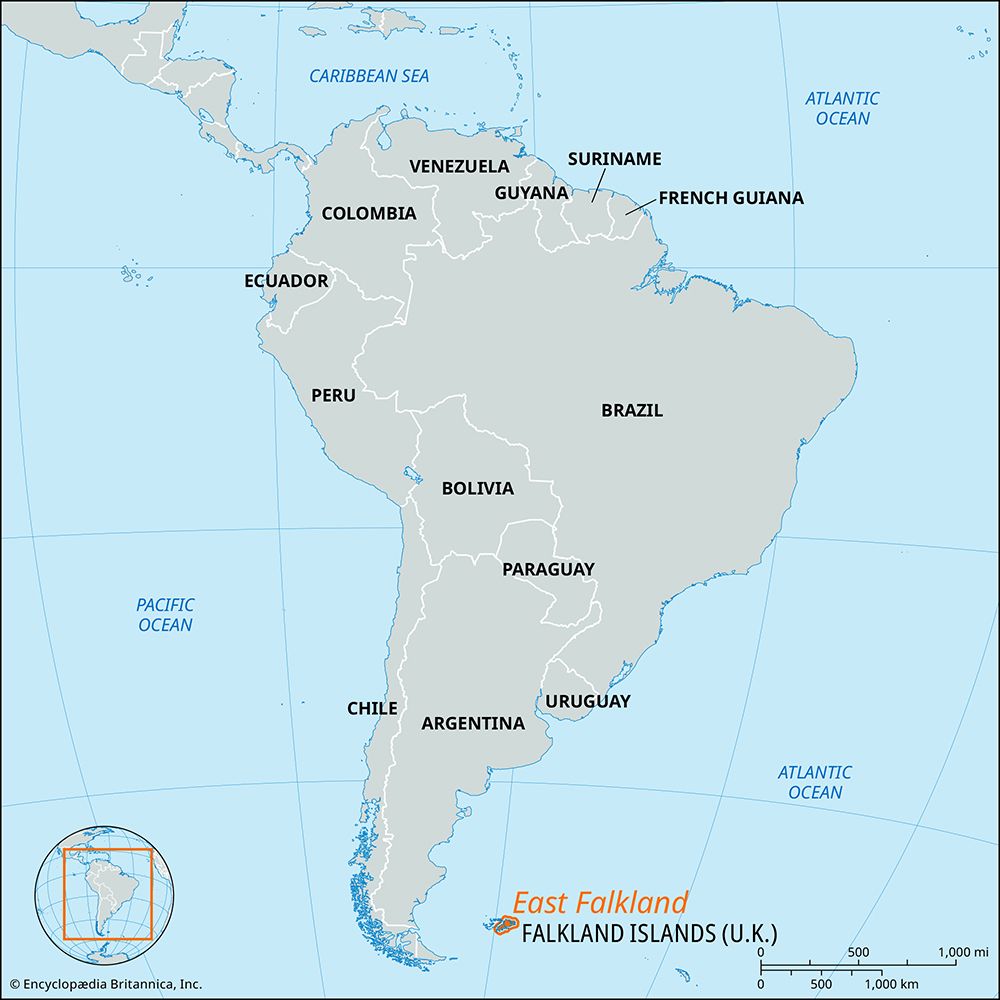
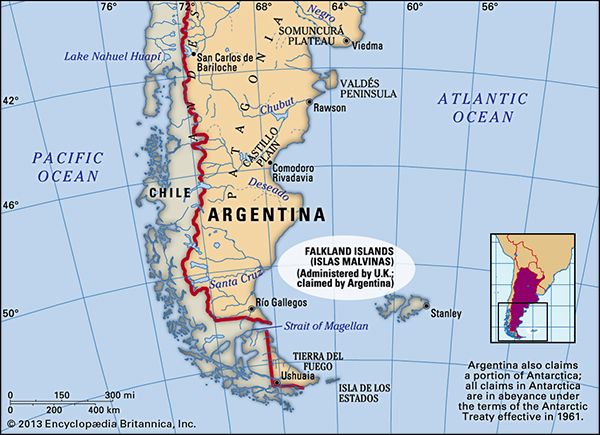
The Falkland Islands are an internally self-governing overseas territory of the United Kingdom located in the South Atlantic Ocean. They are situated approximately 300 miles (480 km) northeast of the southern tip of South America and a similar distance east of the Strait of Magellan.1
The archipelago consists of two main islands, East Falkland and West Falkland, along with about 200 smaller islands. The landscape is characterized by ranges of hills running east-west across the northern parts of the main islands, reaching a peak of 2,312 feet (705 metres) at Mount Usborne on East Falkland. The coastal topography features many drowned river valleys that form protected harbours, while the interior is marked by broad, peat-covered valleys. The islands experience a cool, windy climate with no natural tree growth, resulting in a landscape dominated by dense, low-lying vegetation such as white grass and diddle-dee.2
How has the population of the Falkland Islands changed over time?
The population of the Falkland Islands has grown steadily since the 19th century, evolving from a small community into a self-governing population of over 3,000 residents. By 1885, the British community on the islands numbered approximately 1,800 people.5
In more recent decades, census data for specific regions and the territory as a whole reflect this gradual increase:
- East Falkland: The population was recorded at 2,352 in 1996 and 2,197 in 2001.6
- West Falkland: The population was 174 in 1996 and 2001 saw a slight increase to 208.4
- Stanley: As the capital and primary population center, Stanley is home to the majority of the islanders. In 2001, the town’s population was 1,989.1
- Total Population: By 2016, the total population of the islands—excluding British military personnel—had reached 3,032.3
Today, the population is primarily of British descent and is English-speaking. Living patterns remain distinct, with about four-fifths of the population residing in Stanley, while the remainder of the inhabitants live in small, isolated sheep-farming communities.7
How does the Falkland Islands’ status as a British overseas territory affect its governance and economy?
The Falkland Islands operate as a self-governing British overseas territory, a status that shapes both their political structure and economic framework.
Governance
Executive authority is vested in the British Crown, represented by a governor who oversees the territory. Under the 2009 constitution, the islands possess significant autonomy, with a Legislative Assembly composed of eight elected members. While the governor presides over the Executive Council, they must consult with local representatives on most matters. However, the governor is required to coordinate with the regional commander of the British military regarding defense and internal security, reflecting the territory’s strategic relationship with the United Kingdom.9
Economy
The islands’ status influences their economic development in several ways:
- Currency and Banking: The official currency is the Falkland pound, which is pegged to the British pound, and financial services are provided by a London-headquartered bank.9
- Trade and Industry: Historically centered on sheep farming and wool exports to Britain, the economy has diversified through the sale of fishing licenses to foreign vessels and the growth of ecotourism.4
- Infrastructure: The presence of the Mount Pleasant Military Complex supports an international airport, facilitating both military and civilian logistics.4
What are the main industries and economic activities in the Falkland Islands?
The economy of the Falkland Islands has undergone significant diversification since the late 20th century, moving beyond its traditional reliance on agriculture to a more varied economic base.
Key Economic Sectors
- Agriculture: Sheep farming remains a foundational activity, occupying nearly all land outside of Stanley. The industry produces wool—the islands’ primary land-based export—as well as mutton. Recent government policies have shifted focus toward smaller, locally operated farms, and the establishment of a slaughter facility in 2002 enabled the export of sheep and lamb meat to the United Kingdom.6
- Fishing: Since the government began selling fishing licenses to foreign vessels in 1987, this sector has become a major contributor to the economy.6
- Tourism: Ecotourism has grown rapidly in the 21st century, establishing itself as a leading economic sector. Stanley Harbour serves as a primary port for cruise ships, which also visit the outer islands.6
- Energy Exploration: Seismic studies conducted in the 1990s indicated the presence of offshore oil reserves, leading to the granting of exploration licenses to foreign companies.6
Sources
- East Falkland — Encyclopædia Britannica
- Falkland Islands - Land — Encyclopædia Britannica
- Falkland Islands — Encyclopædia Britannica
- Falkland Islands - History of the Falkland Islands — Encyclopædia Britannica
- Falkland Islands - People — Encyclopædia Britannica
- Falkland Islands - Economy — Encyclopædia Britannica
- Stanley — Encyclopædia Britannica
- West Falkland — Encyclopædia Britannica
- Falkland Islands - Government and society — Encyclopædia Britannica
- list of islands - Argentina — Encyclopædia Britannica
- Maldives - Agriculture, forestry, and fishing — Encyclopædia Britannica
- South Sandwich Islands — Encyclopædia Britannica
Published on · 3 min read