East Scotia Basin
The East Scotia Basin is a submarine trough located in the eastern portion of the Scotia Sea, which is a marine region within the South Atlantic Ocean…
What is the East Scotia Basin and where is it located in the Atlantic Ocean?
The East Scotia Basin is a submarine trough located in the eastern portion of the Scotia Sea, which is a marine region within the South Atlantic Ocean southeast of Argentina.1
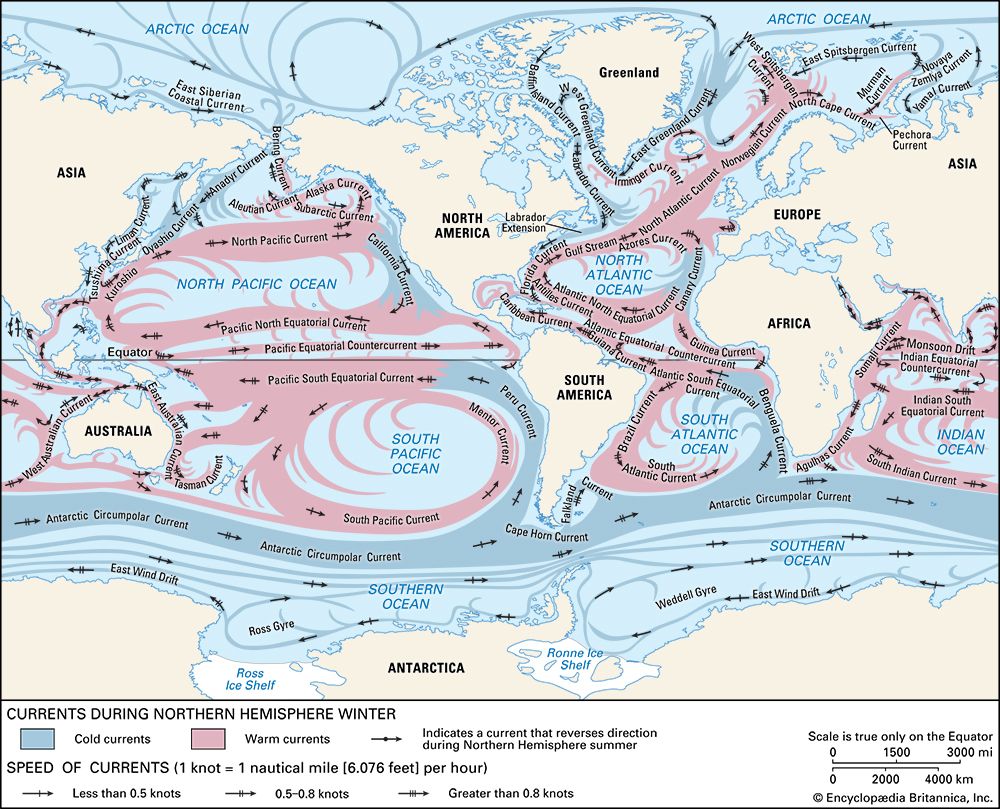
Situated approximately 1,300 miles (2,000 km) east of Tierra del Fuego, the basin spans roughly 700 miles (1,100 km) east-west and 300 miles (500 km) north-south. It is geographically bounded by the island of South Georgia to the north and the South Sandwich Islands to the east. The basin lies within a large loop formed by the Scotia Ridge and is separated from the West Scotia Basin by a minor submerged rise that connects South Georgia to the South Orkney Islands. The Antarctic Circumpolar Current flows through the basin, which features an average depth of 5,000 feet (1,500 m).123
How does the East Scotia Basin compare to other submarine basins in the Atlantic Ocean?
The East Scotia Basin is a submarine trough in the South Atlantic Ocean that differs significantly in depth and composition from many other Atlantic basins.
- Depth: With an average depth of 5,000 feet (1,500 m), the East Scotia Basin is notably shallower than the West Scotia Basin, which averages 9,800 feet (3,000 m). It is also significantly shallower than major Atlantic depressions like the Cape Verde Basin, which reaches depths exceeding 23,600 feet (7,200 m), and the general abyssal basins of the Atlantic, which typically lie between 12,000 and 18,000 feet (3,700 to 5,500 m) below sea level.1245
- Composition: While much of the Atlantic floor is covered by oceanic oozes, the East Scotia Basin floor is specifically characterized by oozes composed of diatom and foraminifera skeletons, with occasional manganese nodules. In contrast, the Cape Verde Basin is dominated by red clay, and parts of the West Scotia Basin contain glacial rock flour.125
- Geological Context: Unlike the broad, relatively even-profiled basins flanking the Mid-Atlantic Ridge, the East Scotia Basin is constrained within the Scotia Ridge loop.14
Have any significant scientific discoveries been made in the East Scotia Basin?
The provided search results do not contain information regarding specific scientific discoveries made within the East Scotia Basin. While the region has been the subject of extensive exploration by international scientific teams since the International Geophysical Year (1957–59), the available documentation focuses on the basin’s geography, physical characteristics, and the general history of exploration in the broader Scotia Sea region rather than detailing individual scientific findings.1
What is the depth range of the East Scotia Basin?
The East Scotia Basin has an average depth of approximately 5,000 feet (1,500 m). While the broader Scotia Sea region generally features water depths ranging between 10,000 and 13,000 feet (3,000 to 4,000 m), the East Scotia Basin is notably shallower, situated within the loop of the Scotia Ridge of the Scotia Ridge.21
Sources
- East Scotia Basin — Encyclopædia Britannica
- West Scotia Basin — Encyclopædia Britannica
- Scotia Sea — Encyclopædia Britannica
- Atlantic Ocean - Relief of the ocean floor — Encyclopædia Britannica
- Cape Verde Basin — Encyclopædia Britannica
Published on · 2 min read