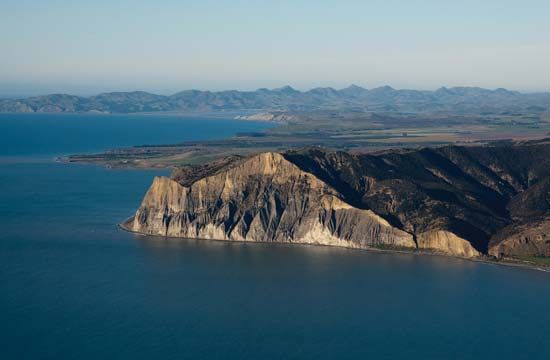
Easter Island
The original inhabitants of Easter Island were a Polynesian group that likely originated from the Marquesas Islands. Archaeological evidence and island…
Who were the original inhabitants of Easter Island, and when did they arrive?
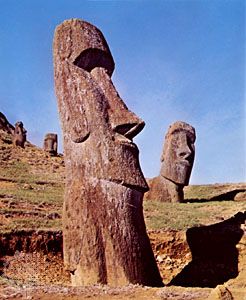
The original inhabitants of Easter Island were a Polynesian group that likely originated from the Marquesas Islands. Archaeological evidence and island traditions indicate that these first ancestors arrived as an organized party of emigrants rather than as accidental voyagers, bringing with them established architectural concepts and advanced megalithic masonry techniques.12
While the specific date of the initial arrival is not explicitly stated in the provided records, excavations and carbon dating confirm that the island was the site of a pre-European civilization, with significant activity such as the construction of the Poike ditch dating back to approximately 380 CE. The islanders’ own traditions describe a history involving two distinct ethnic groups, the “Long-Ears” and the “Short-Ears,” whose peaceful coexistence eventually gave way to conflict and significant cultural shifts by the late 17th century.21
What are the moai statues, and why are they significant to Easter Island’s history?
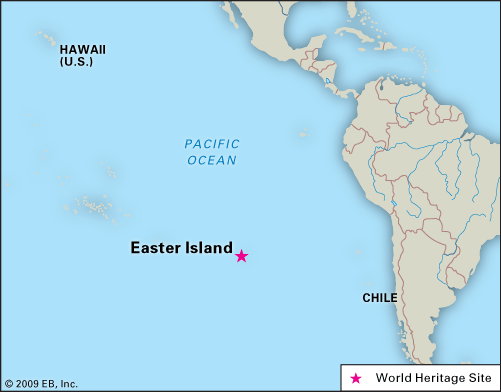
The term moai refers to the iconic stone statues of Easter Island, which are central to the island’s archaeological and cultural history. These figures are generally categorized into two distinct types: the monumental stone busts of the middle period and smaller wooden figures known as moai kavakava and moai paepae.45
The Monumental Stone Moai
The famous stone statues, numbering over 600, were primarily created during the island’s middle period (c. 1050–1680 CE). These statues are significant for several reasons:5
- Ancestral Representation: Traditions suggest these images represented important personalities who were deified after death.5
- Engineering Feats: Carved from volcanic tuff at the Rano Raraku quarry, these statues reached massive proportions, with some standing up to 32 feet tall and weighing dozens of tons. They were often topped with large red stone cylinders called pukao.5
- Cultural Placement: The statues were erected on stone platforms known as ahu, typically facing inland to watch over the community.5
Small Wooden Figures
In contrast, the smaller wooden moai were often kept in private homes. These were used for fertility rites or harvest celebrations, where they served as focal points for offerings.4
What role did European explorers play in the history of Easter Island?
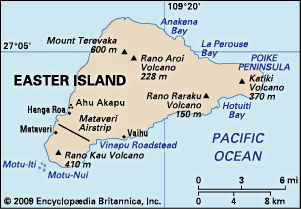
European explorers played a transformative and often devastating role in the history of Easter Island, beginning with the Dutch admiral Jacob Roggeveen, who made the first recorded European landing in 1722.2
Subsequent interactions significantly altered the island’s trajectory:
- Documentation and Observation: In 1770, a Spanish expedition reported on the island’s unique script, while Captain James Cook visited in 1774, documenting a population that had been decimated by civil war and the abandonment of the moai statues.2
- Demographic Collapse: The island suffered catastrophic population loss due to external factors. A major slave raid from Peru in 1862, followed by smallpox epidemics, reduced the population to just 111 people by 1877.2
- Cultural and Political Shifts: Missionaries arrived in 1864, leading to the conversion of the population to Christianity and the introduction of the Tahitian dialect. By 1888, the island was annexed by Chile, eventually leading to the full integration of the islanders as Chilean citizens.21
How has Easter Island’s culture and economy evolved since it became part of Chile?
Since its annexation by Chile in 1888, Easter Island (Rapa Nui) has undergone significant cultural and economic transformation while striving to maintain its unique heritage.
Cultural Evolution
Following the demographic collapse of the 19th century, the island experienced rapid acculturation to continental standards after its inhabitants became full Chilean citizens in 1965. While the original Rapa Nui language persists, Spanish is now the primary language spoken, and the population has seen an increasing influx of settlers from continental Chile. Despite these changes, the community has maintained a strong sense of identity. Residents actively preserve their history through annual February festivals that celebrate traditional arts, including tattooing, carving, reed-boat building, and ancestral singing and dancing.261
Economic Shift
The island’s economy has transitioned from a traditional subsistence model—based on fishing, chicken raising, and sweet potato cultivation—to a modern cash economy driven by tourism. Key developments include:7
- Infrastructure: The opening of the airport at Mataveri has facilitated a steady rise in visitors, supported by local hotels and accommodations.7
- Integration: Ties to the mainland are reinforced by regular flights from Santiago and the development of modern schools, hospitals, and community facilities.7
- Conservation: The establishment of a national park system protects archaeological sites, while environmental initiatives like reforestation projects and the massive Rapa Nui Marine Protected Area help manage the island’s natural resources.27
Sources
- Easter Island - People of Easter Island — Encyclopædia Britannica
- Easter Island - History — Encyclopædia Britannica
- Easter Island - Traditional culture — Encyclopædia Britannica
- Moai figure — Encyclopædia Britannica
- Easter Island - Archaeology of Easter Island — Encyclopædia Britannica
- Easter Island - Economy — Encyclopædia Britannica
- Polynesian culture — Encyclopædia Britannica
Published on · 3 min read