Amur River
The Amur River is formed by the confluence of the Shilka and Argun rivers. Its drainage system includes several significant tributaries that contribute to…
What are the major tributaries of the Amur River?
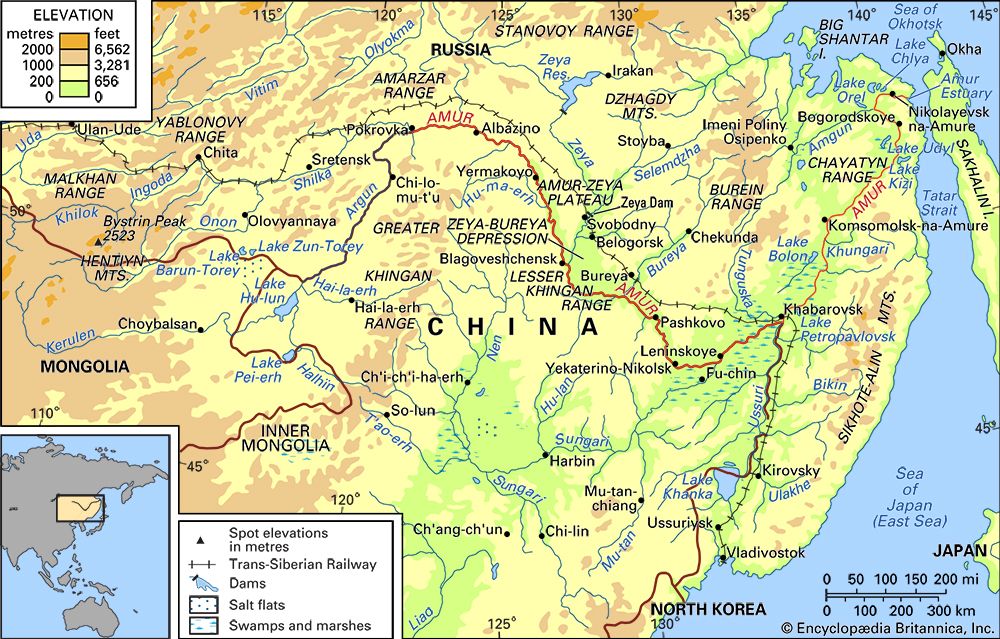
The Amur River is formed by the confluence of the Shilka and Argun rivers. Its drainage system includes several significant tributaries that contribute to its flow.1
The major tributaries of the Amur include:
- Left-bank tributaries (from Siberia): The Zeya, the Bureya, and the Amgun rivers.1
- Right-bank tributaries: The Sungari (Songhua) River, which is the Amur’s largest tributary, and the Ussuri (Wusuli) River, which joins the Amur at Khabarovsk.1
The Ussuri River is notable for originating from Lake Khanka, the largest lake in the river system.1
What role did the Amur River play in the expansion of the Russian Empire?
The Amur River was central to the eastward expansion of the Russian Empire as it sought to establish a strategic presence in the Far East and secure access to the Pacific Ocean.
Although Russian explorers like Vasily Poyarkov and Yerofey P. Khabarov entered the basin in the 17th century, the Treaty of Nerchinsk (1689) initially confirmed Chinese sovereignty over the region. However, Russian interest persisted, and by the mid-19th century, the empire intensified its encroachment. Following the expeditions of Gennady I. Nevelskoy, which proved the river’s accessibility from the south, Russia secured significant territorial gains. Through the treaties of 1858 and 1860, China ceded lands north of the Amur and east of the Ussuri River to Russia.
These acquisitions allowed Russia to extend its influence into Manchuria and develop vital transport links, including ports, to facilitate trade and military reach in the Pacific.
What are some of the unique species of fish found in the Amur River?
The Amur River is exceptionally rich in biodiversity, hosting approximately 100 fish species in its lower reaches and 60 in its upper sections, a variety that surpasses many large European rivers like the Volga and the Danube.5
Notable species found in the Amur include:
- Kaluga (Huso dauricus): A member of the genus Huso, this large fish is a unique inhabitant of the Amur River basin.6
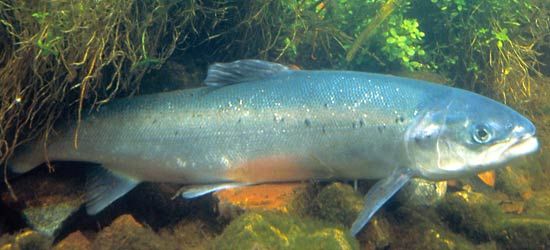
- Salmonids and others: The river supports northern species such as the Siberian salmon and the burbot.5
- Southern forms: The river is home to species such as the Chinese perch and the white amur.5
- Carp and broadhead: There are approximately 20 indigenous species of these fish within the river system.5
A distinct characteristic of the Amur’s ecosystem is the presence of numerous species, including the Siberian salmon, that develop in the sea. This migratory behavior allows them to avoid the significant fluctuations in water levels that frequently occur in the river during the summer months.5
What is the total length of the Amur River and how does it compare to other major rivers in Asia?
The Amur River, specifically the Amur–Argun river system, has a total length of approximately 4,444 kilometers (2,761 miles).4
When compared to other major rivers in Asia, the Amur holds a significant position:
- Within Russia: It is the longest river in the Russian Far East.1
- Within China: It ranks behind only the Yangtze and the Huang He (Yellow River) in length.1
- Global/Continental Context: It is recognized as the 10th longest river system in the world. In the broader Asian context, it is longer than several other major waterways, including the Lena and the Mekong, but shorter than the Yenisey, the Ob, and the aforementioned Yangtze and Huang He.4
The river’s length is measured from the headwaters of its most distant source, the Argun River, which joins the Shilka River to form the Amur proper.84
Sources
- Amur River - Physiography — Encyclopædia Britannica
- Amur River - History — Encyclopædia Britannica
- Amur River - Economy — Encyclopædia Britannica
- Amur River — Encyclopædia Britannica
- sturgeon — Encyclopædia Britannica
- Amur River - Animal life — Encyclopædia Britannica
- chondrostean - Distribution — Encyclopædia Britannica
- world’s longest rivers — Encyclopædia Britannica
Published on · 3 min read