Ecological Succession
Ecological succession is the process by which the structure of a biological community evolves over time. The primary difference between the two types of…
How does primary succession differ from secondary succession?
Ecological succession is the process by which the structure of a biological community evolves over time. The primary difference between the two types of succession lies in the starting conditions of the environment.12
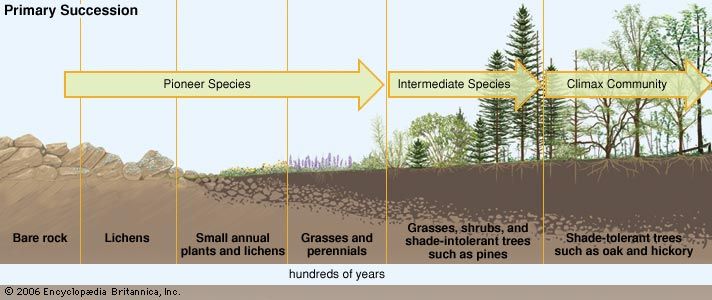
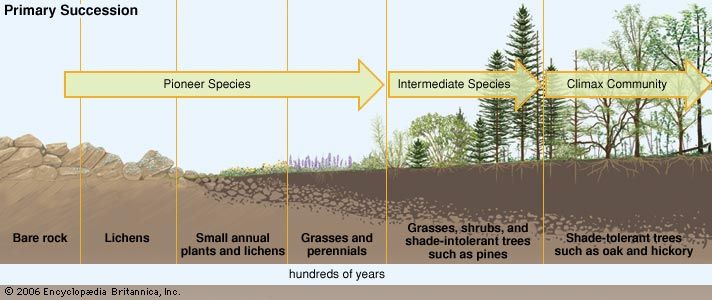
- Primary succession occurs in essentially lifeless areas where no soil exists or the environment is incapable of sustaining life, such as on newly formed sand dunes, lava flows, or rock left behind by retreating glaciers. Because there is no pre-existing soil or seed bank, the process begins with pioneer species that slowly build the soil through their growth and decomposition.132
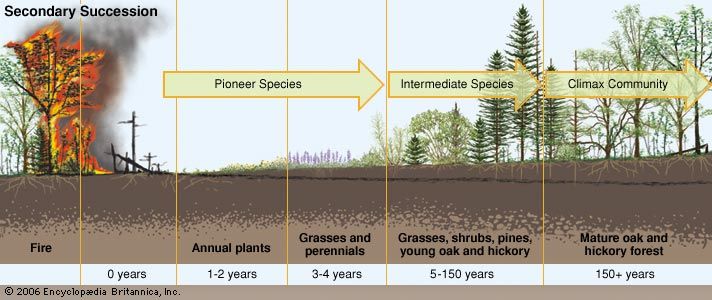
- Secondary succession occurs in areas where a community previously existed but was removed by a disturbance, such as a wildfire, flood, or human activity. Unlike primary succession, the environment is not lifeless; the soil remains intact and typically contains a bank of seeds and nutrients that allow for faster recolonization.42
How do pioneer species contribute to the process of ecological succession?
Pioneer species are the first organisms to colonize barren or disturbed environments, playing a critical role in initiating ecological succession. By establishing a simple initial biological community, they transform harsh conditions into habitats capable of supporting more complex life.5
Their contributions include:
- Soil Formation: Organisms like lichens and mosses release acids that chemically break down rock. When these organisms die, their decomposing organic matter mixes with rock fragments to create the first layers of soil.5
- Nutrient Enrichment: Pioneer species improve soil fertility by fixing nitrogen and adding carbon to the substrate.5
- Facilitating Colonization: By creating soil and trapping moisture, they provide a foundation where seeds and spores of other plants can lodge and germinate. Later, invertebrates arrive to process organic material and aerate the soil, further advancing the ecosystem’s development.5
Eventually, as larger plants grow and cast shade, the pioneer species are outcompeted for sunlight and are replaced by intermediate species.5
How does the process of ecological succession affect biodiversity over time?
Ecological succession significantly influences species diversity by driving a predictable, yet dynamic, sequence of change in community composition. As succession progresses, the environment is modified—for instance, through changes in soil mineral composition or light availability—which allows new species to replace earlier ones.16
The impact on biodiversity varies based on the successional stage and the disturbance regime:
- Early Stages: Initially, only a small number of species capable of thriving in disturbed habitats are present. These pioneer species are essential for building the foundation of the ecosystem but typically result in lower initial diversity.17
- Intermediate Stages: As the habitat becomes more complex, a wider variety of species can coexist, often leading to increased species richness.16
- Climax Communities: In some environments, succession leads to a climax community, a stable state dominated by a small number of prominent species where the web of interactions becomes so intricate that few new species can enter.185
- Disturbance Dynamics: In environments with continual small-scale disturbances, communities maintain a diverse mix of species rather than reaching a single stable equilibrium. The intermediate disturbance hypothesis suggests that maximum species richness often occurs when disturbances happen at intermediate levels of intensity and frequency.189
Ultimately, species-rich communities are generally more resilient, recovering faster from disturbances and maintaining greater stability in productivity and biomass compared to species-poor communities.8
What are the key stages of ecological succession?
Ecological succession is the process by which the structure of a biological community evolves over time through a partially predictable sequence of species replacement. The process generally follows these key stages:11
- Pioneer Stage: Pioneer species—such as bacteria, lichens, and mosses—are the first to colonize barren or disturbed environments. These organisms are adapted to harsh conditions, grow quickly, and begin the essential work of soil formation and nutrient enrichment.15
- Intermediate Stages: As pioneer species modify the environment (e.g., by creating soil or altering light levels), they are gradually outcompeted by intermediate species. This stage involves a succession of increasingly complex plants, such as grasses, ferns, shrubs, and small trees, accompanied by various animals.1115
- Climax Community: In many environments, succession culminates in a climax community. This is a relatively stable state of equilibrium dominated by a small number of prominent species, where the web of biotic interactions becomes so intricate that the community structure remains stable until a significant disturbance occurs.2115
The progression can begin as primary succession on lifeless substrates or secondary succession in areas where a previous community was disturbed but the soil remains.115
Sources
- ecological succession — Encyclopædia Britannica
- secondary succession — Encyclopædia Britannica
- What Is the Difference Between Primary and Secondary Ecological Succession? — Encyclopædia Britannica
- primary succession — Encyclopædia Britannica
- pioneer species — Encyclopædia Britannica
- community ecology - The process of succession — Encyclopædia Britannica
- community ecology - Community equilibrium and species diversity — Encyclopædia Britannica
- ecological disturbance - Intermediate disturbance hypothesis — Encyclopædia Britannica
- climax — Encyclopædia Britannica
- ecological disturbance - Disturbance intensity and the pace of recovery — Encyclopædia Britannica
- ecological succession: Top Questions — Encyclopædia Britannica
Published on · 4 min read